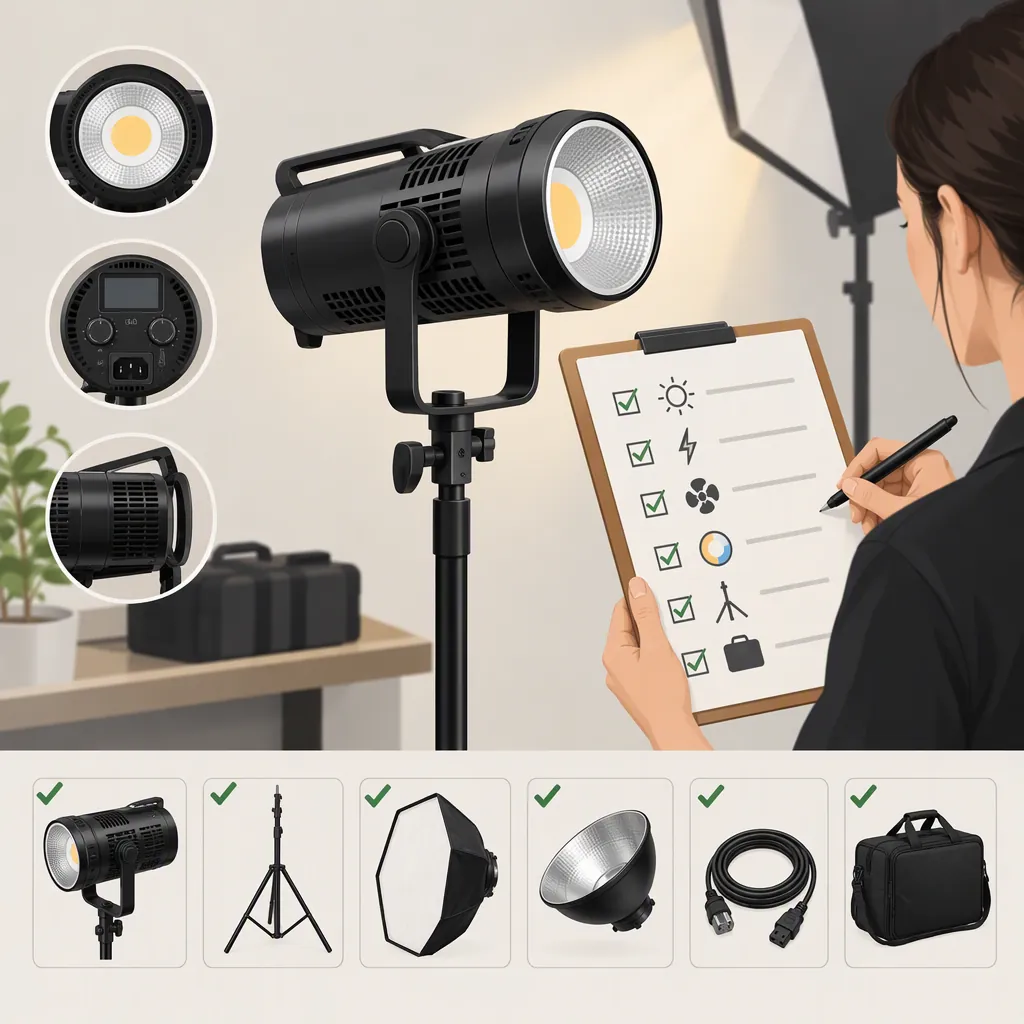
Godox M150 Continuous Light: A Filming-Light Selection Checklist
If you are searching for “godox m150 continuous light,” verify the exact model before judging its suitability for filming. The available Godox USA KNOWLED M Series category page does not list an M150 and does not establish its specifications. This is a limitation of the available evidence—not proof that the model does not exist. [c1]
The selection process below helps you confirm the fixture’s identity, define your filming requirements, and compare complete setups. It does not assign wattage, output, color range, modifier compatibility, power options, operating noise, or control features to an M150.
Verify the Model Before Comparing Specifications
Record the complete model name from the fixture label, including every suffix. Keep that name separate from a kit name or a seller’s shortened description, then match it to model-specific manufacturer documentation.
If the label, listing, and documentation disagree, leave the identity unresolved rather than substituting a similarly named light. The available reference is a category page, not an M150 product page or manual. [c1]
Model Identity Record
- Search phrase: godox m150 continuous light
- Exact fixture label: ______
- Full model name and suffix: ______
- Kit name, if different: ______
- Matching manufacturer documentation: ______
- Identity status: confirmed / unresolved
- Specifications still requiring verification: ______
Define the Filming Job First
Start with the shot rather than a presumed power rating. Identify whether the light will serve as a key, fill, background light, or accent. Record the subject area, available placement distance, intended light quality, and other lights that will remain on.
Include the practical demands of the scene:
- Seated interview: Intended framing, subject movement, and microphone position.
- Tabletop demonstration: Working surface, hand movements, and any objects that must remain visible.
- Wider shot: Every area and subject position that must meet the project’s lighting requirements.
Set acceptance conditions before comparing candidates. The following are examples of project-defined standards, not M150 performance claims:
| Requirement | Example Acceptance Condition |
|---|---|
| Exposure | The subject reaches your chosen exposure target at the planned camera settings, distance, and modifier configuration. |
| Coverage | The entire required working area meets the intended exposure and shadow requirements, including expected movement. |
| Color appearance | The recorded subject meets your chosen color reference under fixed white balance, with the other scene lights in use. |
| Audio | Operating noise does not obscure dialogue or exceed the project’s agreed noise tolerance in the actual recording. |
| Recording duration | The setup completes the expected uninterrupted take within documented operating limits, without an interruption or unacceptable change. |
| Recorded-image stability | No brightness changes or banding unacceptable to the project appear in the tested frame-rate, shutter, and dimming combinations. |
Filming Requirements Worksheet
- Shot type and framing: ______
- Lighting role: ______
- Subject area and movement to cover: ______
- Available light-to-subject distance: ______
- Intended modifier and light quality: ______
- Room lights kept on or turned off: ______
- Camera frame rate, shutter, aperture, and ISO: ______
- White balance setting: ______
- Target exposure and method of checking it: ______
- Microphone location and recording settings: ______
- Required uninterrupted recording time: ______
- Must-pass image and audio conditions: ______
- Optional preferences: ______
Evaluate the Complete Lighting Setup
Compare complete setups rather than isolated fixtures. For each candidate, distinguish what manufacturer documentation confirms from what a recorded test demonstrates. Mark unresolved requirements explicitly.
| Criterion | What to Verify |
|---|---|
| Model identity | Exact fixture name and matching model-specific documentation |
| Output in the intended setup | Target exposure at the working distance, with the intended modifier and fixed camera settings |
| Coverage and shadows | Required subject positions and working areas meet the planned image criteria |
| Color behavior | Recorded color meets the project’s criteria under fixed white balance and intended scene lighting |
| Modifier compatibility | Exact mount, any required adapter, and documented support for the chosen accessory |
| Power | Documented input requirements and any explicitly supported portable power configuration |
| Audio | Recorded operating noise meets the project’s tolerance at the intended microphone position |
| Support and placement | Documented mounting requirements, suitable support, and workable cable routing |
| Controls | Documented controls support the intended workflow |
| Recording duration | The expected take completes within documented operating limits |
Do not treat a similar name, shared brand, or category placement as confirmation of accessory compatibility. M150-specific compatibility and configuration remain unverified in the available reference. [c1]
When comparing costs, use the same scope for every candidate: fixture, required power equipment, modifier, adapters, support, and transport needs. Leave unknown costs visible rather than assuming them.
Candidate Comparison Template
Use entries such as verified, passed in tested setup, failed requirement, or unverified, with a brief note explaining each result.
| Criterion | Candidate A | Candidate B |
|---|---|---|
| Exact model and documentation confirmed | ______ | ______ |
| Exposure with intended modifier | ______ | ______ |
| Coverage and shadows | ______ | ______ |
| Color result in scene | ______ | ______ |
| Modifier fit documented | ______ | ______ |
| Power configuration documented | ______ | ______ |
| Recorded operating noise | ______ | ______ |
| Support requirements checked | ______ | ______ |
| Controls fit workflow | ______ | ______ |
| Expected take duration completed | ______ | ______ |
| Complete setup cost | ______ | ______ |
| Unresolved requirements | ______ | ______ |
Use a Repeatable Camera and Audio Test
Once model identity and safe setup requirements are verified, evaluate each candidate with the camera, modifier, and microphone intended for the shoot.
- Fix the comparison conditions. Keep framing, subject position, light-to-subject distance, and room lighting consistent. Record and lock exposure settings and white balance so automatic adjustments do not change the comparison.
- Record the intended shot. Use the planned modifier and note the light’s settings. Include expected subject movement or tabletop activity, not just a stationary sample.
- Review the recorded image. Check the target exposure, coverage, shadow appearance, and color against the acceptance conditions established before testing.
- Check each intended recording combination. Test the frame rates, shutter settings, and dimming levels you expect to use. Inspect the footage for visible brightness changes or banding. A passing result applies only to the combinations tested; it does not establish that every setting is free of problems.
- Make a controlled audio comparison. Keep microphone position, recording gain, and relevant automatic processing settings fixed between candidates. Record both quiet-room sound and representative dialogue, then assess operating noise against the project’s tolerance.
- Test the expected take length. Run the setup within documented operating limits for the anticipated uninterrupted recording period. Note interruptions or changes in image, sound, or operation.
These are proposed evaluation steps, not reported test results. A satisfactory test supports a decision for that configuration—not a general performance claim about the model.
Test Result Log
- Confirmed model: ______
- Modifier and light-to-subject distance: ______
- Subject positions or working area tested: ______
- Frame rate, shutter, aperture, and ISO: ______
- Locked white balance: ______
- Light settings and dimming levels tested: ______
- Microphone position, recording gain, and processing settings: ______
- Recording duration: ______
- Exposure, coverage, and shadow assessment: ______
- Color assessment: ______
- Visible banding or brightness changes: ______
- Dialogue and operating-noise assessment: ______
- Interruptions or operating changes: ______
- Must-pass conditions not met or still unknown: ______
- Decision: suitable for tested setup / unsuitable for current shoot / further verification needed
Make the Selection Decision
Use the documentation checks and test results together:
- Model identity or safe configuration unresolved: Do not make a suitability conclusion or proceed with an unverified setup.
- A necessary condition fails: Mark the candidate unsuitable for the current shoot as tested. If you change the configuration, repeat the affected checks.
- A critical requirement remains unknown: Keep the decision open and identify the documentation or test needed to resolve it.
- All necessary conditions pass: Describe the candidate as suitable for the tested configuration only. Then compare complete setup cost, placement constraints, and workflow preferences among candidates that passed.
A lower cost or a convenient control feature should not substitute for a must-pass requirement. Keep the final decision tied to the exact fixture, accessories, camera settings, audio setup, and take duration evaluated.
FAQ
Is a Godox M150 Continuous Light Confirmed, and Can It Be Recommended for Video?
The available Godox USA M Series category page does not list an M150 or establish its specifications, so it does not support a model-specific recommendation. That does not prove the model does not exist. Confirm the exact fixture and documentation, then assess it against your filming requirements. [c1]
Should I Choose a Filming Light by Wattage Alone?
No—use wattage as a comparison field, not as the acceptance test. Check whether the complete setup reaches your target exposure and covers the required area at your planned distance, with the intended modifier and camera settings. No M150 wattage or output figure is established by the available reference. [c1]
What Should I Do When Specifications or Compatibility Remain Unclear?
Mark the requirement as unverified. Match the exact fixture name to model-specific documentation before selecting accessories or a power configuration. If the unknown detail is necessary for safe setup or the intended shot, keep the suitability decision unresolved.
Does a Successful Flicker or Noise Test Prove the Light Will Work at Every Setting?
No. Limit the conclusion to the tested frame-rate, shutter, dimming, microphone, and recording-setting combinations. Repeat the relevant tests when those conditions change rather than extending the result to untested configurations.
When Is There Enough Information to Select a Candidate?
Select a candidate for the tested setup only after its identity and safe configuration are confirmed, every must-pass requirement is met, and no critical requirement remains unknown. Compare complete cost and workflow convenience after those checks—not instead of them.