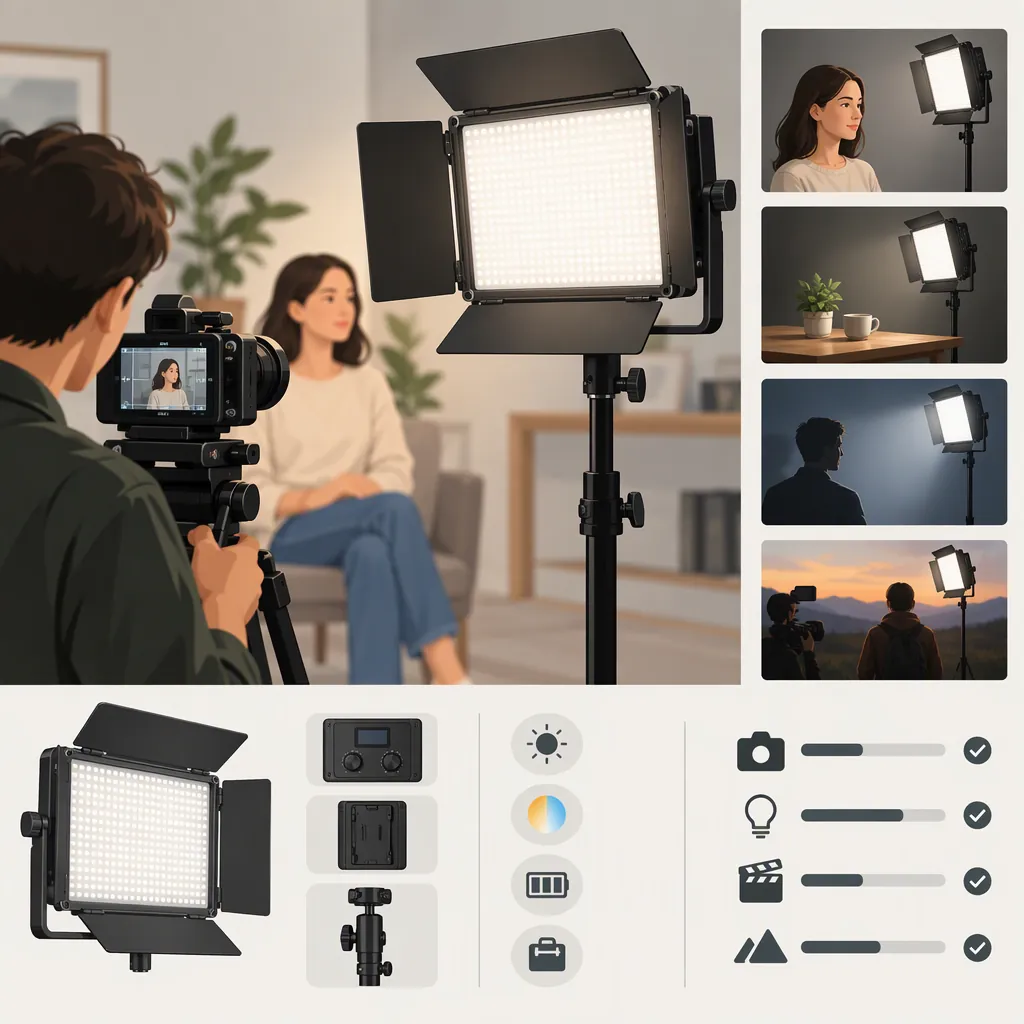
Godox Lf308d: How to Evaluate It for Your Filming Setup
Evaluate the Godox LF308D against your shooting distance, camera settings, scene lighting, and recording duration—not the listing headline alone. Retain it as a candidate only when your essential requirements are verified for the intended configuration; an untested requirement is not a pass.
The Lazada and FOTOSALE.UA retailer pages cited here do not provide independent camera-based flicker testing, a measured continuous-output comparison, or a measured runtime test. They therefore do not establish suitability for a particular filming setup. This guide provides a selection method, not a tested verdict on the LF308D. [c1] [c2]
Identify the Exact Model Before Comparing
The Lazada listing places LF308D and LF308Bi together in its title and lists them as separate model options. The FOTOSALE.UA page specifically names LF308D Daylight LED Video Light with Flash Sync. Treat these as retailer descriptions, not independent verification of performance. [c1] [c2]
Record the exact model designation before comparing lights. Keep LF308D information separate from descriptions of another variant, and obtain model-specific documentation for any feature essential to your workflow.
For video selection, assess continuous illumination separately from any advertised flash function. A flash-related headline is not evidence that the light will provide the continuous exposure your scene requires.
Model Verification Worksheet
- Exact model designation: ______
- Model shown on the unit or packaging: ______
- Model-specific documentation available: ______
- Required continuous-light functions: ______
- Included power and mounting accessories confirmed: ______
- Unresolved differences between listing and documentation: ______
Define the Shot and Its Pass Conditions
Start with the scene rather than a specification ranking. Identify the light's intended role—such as illuminating a face, adding fill, or lighting a background—and mark each requirement as essential or optional.
Set pass conditions before reviewing footage. There is no single exposure, color, or runtime threshold that this guide can apply to every shoot.
Filming Requirements Template
- Scene and light's intended role: ______
- Subject-to-light distance and light position: ______
- Camera, lens, and framing: ______
- Frame rate and shutter setting: ______
- Aperture, ISO, and white balance: ______
- Other light sources and ambient conditions: ______
- Intended diffusion or other light-shaping arrangement: ______
- Desired shadow appearance: ______
- Required uninterrupted recording duration: ______
- Planned power and mounting arrangement: ______
- Essential requirements and their pass conditions: ______
- Optional preferences: ______
Compare Against the Shot, Not Just the Specification
Use the following criteria for every candidate. These are evaluation instructions, not statements of LF308D capabilities.
| Criterion | How to Check and Record It | Define a Pass Before Testing |
|---|---|---|
| Exposure | At the planned distance and camera settings, record the subject and save a frame. Use the camera's histogram or waveform, if available, to help document exposure. Record the light's brightness setting. | Specify which subject areas need the intended exposure and where clipping is unacceptable. |
| Light quality | Review shadows and facial detail in the recorded image. Note light position and any diffusion. | Describe the shadow softness, direction, and detail needed for the shot. |
| Color | Include the same neutral reference object and subject in each comparison. Keep white balance and the viewing workflow unchanged; compare visible color casts and skin tones. | Define what color differences are acceptable in the intended scene. A visual check is not a laboratory color measurement. |
| Recording artifacts | Record clips at every intended frame rate, shutter setting, and brightness level. Review for flicker or banding. | Specify that no objectionable artifacts should appear in the settings you will actually use. |
| Placement | Check the final framing, subject movement, and reflective surfaces with the light in position. | Require the needed position without blocking the shot or creating unwanted reflections. |
| Power | With a documented compatible supply, run the light at the planned brightness for the required duration, following model-specific instructions. Record elapsed time, interruptions, and any visible output changes. | Set the required continuous operating time and acceptable interruption or output-change limits. |
| Mounting | Check the proposed support, attachment, and cable routing against model-specific instructions. Inspect the assembled setup before recording. | Require a compatible, secure arrangement that stays in position during the planned use. |
Apply the same criteria to each candidate. Do not rank lights solely by model names, LED counts, or headline power figures.
Run a Repeatable Camera Test
If a unit is available, separate a fixed-condition comparison from a target-exposure trial. They answer different questions.
First Round: Compare Under Fixed Conditions
- Set up a representative subject and neutral reference object.
- Mark the subject position, light position, and subject-to-light distance.
- Keep the camera, lens, framing, exposure settings, and white balance identical across candidates. Disable automatic adjustments that would change those settings.
- Keep ambient light and other scene lights unchanged. If they change, repeat the affected comparison.
- Record each candidate in the same position and document its brightness setting. Do not assume matching percentage settings mean matching light output.
- Record clips at the brightness levels, frame rates, and shutter settings relevant to your shoot.
- Save representative frames and review exposure, color, shadows, reflections, and recording artifacts using the same viewing workflow.
This round compares recorded results under documented conditions. It is not a calibrated output measurement.
Second Round: Test Whether Each Candidate Can Meet the Shot
Keep the planned camera settings, scene, and working distance fixed, but allow adjustment of each light's brightness to reach your target exposure. Record whether the target is reached and the setting required.
Test the intended diffusion or other light-shaping arrangement separately. Record the material or accessory, its position, and any changes to the setup. Do not combine results from an unmodified light with results from a modified configuration without labeling the difference.
Then check power for the required recording duration and mounting against model-specific instructions. Do not improvise incompatible power connections or unsupported mounting arrangements.
Turn Test Results into a Selection Decision
Record each requirement as:
- Acceptable: Evidence shows that the documented configuration meets your preselected pass condition.
- Unacceptable: The configuration fails that condition.
- Not verified: Evidence is missing, unclear, or does not match the intended setup.
Comparison Record
Enter E for an essential requirement or O for an optional preference. Replace “Not verified” only when you have evidence.
| Requirement | E/O | Pass Condition | LF308D Result | Other Candidate Result | Evidence or Open Question |
|---|---|---|---|---|---|
| Exposure at working distance | ______ | ______ | Not verified | Not verified | ______ |
| Color in the actual scene | ______ | ______ | Not verified | Not verified | ______ |
| Flicker or banding | ______ | ______ | Not verified | Not verified | ______ |
| Desired shadow appearance | ______ | ______ | Not verified | Not verified | ______ |
| Placement and reflections | ______ | ______ | Not verified | Not verified | ______ |
| Power for recording duration | ______ | ______ | Not verified | Not verified | ______ |
| Compatible, secure mounting | ______ | ______ | Not verified | Not verified | ______ |
Use these decision rules:
- An essential requirement fails: Exclude the current configuration from that shoot. If a permissible change could resolve the failure, document the change and retest; do not carry the earlier result over to the revised setup.
- An essential requirement is not verified: Keep suitability unresolved. Obtain the missing evidence before relying on the candidate for the shoot.
- All essential requirements pass: Retain the candidate for the tested scenario, then compare optional needs such as setup effort, placement flexibility, and power logistics.
- Several candidates pass: Choose according to the practical priorities you defined, rather than treating one specification as a universal winner.
A pass applies to the documented camera settings, distance, accessories, and power arrangement. It is not a claim that the LF308D—or another candidate—will suit every filming situation.
If You Cannot Test a Unit
Use documentation to narrow uncertainties, not to turn them into assumed passes. Request:
- An LF308D-specific manual or technical document, with the exact model identified.
- Continuous-light output measurements that state distance, brightness setting, and any modifier used.
- Original representative footage with camera model, frame rate, shutter setting, exposure, white balance, working distance, and light brightness documented.
- Runtime evidence identifying the power supply or battery, brightness setting, test duration, and any output changes.
- Power compatibility, mounting instructions, and a clear list of included versus optional accessories.
Check whether each item answers your actual requirement. Footage at a different shutter setting does not resolve your own artifact test; runtime information from a different power configuration does not establish your required operating time.
Documentation may clarify compatibility and operating limits. It cannot, by itself, settle how skin tones, shadows, reflections, or exposure will look in your exact scene. If essential questions remain unanswered, retain a not verified status rather than making a suitability recommendation.
FAQ
Is the Godox Lf308d Suitable for Filming?
The Lazada and FOTOSALE.UA retailer pages cited here are not enough to establish suitability for a specific scene. They do not provide the independent flicker, continuous-output comparison, and runtime testing needed for a tested verdict. [c1] [c2]
Retain the LF308D as a candidate only after essential exposure, color, artifact, power, placement, and mounting requirements pass for your intended configuration.
Should Lf308d and Lf308bi Listing Information Be Treated as Interchangeable?
No. The Lazada listing includes both names and separate model options. Keep variant information separate and verify LF308D-specific documentation before relying on a feature description. [c1]
Does the Flash-Sync Description Establish Video Brightness?
No. FOTOSALE.UA names flash sync in its product title, but that wording does not establish measured continuous-light performance for your scene. Evaluate continuous illumination at your planned distance and camera settings separately. [c2]
What Should I Do If I Cannot Test the Lf308d?
Seek model-specific documentation and representative test materials with their conditions clearly stated. The retailer pages cited here do not supply independent camera-based flicker testing, a measured continuous-output comparison, or a measured runtime test. [c1] [c2]
Mark any essential requirement that remains unresolved as not verified. Do not treat missing evidence as proof that the light will meet the shoot's needs.