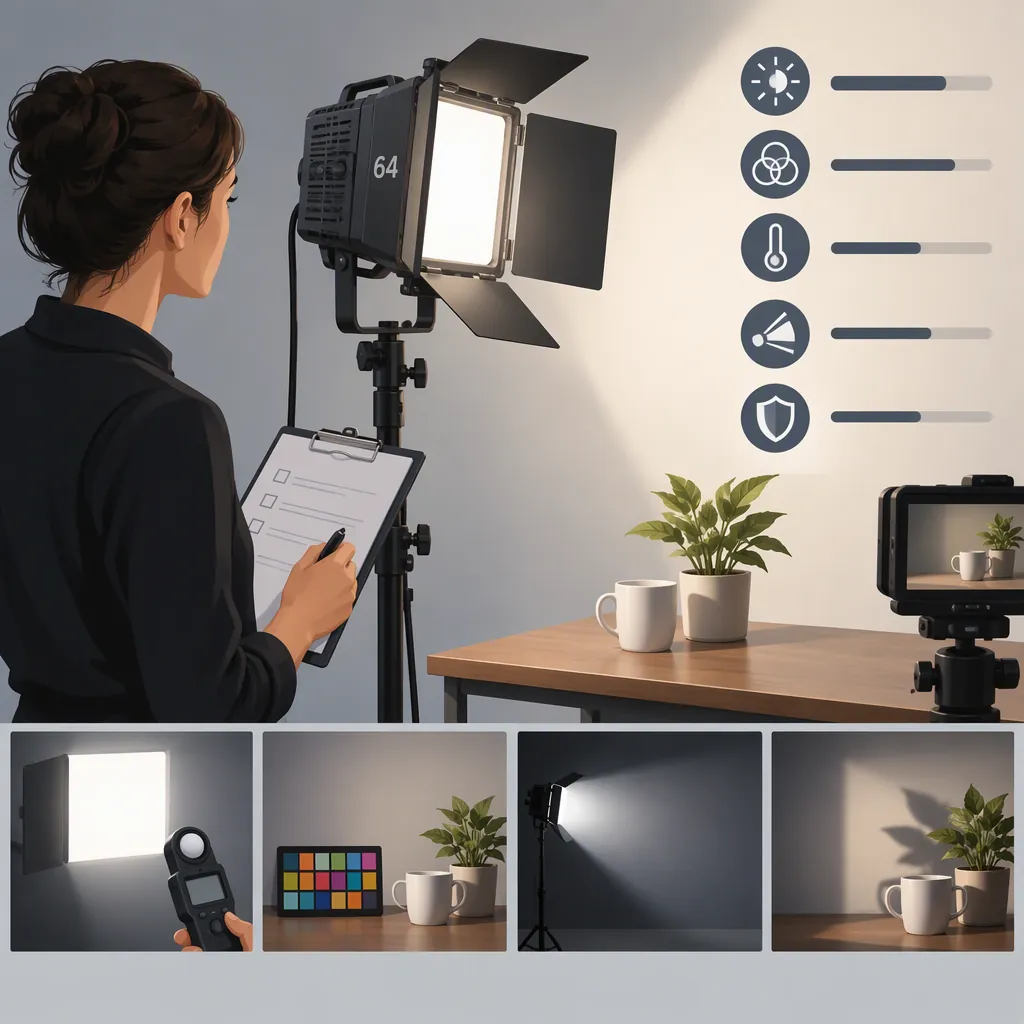
Godox 64: Choosing a Light for Your Filming Setup
If “godox 64” refers to the Godox LED64, start by confirming the exact model: Godox names LED64 on its LED36/64/126/170 product page. [c1] Then use two stages to decide whether it fits your filming needs: screen its documentation against your requirements before obtaining it, and verify the recorded image and practical fit when a unit is available.
The manufacturer page provided for this guide identifies LED64 and lists a Chinese/English manual download. Its supplied text does not establish brightness, color accuracy, flicker performance, runtime, mounting compatibility, or accessory support. [c1] This is a selection guide—not a product review or a verified recommendation for a particular scene.
Confirm Which Light You Mean
Check the model printed on the fixture or packaging against the documentation. Godox’s family page names LED36, LED64, LED126, and LED170; do not transfer specifications from another model on that page to LED64. [c1]
Model Identification Checklist
- Record the exact model designation.
- Record any version designation separately.
- Match the unit to its own manual and specifications.
- Mark details as unknown if they cannot be confirmed for that exact model.
- Distinguish a documented specification from a result observed in your own test.
Before Obtaining the Light: Define and Screen Your Requirements
Describe the shot before comparing fixtures. Treat a small-object close-up, a seated interview, and a moving subject as separate setups rather than one generic “video” requirement.
Decide whether the candidate would serve as the main light, supporting fill, or background accent. Record the framing, light-to-subject distance, available placement space, and existing room or window light.
Next, identify your non-negotiable requirements. These are conditions the light must meet without changing the intended shot—for example, a fixed mounting location, an approved power arrangement, or a minimum uninterrupted recording duration.
Pre-Test Screening Worksheet
| Requirement | What to define | What to check before obtaining a unit |
|---|---|---|
| Exposure | Frame rate, shutter setting, acceptable aperture and maximum ISO at the intended distance | Whether exact-model output documentation is available and relevant to your setup; leave scene adequacy unconfirmed until tested |
| Lighting role and coverage | Main, fill, or accent; subject size and framing | Whether available documentation answers your placement and coverage questions |
| Mounting | Intended support, available space, and placement limits | Exact-model mounting requirements and compatibility with the intended support |
| Power | Available supply and cable-routing constraints | Documented electrical requirements and approved power arrangements |
| Recording duration | Required continuous session length | Any documented operating-duration information and its stated conditions |
| Accessories and safety | Any required diffusion, attachment, or other accessory | Compatibility and safety instructions for the exact unit |
For each requirement, record one of three screening results:
- Documented match: The documentation addresses the requirement and shows no identified conflict. Image performance may still need testing.
- Documented mismatch: A hard requirement is not met. Exclude the candidate for the planned setup unless that requirement can legitimately change.
- Needs confirmation: Essential information is missing, unclear, or not applicable to your conditions. Do not treat that gap as a pass.
If you cannot access a unit, stop at this screening result. “Candidate for testing” is a more defensible conclusion than “suitable for filming” when scene performance remains unverified.
Filming Requirements Worksheet
- Shot type and subject: ______
- Framing: ______
- Intended lighting role: main / fill / accent
- Planned light-to-subject distance: ______
- Frame rate and shutter setting: ______
- Aperture and ISO limits: ______
- Existing room or window light: ______
- Required coverage and shadow appearance: ______
- Required uninterrupted recording time: ______
- Mounting and space limits: ______
- Non-negotiable requirements: ______
- Documentation gaps to resolve: ______
When comparing alternatives, apply the same requirements to each exact model. Do not rank candidates solely by a model number, a wattage label, or a seller’s description. This guide establishes no output comparison between LED64 and another fixture.
With a Borrowed, Demonstration, or Available Unit: Test the Recorded Image
Once you can access the light, test it in the intended setup. Use a repeatable camera test rather than judging only how bright it appears to your eyes.
Fix exposure and white balance for the comparison. Record the subject at the planned distance, with the intended framing and other lights present. Note the fixture setting and any accessories used.
What to Review in the Footage
- Exposure: Can you obtain the intended image within your aperture and ISO limits?
- Coverage: Are all important parts of the subject lit as intended?
- Shadows: Do facial or object shadows suit the shot?
- Reflections: Are highlights in glasses, screens, or reflective products acceptable?
- Color: Do skin tones and familiar objects look acceptable under the intended mix of lights?
- Temporal artifacts: Are bands, pulsing, or other visible changes present at the frame rate, shutter setting, and light setting you plan to use?
If a result fails, identify whether an allowed adjustment could resolve it. Change one variable at a time—such as placement or lighting role—and record the new conditions. Follow the fixture’s safety instructions before using diffusion or other accessories; do not assume an improvised attachment is suitable.
A satisfactory clip supports a decision for those tested conditions. It is not proof of universal flicker-free operation, measured color accuracy, or equivalent performance at other distances.
Repeatable Image Test Log
| Test detail | Record |
|---|---|
| Exact model | ______ |
| Placement and distance | ______ |
| Exposure and white balance | ______ |
| Light setting | ______ |
| Other lights present | ______ |
| Accessories used | ______ |
| Exposure | pass / fail / not tested |
| Coverage and shadows | pass / fail / not tested |
| Color and reflections | pass / fail / not tested |
| Visible temporal artifacts | observed / not observed in this test / not tested |
| Proposed adjustment, if any | ______ |
| Retest result | ______ |
Verify Mounting, Power, and Recording Duration
An acceptable image does not complete the selection process. Check the intended mounting arrangement, cable routing, power source, and session duration.
Confirm electrical and mounting requirements in documentation for the exact unit before setting up the test. If a safety-critical detail is unclear, leave it unresolved rather than improvising a connection or attachment.
Run a duration test that matches your planned session using the intended power arrangement. Record whether the light operates for the required time and whether interruptions or visible changes occur. Keep any advertised or documented runtime separate from the duration achieved under your test conditions.
For a demonstration or borrowed unit, note any differences from your planned setup. A short demonstration with a different power arrangement does not establish that your full recording session will work.
Make the Selection Decision
Use four outcomes to close the process:
| Decision | When it applies |
|---|---|
| Suitable for the tested setup | Image, mounting, power, and duration requirements were met under recorded conditions, with no essential unresolved detail |
| Needs a revised setup and retest | A requirement failed, but a specific, permitted adjustment could plausibly resolve it |
| Not suitable for the planned or tested setup | A confirmed hard requirement is not met and cannot be resolved within the allowed setup |
| Unresolved | Essential documentation is missing, a required test has not been performed, or the result remains inconclusive |
Keep failure, missing evidence, and an adjustable problem separate. For example:
- An untested recording duration is unresolved.
- A duration test that ends before the required session length is a failed test. If no approved change can meet the requirement, the light is not suitable for that setup.
- Unacceptable shadows that might be corrected by permitted placement changes call for revision and retesting.
- A confirmed mounting incompatibility is not suitable for the planned setup if that mounting arrangement is non-negotiable.
Do not average away a failed hard requirement because other results passed. Likewise, do not treat missing information as proof of either suitability or failure.
Final Decision Record
- Exact model and intended setup: ______
- Documentation reviewed: ______
- Image requirements: pass / fail / not tested / inconclusive
- Mounting requirements: confirmed match / confirmed mismatch / unresolved
- Power requirements: confirmed match / confirmed mismatch / unresolved
- Required duration: pass / fail / not tested / inconclusive
- Safety-critical details: confirmed / unresolved
- Permitted adjustments and retest results: ______
- Remaining unknowns: ______
- Final decision: suitable for tested setup / revise and retest / not suitable for planned or tested setup / unresolved
- Conditions limiting this decision: ______
FAQ
Does “Godox 64” Mean Led64?
LED64 is a model named on Godox’s LED36/64/126/170 product page. Confirm the designation on the fixture or its documentation before applying specifications. [c1]
How Can I Evaluate Godox 64 Before I Have Access to One?
Define your non-negotiable exposure, mounting, power, and recording-duration requirements, then check exact-model documentation. Exclude a candidate with a confirmed hard mismatch and mark missing information as unresolved. If documentation screening passes, classify it as a candidate for testing—not yet as proven suitable.
Can Godox 64 Be the Main Light for Video?
That is not established by the manufacturer page text available for this guide. [c1] Test the candidate as a main light at your intended distance, framing, exposure, and ambient-light conditions. A passing result applies to that tested setup.
What If the Light Fails a Test?
Record the failed requirement. If an allowed adjustment could address it, revise the setup and retest. If a non-negotiable requirement cannot be met, classify the light as not suitable for that setup. Reserve “unresolved” for missing or inconclusive evidence.
Are Brightness, Runtime, and Color Performance Verified Here?
No. The supplied manufacturer page text identifies LED64 and a manual download but does not establish those performance details. [c1] The checklists help you separate documented specifications, observed test results, and remaining unknowns.