Godox Vl300 Selection Guide: Check the Model, Setup, and Power Needs
Short Answer
The official product name matching the search “godox 300vl” is Godox VL300, an LED video light in Godox’s VL150/VL200/VL300 series. Godox also lists a separate VL300II model, so check the exact name on the product listing and manual before buying or matching accessories. The original VL300 may suit a setup that needs a continuous, daylight-balanced light and can accommodate its separate controller and power equipment; whether it is suitable depends on your scene, distance, modifiers, and power source. If you need a different color temperature, a smaller travel kit, or a confidently priced value comparison, the available documentation alone does not settle the choice. (godox.com)
First, Confirm Which Vl300 You Mean
Godox’s official product pages distinguish VL300/VL200/VL150 from VL150II/VL200II/VL300II. Treat “VL300” and “VL300II” as different model names—not interchangeable shorthand—and verify the model printed on the light, box, listing, and manual. The original VL-series manual identifies the VL300 as an LED video light. (godox.com)
That distinction matters when checking specifications, accessories, included items, and power arrangements. The details below are from Godox’s manual for the original VL300/VL200/VL150 series, not the VL300II manual. If your listing says “VL300II,” use the II-series documentation instead. (godox.com)
When the Original Godox Vl300 May Fit
Use the documented details as checks against your actual setup—not as a guarantee of a particular result on camera:
- You need continuous light: The manual lists the VL300’s rated power as 300W. That number alone does not tell you whether it will be bright enough through your chosen modifier, at your working distance, or against ambient light. (godox.com)
- You can work with its listed daylight setting: Godox’s manual lists the VL-series color temperature as 5600+200K. Because the extracted specification does not clearly show whether that notation means a tolerance, confirm the exact wording in the manual for your unit if color-temperature tolerance is important. If your workflow needs adjustable color temperature, do not assume this model provides it based on the original VL-series manual. (godox.com)
- You can use the available power arrangement: The manual lists AC power and V-mount battery power (battery sold separately). For the VL300, it lists AC 100–240V, 50/60Hz, 4.3A, and DC 33V, 10A. Confirm what is included in the specific kit and whether your location, cables, and batteries meet the manual’s requirements. (godox.com)
- Your modifier fits: The manual describes a Bowens mount. Check the exact mount on your light and the fit of your modifier; do not assume that every accessory marketed as Bowens-compatible will clear your stand, yoke, or other equipment in your intended arrangement. (godox.com)
- You have room for a multi-part setup: The manual lists separate weights for the light head (2.64 kg), controller (1.26 kg), and adapter (1.14 kg). Added together, those listed components total 5.04 kg, before any stand, modifier, batteries, or bag. That arithmetic is a useful starting point for packing and support planning, not a full kit weight. (godox.com)
How to Read the Illuminance Figures
Godox’s manual lists the VL300 at 77,000 lux at 1 metre with the supplied reflector and 10,800 lux at 1 metre bare. These are different configurations, so do not compare one figure with another light’s measurement unless distance, reflector or modifier, measurement method, and operating conditions are comparable. They also do not predict exposure through a softbox or at a different subject distance. (godox.com)
A practical check is to recreate your intended setup before committing: place the light where it would go, use the modifier you expect to use, set the subject at the real working distance, and assess the result with your camera settings and ambient light. This is a planning method, not a claim that the light has been tested here.
When It May Not Be the Right Choice
Consider another option—or get more information—if:
- Your project needs adjustable color temperature. The original VL-series manual provides a single listed color-temperature figure, not evidence of a tunable range. Confirm the exact model’s manual before choosing it for mixed-color-temperature work. (godox.com)
- You need a very light travel package. The listed head, controller, and adapter together weigh 5.04 kg, with other kit items still to account for. Compare the packed weight and bulk of complete kits, not just the light head. (godox.com)
- Your shoot depends on battery operation. V-mount battery power is listed, but the manual excerpt does not establish runtime for a particular battery. Check battery compatibility, capacity, quantity, and expected operating duration against the exact unit and your intended output. (godox.com)
- You need a current value judgment. No price or like-for-like alternative is established here. Compare the price in your market and currency for the same model and kit contents, including any separately needed batteries, modifiers, stands, or cables. Without that context, it is not possible to call the VL300 good or poor value.
A Quick Choose-Or-Not-Choose Checklist
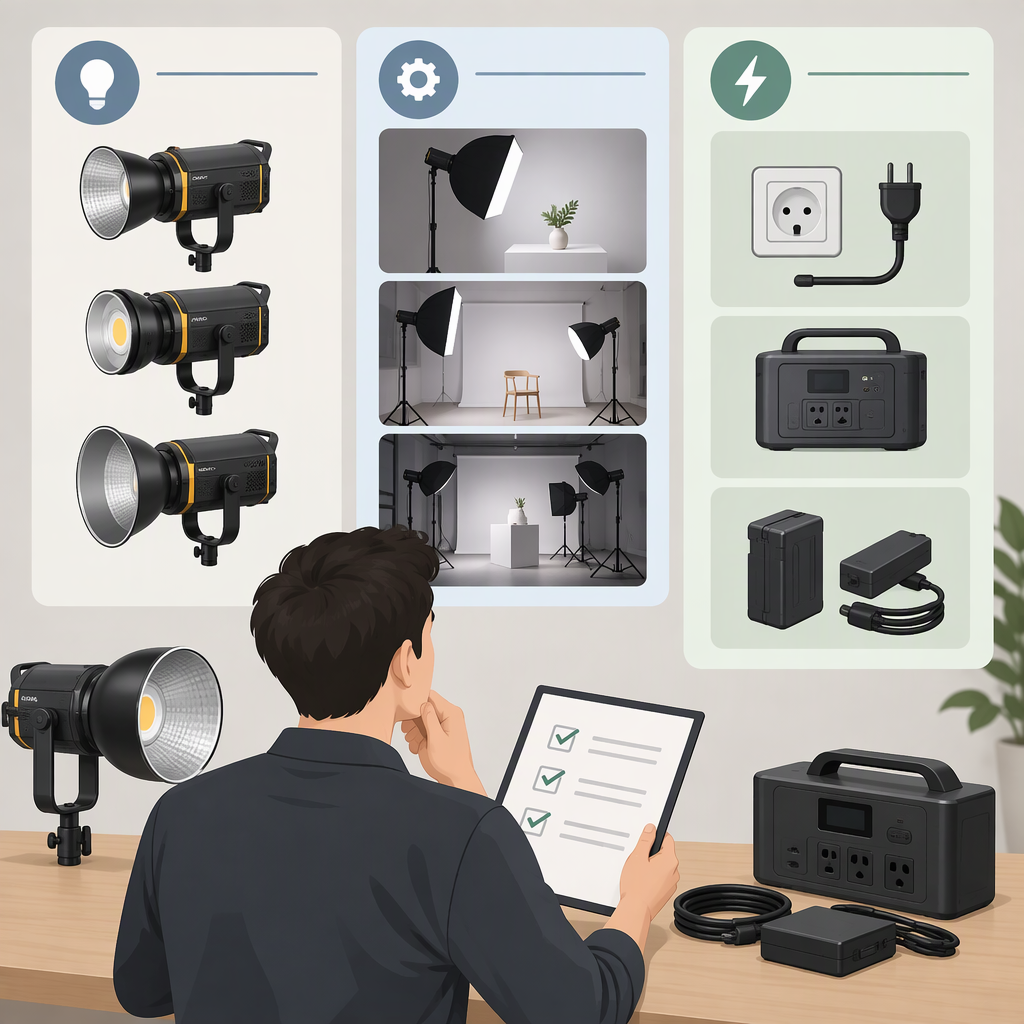
Before deciding, answer these questions:
- Is the model definitely VL300, not VL300II? Match the product label and manual.
- Does the light work for the scene you actually shoot? Consider subject distance, scene size, ambient light, modifier, and desired look; do not rely on the 300W rating alone.
- Does the color-temperature specification meet your workflow? Confirm it in the exact model’s documentation if tolerance or tunability matters.
- Can you power and carry the complete setup? Check AC availability or the exact V-mount battery requirements, plus the weight of the head, controller, adapter, and remaining kit.
- Do your modifiers fit? Verify the mount and kit contents rather than assuming accessories are included.
- Does the complete cost fit your budget? Compare equivalent kits in the same market and currency; include any essential items not in the quoted package.
Choose the original VL300 conditionally if its documented configuration matches your requirements, the complete power and modifier setup works for your shoot, and the packed kit fits your transport and budget constraints. Do not choose on the name or wattage alone if you require tunable color, a lighter complete kit, confirmed battery runtime, or a current price comparison; resolve those points for the exact model first.