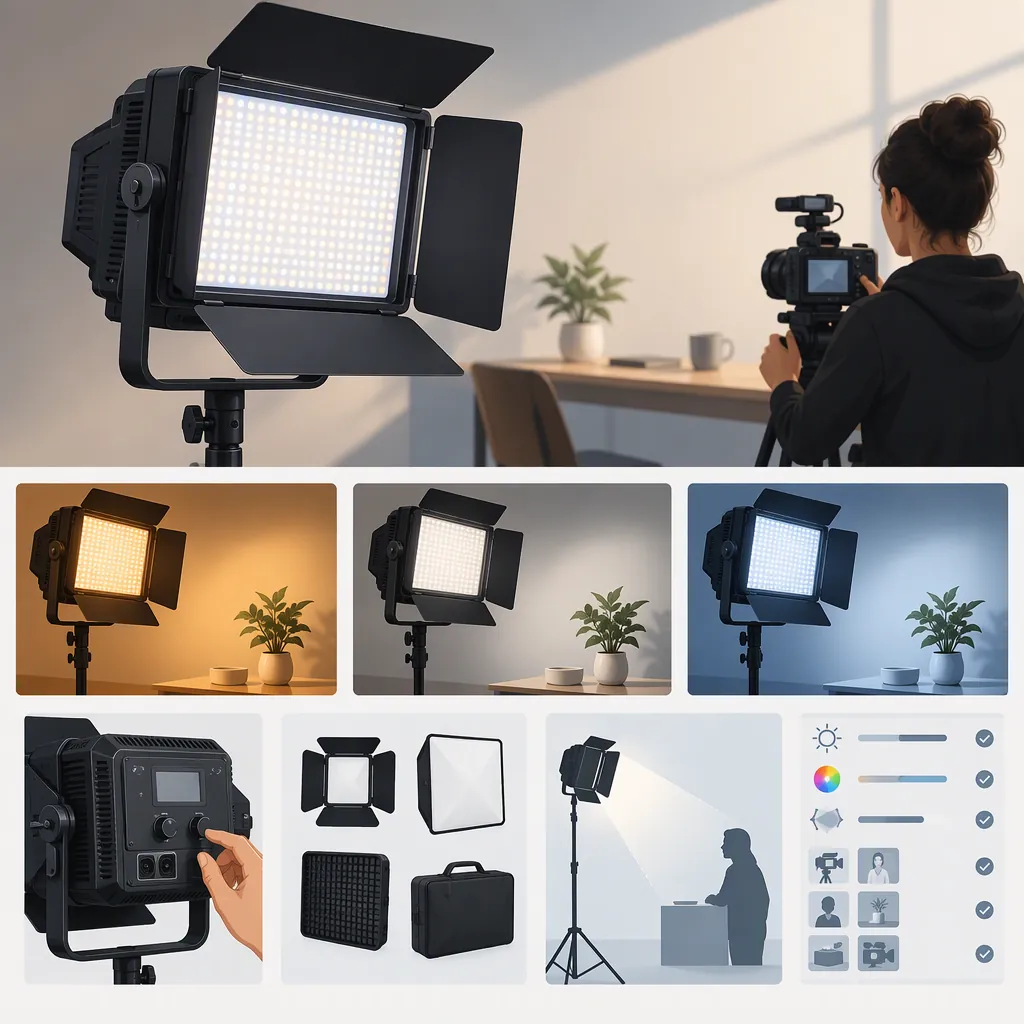
Godox 260C: How to Choose a Light for Filming
Confirm the exact light model before deciding whether “godox 260c” meets your filming needs. The available reference identifies a Godox P260C light stand base, not a dedicated light specification sheet. It does not conclusively resolve which light the shortened search name means or establish its filming performance. [c1]
What the Available Evidence Confirms
| Status | Finding | What to do with it |
|---|---|---|
| Confirmed | The reference’s main product is titled “Godox P260C Light Stand Base,” an accessory. [c1] | Keep its identity separate from the light being evaluated. |
| Confirmed | Related listings include “Godox LEDP260C Bi-Color LED Light Panel,” “Godox LEDP-260C LED Video Light (2-Light Kit),” “Godox P260C PRO Bi-Color LED Light Panel,” and “Godox LEDP-260C LED Video Light 3 Kit w/ Stands & Carry Bag.” [c1] | Treat these as distinct listing names to investigate, not interchangeable equipment. |
| Unconfirmed | Those names do not establish model equivalence, accessory compatibility, or which light “godox 260c” refers to. The accessory page is also insufficient to verify light output, color accuracy, runtime, or flicker behavior. [c1] | Leave model-specific suitability undecided. |
| Next step | Match the candidate’s full model-label text to documentation that explicitly names it. | Then verify the exact package contents and compatibility of required accessories. |
The selection process below is general filming guidance, not a performance assessment or recommendation for a particular Godox model.
Confirm the Model and Complete Setup
Keep the light model, kit name, and accessory models separate. Similar names and related-product listings are not enough to establish that components work together. [c1]
Before evaluating a candidate:
- Obtain a readable photo of the light’s model label, from the equipment or the listing under consideration.
- Locate a public manual that explicitly names that model.
- Check the component list for the exact package—not merely another kit with a similar name.
- Record the power supply, batteries, charger, mount, stand, and modifiers separately. Mark each as included, separate, not required, or unconfirmed.
- Verify necessary mounting and accessory compatibility against the relevant documentation. Do not treat a visual fit as confirmation.
If the label, manual, and listing use inconsistent names, record the unresolved question rather than assuming equivalence.
Model and Configuration Record
Use one record per candidate. This table captures identity and configuration facts; the later acceptance log captures suitability judgments.
| Field | Record |
|---|---|
| Search term | godox 260c |
| Exact light model shown on label | ____ |
| Model named in matching manual | ____ |
| Kit or package name | ____ |
| Included components and supporting documentation | ____ |
| Required separate components | ____ |
| Accessory models and documented compatibility | ____ |
| Planned power and mounting arrangement | ____ |
| Complete setup cost and date recorded | ____ |
| Unresolved identity or configuration questions | ____ |
| Identity status | Confirmed / unconfirmed |
Define the Shoot Before Comparing Lights
Choose requirements for your production before reviewing candidate results. These questions do not describe verified capabilities of any Godox model.
- Lighting role: Will the light be a key, fill, background, or accent light?
- Coverage and placement: What subject area must it illuminate, at what distance, and where can the light and support fit without entering the frame?
- Exposure: What aperture, ISO, frame rate, and shutter setting must the setup support?
- Appearance: What recorded color balance, shadow shape, highlight control, and background separation do you need?
- Power and mounting: What power source, support arrangement, and floor space are available?
- Recording conditions: Will you record dialogue, slow motion, or long uninterrupted takes?
- Budget: What is the limit for the complete usable setup, including required separate components?
Divide requirements into must-haves and preferences. A must-have determines whether the setup is usable for the planned shoot; a preference distinguishes otherwise suitable candidates.
For example, acceptable noise in recorded dialogue may be essential for an interview, while compact packing may be only a preference. Neither priority is universal.
Make acceptance criteria specific enough to judge. Instead of “bright enough,” state the required exposure and subject coverage at your planned distance. Instead of “good for video,” specify the camera settings and visible artifacts you will check.
Compare Candidates with a Repeatable Camera Test
Evaluate recorded footage and audio, not only how the room looks or sounds in person. Use the same baseline scene and settings for each candidate, and document any necessary differences between complete setups.
Before Recording
- Lock exposure: Fix aperture, ISO, shutter setting, and frame rate for each comparison. Disable automatic exposure adjustments for the baseline test.
- Lock white balance: Use the same fixed white-balance setting initially. Record any later adjustment as a separate test.
- Record image processing: Note the picture profile and relevant processing settings, such as noise reduction or sharpening, and keep them consistent.
- Control the scene: Keep subject position, framing, ambient lighting, and light-to-subject distance consistent.
- Document the light setup: Record operating settings, power source, and modifiers. If different modifiers are necessary to meet the intended appearance, identify them and include their cost.
- Control audio: Keep microphone position, recording chain, and recording gain fixed for noise comparisons. Disable automatic gain where available and record whether it is off. If automatic gain cannot be disabled, note that limitation.
Keep these baseline conditions unchanged between candidates. Adjustments intended to improve a candidate’s result are allowed, but label them separately and record the revised conditions rather than silently replacing the baseline.
Recording Checks
- Exposure and coverage: Record the subject at the planned distance and framing. Compare the result with your stated acceptance criterion.
- Color and shadow appearance: Record a neutral target and representative subject materials using fixed white balance. If you adjust white balance or placement afterward, retain both the baseline and adjusted results.
- Visible artifacts: Record at every frame rate and shutter setting you expect to use, with the intended light settings. Inspect clips for bands, pulsing, or other distracting artifacts.
- Recorded noise: Record room tone with the light operating and the microphone in its planned position. Compare recordings using the same gain and playback conditions.
- Take duration: Run the setup for the planned uninterrupted take. Note interruptions or changes that affect the shot.
- Power and mounting: Verify compatibility from documentation and follow the relevant equipment instructions. Confirm that the documented arrangement fits the planned location.
A successful test supports only the configuration and conditions tested. It does not verify every operating setting or future shooting arrangement.
Requirements Acceptance Log
Enter pass, fail, or unverified, with the evidence or test conditions supporting each result. Keep missing evidence marked unverified; it is neither a pass nor proof of failure.
| Requirement | Acceptance criterion | Must-have or preference | Candidate A: result and evidence | Candidate B: result and evidence | Next step |
|---|---|---|---|---|---|
| Exposure and subject coverage | ____ | ____ | ____ | ____ | ____ |
| Recorded color and shadow appearance | ____ | ____ | ____ | ____ | ____ |
| Artifacts at intended camera settings | ____ | ____ | ____ | ____ | ____ |
| Noise in recorded audio | ____ | ____ | ____ | ____ | ____ |
| Planned uninterrupted take duration | ____ | ____ | ____ | ____ | ____ |
| Power, placement, and mounting | ____ | ____ | ____ | ____ | ____ |
| Complete setup within budget | ____ | ____ | ____ | ____ | ____ |
A recorded price alone is not a budget pass. Compare the cost of all required components with your stated limit.
Hypothetical Example: Turning Evidence into a Result
This is a worksheet example, not a Godox product test or an observed result.
| Criterion | Evidence or test conditions | Result | Next step |
|---|---|---|---|
| Must-have: no distracting bands or pulsing at 24 fps with a 1/50-second shutter, at the planned light setting | A hypothetical candidate has only been checked at 30 fps with a 1/60-second shutter. No clip exists at the required settings. | Unverified | Record and inspect a clip at 24 fps and 1/50 second using the documented baseline setup before judging suitability. |
The example shows why a result must match the acceptance criterion: evidence from a different configuration does not automatically establish a pass.
Turn the Results into a Selection
Apply this sequence to the exact model and complete setup evaluated:
- Resolve identity first. If the light model or necessary compatibility remains unclear, defer a model-specific suitability judgment.
- Exclude must-have failures. A candidate that fails an essential requirement is unsuitable for the planned setup as tested.
- Pause on unverified must-haves. Obtain the missing documentation or relevant test before classifying the candidate as suitable.
- Compare passing setups. Among candidates that meet all must-haves, compare complete setup cost and your established preferences.
- Retest meaningful changes. If you change placement, power, modifiers, or camera settings to address a failure, document the revised configuration and repeat the relevant checks.
If no candidate passes, reconsider the arrangement, requirements, or candidate list rather than choosing the one with the fewest documented failures.
The available accessory listing cannot establish a filming-performance ranking or recommendation for a Godox 260C light. [c1] A defensible selection is therefore a decision about a confirmed model under defined shooting conditions—not a conclusion based on the shortened name.
FAQ
Does “Godox 260C” Identify a Specific Filming Light?
Not conclusively from the available reference. Its main product is a P260C light stand base, while related listings use LEDP260C, LEDP-260C, and P260C PRO names. Those listings do not establish that the names are equivalent. [c1] Match the candidate’s label to a model-specific manual.
Is a Godox 260C Suitable for Interviews?
Interview suitability is not established by the accessory listing. [c1] Evaluate the exact candidate for exposure, subject coverage, recorded color, visible artifacts, and noise at the intended microphone position. Essential results that remain unverified should delay a suitability judgment.
What If I Cannot Test the Light Before Selecting It?
Use documentation only for the claims it actually supports. Record any missing filming-performance checks as unverified. If an essential requirement cannot be verified, do not classify the candidate as suitable solely because its listing calls it a video light.
Does Passing One Test Prove the Light Will Work for Every Shoot?
No. Keep the model, configuration, operating settings, and camera conditions with the result. Repeat the relevant checks when those conditions change rather than extending a pass to an untested setup.