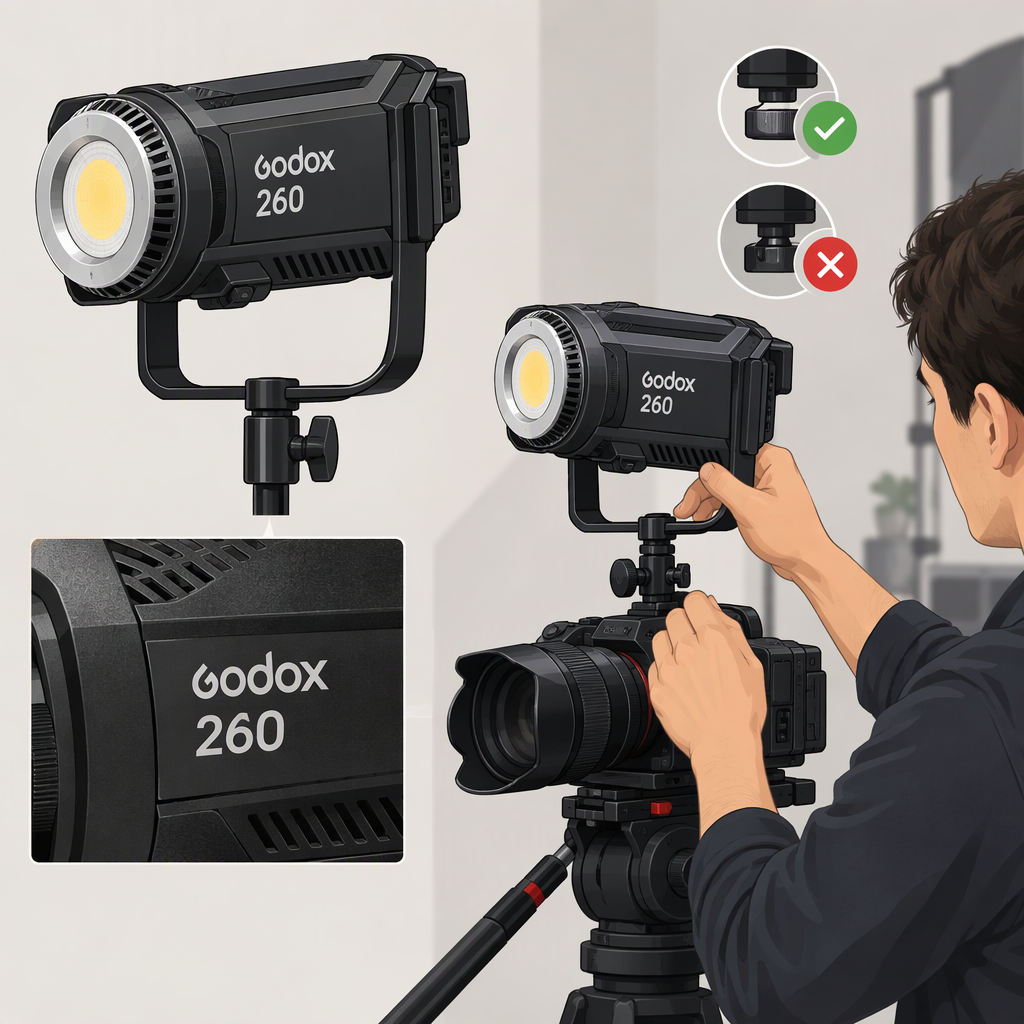
Godox 260 for Filming: Identify the Model and Check the Fit
Short answer: “Godox 260” is ambiguous. Godox’s official materials identify a LEDP260C video light and a separate P260C Pro light panel; the numbers alone do not establish which one a listing or searcher means. Check the exact model on the product label, listing, or matching manual before relying on specifications. If you mean the LEDP260C, Godox’s manual lists it as a continuous video light and provides specifications that can help you judge whether it suits a close, modest-scale filming setup. (cn.godox.com)
Identify the Exact “Godox 260” First
The phrase is a useful search clue, not a complete model name. Godox’s product materials include LEDP260C and P260C Pro—similar names, but different models with different published specifications. The official LEDP260 product page also links to a manual labeled LEDP260C, so confirm the model marking on the item itself rather than relying on a shortened page title or a seller’s shorthand. (godox.com)
Before making a choice, match at least one of these identifiers:
- The model number printed on the light or its packaging.
- The model name in the manual supplied with that light.
- A listing that gives the complete model number and specifications, rather than only “Godox 260.”
If those identifiers disagree—or the listing leaves off the letters and suffix—treat the model as unconfirmed. Do not assume that LEDP260C and P260C Pro share the same power, controls, or color-temperature range.
Check Whether the Ledp260c Fits Your Filming Setup
For the LEDP260C specifically, Godox’s manual lists a maximum power of 30 W, a 3300–5600 K color-temperature range (with a stated ±300 K tolerance), and illuminance of 2,050 lux at 0.5 m and 3300 K, or 2,200 lux at 0.5 m and 5600 K. It lists a color-rendering index above 95 and TLCI of at least 94. These are manufacturer-published figures, not independent test results; the illuminance figures are tied to the stated distance and color temperature, so they should not be treated as a brightness guarantee at every filming distance. (cn.godox.com)
Use those details as a checklist against your actual shoot:
- Subject and distance: A panel’s published reading at 0.5 m does not tell you the exposure you will get farther away. Check whether the light can provide the fill you need at the distance and camera settings you plan to use.
- Color match: The LEDP260C’s stated range runs from 3300 K to 5600 K. Consider whether that range can be matched to your room lights or the look you want; do not assume it covers every ambient-light color.
- Power for the shoot: The manual specifies two power options: two NP-F970-interface lithium batteries, which it says are sold separately, or a 13–16.8 V DC adapter. Confirm what is included with the specific item and whether your planned power source is compatible. (cn.godox.com)
- Mounting and placement: The manual describes handheld use with its detachable handle and mounting the light on a light stand. Check that the support and placement suit your set, and follow the manual’s installation instructions. (cn.godox.com)
- Controls you need: The LEDP260C manual describes on-light brightness and color-temperature adjustment plus 433 MHz remote control. If remote operation matters, confirm the remote and any other needed accessories are actually included. (cn.godox.com)
Godox describes the LEDP260C as suitable for video recording, interviews, product shooting, and other photography uses. That is the manufacturer’s stated application guidance—not proof that the light will be bright enough for every room, subject, or camera setup. (cn.godox.com)
When to Choose It—Or Reconsider
The LEDP260C may be worth considering if you have confirmed that model, want a continuous panel light, can place it close enough for your shot, and its documented color range and power options fit your setup. Before relying on it for a real shoot, test it at the intended subject distance and camera exposure; the published 0.5 m figures do not settle that question for your room.
Reconsider or gather more information first if you need a different color-temperature range, cannot use the listed power options, need a known brightness at a greater distance, or the listing does not identify the model clearly. In those cases, “Godox 260” is not specific enough to determine suitability. Ask for the exact model number and consult its matching manual before comparing specifications.
Do not use the P260C Pro specifications to fill gaps in an LEDP260C listing. Godox identifies P260C Pro separately and lists, among other differences, a 45 W input power, a 2800–6500 K range, USB-C power input, and Bluetooth/app control. Those figures describe the Pro model; the cited official product page does not provide a directly comparable lux figure, so its wattage alone is not a like-for-like brightness comparison with the LEDP260C’s stated illuminance. (godox.com)
Bottom Line
For a filming-light choice, first verify whether the item is LEDP260C, P260C Pro, or another model. If it is LEDP260C, compare its manual-listed output, color range, power options, and mounting instructions with your subject distance and shoot requirements. If the exact model or the needed setup details are unknown, the responsible answer is that suitability cannot yet be determined—not that every “Godox 260” listing refers to the same light.