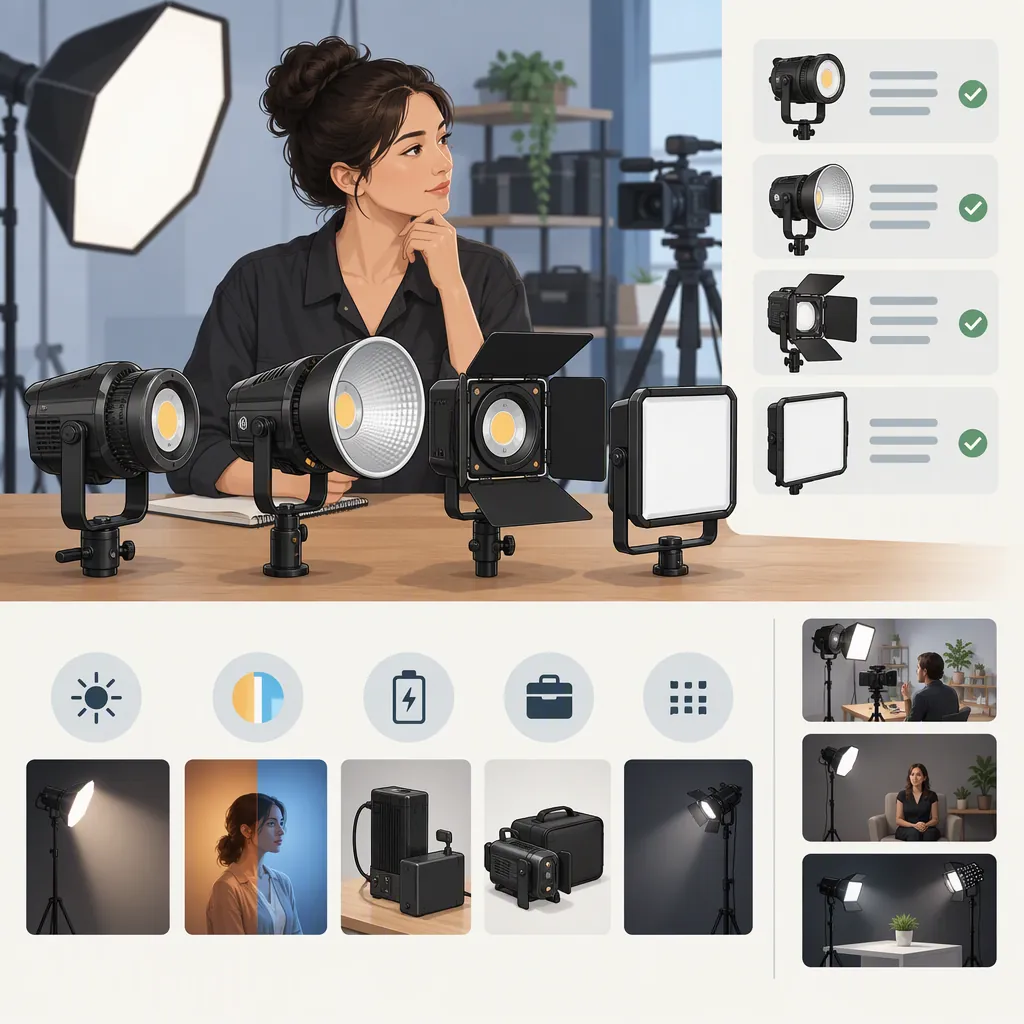
How to Choose a Godox 100W Light for Filming
Choose a Godox 100W filming light by matching the exact model, power arrangement, modifier compatibility, and tested performance to your shot—not by wattage alone. Keep a candidate under consideration when its documented specifications meet your requirements; leave unresolved compatibility questions open until verified; rule it out for that setup if it cannot meet your requirements.
The ML100Bi manufacturer page documents a 2800–6500K color-temperature range, alternative power options, and a Godox-mount accessory system with a Bowens adapter option. The shared SL100D/SL100Bi page identifies both models but does not provide enough detailed specifications in its text for a reliable performance comparison. Neither source establishes which light will adequately illuminate your scene. [c1] [c2]
Start with the Exact Model and Your Requirements
Treat “Godox 100W” as a search category, not a complete specification. The manufacturer pages considered here cover the ML100Bi and SL100D/SL100Bi. Do not assume that similarly named lights share mounts, controls, battery support, or output. [c1] [c2]
Before comparing candidates, record:
- Exact model and edition: Include the full name rather than “Godox 100W.”
- Filming setup: Desk video, interview, location shoot, or another specific use.
- Required light position: Subject distance and any space restrictions.
- Camera requirements: Target exposure, aperture, shutter speed, and acceptable ISO range.
- Power arrangement: Outlet, battery, or power bank, including required operating time.
- Modifier: The actual reflector, softbox, or diffusion you intend to use.
- Audio requirement: Acceptable recorded background noise with the microphone in position.
- Kit contents: Included accessories and anything needed separately.
Evidence boundary: This guide uses the two cited manufacturer pages, not hands-on testing or independent measurements. Their available text differs in detail: several SL100D/SL100Bi specifications remain unconfirmed here. An unknown entry does not mean a feature is absent. The sources do not establish comparative brightness, fan noise, reliability, or value. [c1] [c2]
What the Manufacturer Pages Establish
| Selection factor | ML100Bi | SL100D/SL100Bi |
|---|---|---|
| Color temperature | Technical table lists 2800–6500K. [c1] | Not stated in the cited page text. [c2] |
| Power specifications | Technical table lists 20V DC, 6A, and approximately 110W maximum input. [c1] | Not stated in the cited page text. [c2] |
| Alternative power | Page describes 14.8V V-mount battery and power-bank operation. [c1] | Not stated in the cited page text. [c2] |
| Modifier information | Page describes Godox-mount accessories and expansion through a Bowens mount adapter. [c1] | Page lists optional accessories, including Bowens mount softboxes; detailed compatibility is not provided. [c2] |
| Manuals | Page lists manual downloads, including an entry covering a 2026 edition. [c1] | Page lists separate manual downloads for SL100D and SL100Bi. [c2] |
These entries are manufacturer statements, not independently verified results. In particular, a listed accessory or power option is a starting point for checking the complete configuration, not a guarantee that every modifier, battery, or power bank will work.
Turn Requirements into a Shortlist
Use the following conditions to decide which candidates to retain, which need more information, and which do not fit your planned setup.
| Your requirement | Already supported by the cited pages | Still needs confirmation | How the result affects selection |
|---|---|---|---|
| Mobile operation without an outlet | ML100Bi page describes 14.8V V-mount battery and power-bank operation. [c1] | Exact battery or power-bank compatibility, cables, mounting, available brightness, and runtime; SL model power options. | Retain a candidate only after confirming a complete power arrangement that meets your shooting duration and exposure needs. |
| Reuse existing Bowens modifiers | ML100Bi page describes a Bowens adapter route. The SL page lists Bowens mount softboxes as optional accessories. [c1] [c2] | Exact fixture interface, adapter requirements, fit, and physical support for your modifier. | Keep compatible configurations under consideration. If the required modifier cannot be fitted and supported, exclude that configuration. |
| Adjust color temperature for the scene | ML100Bi technical table lists 2800–6500K. [c1] | The adjustment needed for your scene, the exact SL model’s range or behavior, and the recorded visual match. | Compare your required setting with the confirmed range. If a candidate cannot provide the adjustment you need, exclude it unless your lighting plan changes. |
| Light a subject through diffusion at a fixed distance | These pages do not establish comparable output under your shooting conditions. [c1] [c2] | Exposure with the actual modifier, distance, ambient light, and camera settings. | Retain the candidate if it reaches your target within your allowed camera settings. Record any remaining brightness headroom. |
| Record dialogue near the light | Comparative fan-noise performance is not established by these sources. [c1] [c2] | A recording with the intended light setting, microphone position, and room conditions. | Retain it if the recorded noise meets your requirement. If it does not, test feasible placement changes or exclude it for that setup. |
This process does not establish that one model is universally better. It identifies which configurations meet a particular filming need and which remain unverified.
Test Against Defined Pass Conditions
A short clip is useful only if you know what would count as acceptable. Define your requirements before testing rather than deciding afterward that a result is “bright enough” or “quiet enough.”
Before the Test
Record your own pass conditions:
- Target exposure and how you will judge it: ______
- Required aperture and shutter speed: ______
- Allowed ISO or ISO range: ______
- Required light-to-subject distance: ______
- Intended modifier and framing: ______
- Required color-temperature setting or visual match: ______
- Acceptable recorded background noise: ______
- Required operating time on the intended power source: ______
There is no universal pass threshold established by the cited sources. Use criteria appropriate to your production.
Filming Setup Test
- Fix the camera framing, shutter speed, aperture, ISO, and white balance.
- Position the subject, light, modifier, and microphone as required by the shot.
- Record the ambient-light conditions, light distance, color-temperature setting, and power configuration.
- Adjust brightness to try to reach your target exposure without exceeding your allowed camera settings.
- Record a short clip and review exposure, shadows, reflections, color appearance, and recorded noise.
- Note whether the target was reached and whether brightness adjustment remains available above the setting used.
- Repeat with the intended location power source, if relevant. Separately check operation over your required shooting duration.
- Record a result for each requirement: met, not met, or unresolved.
When comparing candidates, keep the framing, exposure settings, light distance, ambient conditions, and modifier configuration the same where possible. If a different mount requires a different accessory arrangement, document that difference rather than treating the results as identical test conditions.
A candidate that passes your requirements can remain on the shortlist. A failed requirement calls for a feasible setup change or exclusion; an unresolved requirement is not a pass.
Read the Specifications with Caution
The ML100Bi page’s descriptive copy states a maximum power of 100W, while its technical table lists approximately 110W maximum input power. These are differently labeled figures; neither is a measured brightness comparison. [c1]
The same page describes a weight of 487g, while the table lists approximately 530g excluding the lens reflector. Its descriptive copy and table also report different CRI figures. The page text does not resolve these discrepancies. Confirm specifications for the exact edition when planning transport, power, or color-sensitive work. [c1]
Do not convert a wattage label into assumed usable output. For a meaningful output comparison, look for measurements made at the same distance, with the same modifier, color-temperature setting, and measurement method. Comparable measurements of that kind are not established by these sources. [c1] [c2]
FAQ
Is a Godox 100W Light Enough for Filming?
Wattage alone cannot answer that. Test the exact light at your required distance, with your modifier, ambient light, and camera settings. Keep it under consideration if it reaches your target exposure within your allowed settings and meets your audio and power requirements. The cited pages do not establish scene coverage for your setup. [c1] [c2]
Can the Ml100bi Run from a Power Bank?
The manufacturer page describes power-bank operation using a USB-C cable and a separately purchased power bank. It does not specify the required power-bank output profile or runtime in the available text. Verify the exact power bank and cable configuration, then check exposure and operating duration before relying on it for a shoot. [c1]
Can I Use an Existing Bowens Softbox?
The ML100Bi page describes using a Bowens mount adapter, while the SL100D/SL100Bi page lists Bowens mount softboxes among optional accessories. Confirm the exact model’s interface, any required adapter, and support for your particular softbox before treating it as compatible. [c1] [c2]
Should I Choose the SL100D or Sl100bi?
These sources do not establish a better choice between them. Check each exact model’s color-temperature behavior, power requirements, modifier compatibility, output, and noise against your requirements. The shared manufacturer page identifies both models and provides separate manual downloads, but its text lacks the operating specifications needed to resolve that comparison here. [c2]