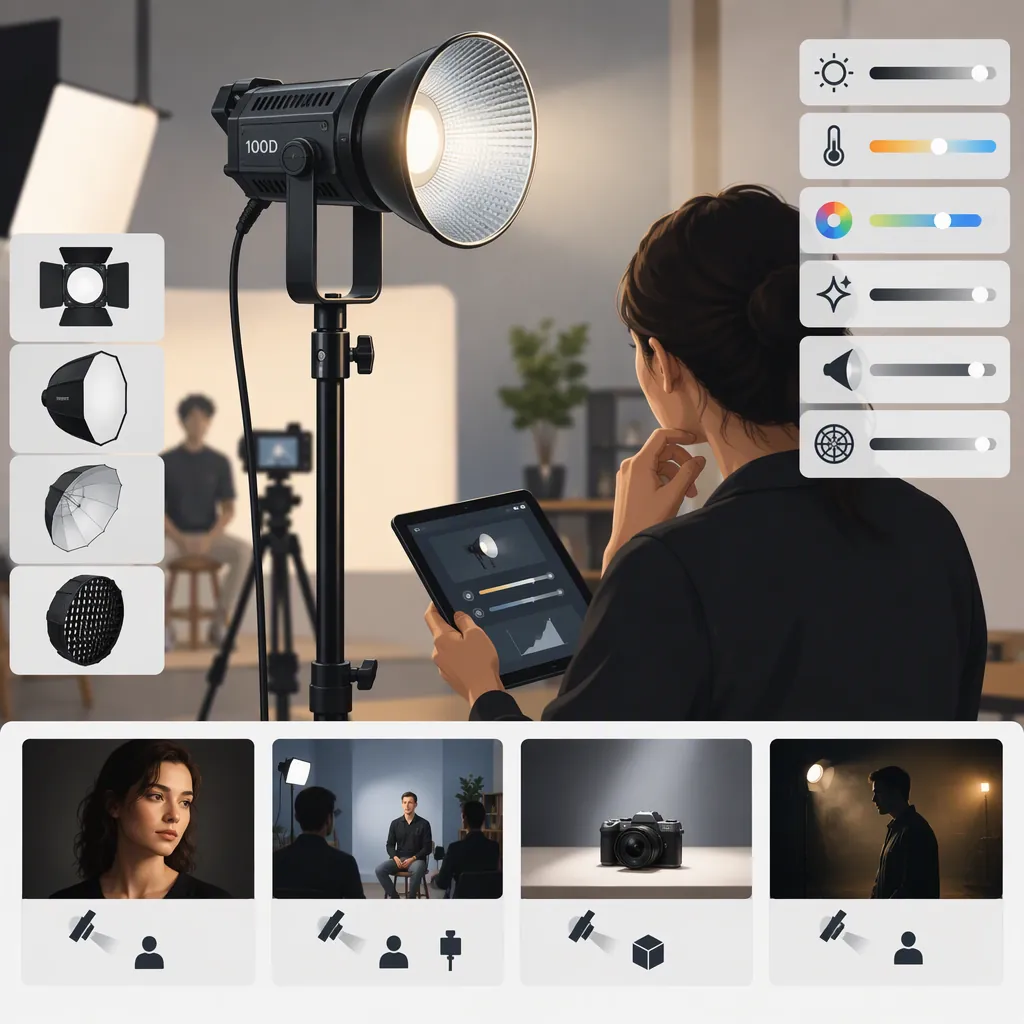
Godox 100D: How to Choose a Light for Filming
For a “godox 100d” search, first confirm the exact model, then evaluate it against your filming requirements: exposure, color, modifiers, recorded sound, power, and mounting. Set your requirements before comparing candidates, and distinguish confirmed results from unresolved questions.
The supplied Newsshooter reference names the Godox SL100D and SL100Bi; it does not establish “100D” as a complete model name. Confirm the fixture label, manual, and listing before applying information about either model. [src-1]
Define What Your Filming Setup Must Achieve
Start with the scene rather than a wattage label or an isolated output figure. Write down the requirements that cannot change—for example, the camera settings, available lighting space, visible room lamps, microphone position, or location power.
Use the same brief for every candidate.
| Filming need | Define before comparing | Check in the planned setup |
|---|---|---|
| Seated interview | Framing, subject position, intended exposure, and facial lighting | Whether the chosen modifier and light position produce the required image |
| Room with existing lamps | Which lamps or windows remain in the shot and the intended color relationship | Subject and background color together, using fixed white balance |
| Product close-up | Which surfaces and details must remain visible | Reflections, highlight transitions, and retained surface detail |
| Dialogue recording | Microphone position and acceptable background noise | Dialogue and a quiet passage recorded with the light operating |
| Location filming | Available power, setup space, support, and cable route | Compatibility with the site and the relevant equipment instructions |
| Motion or slow-motion footage | Intended frame rate and shutter setting | Any visible flicker or banding in recorded footage |
These are general selection criteria, not verified capabilities of the SL100D or another specific light.
Turn Requirements into Decision Rules
Decide what counts as a pass before reviewing candidates. A useful requirement is specific enough to explain a rejection: “retain detail on the product label at the planned camera settings” is more actionable than “look good.”
Apply these rules:
- Identity unresolved: Pause the comparison until the exact model and relevant accessories are confirmed.
- Power or mounting unresolved: Do not treat the setup as ready for use. Check the exact-model instructions and the planned support arrangement.
- Target exposure not achieved: Reassess the candidate or the layout. If you change distance, modifier, or camera settings, record that as a different configuration rather than an equivalent test.
- Color or reflections fail the brief: Record the specific problem and test one permitted adjustment at a time. Reject the configuration if solving it would violate a non-negotiable requirement.
- Visible flicker or recorded noise is unacceptable: Do not accept the configuration for that recording mode without a successful retest.
- All essential requirements pass: Retain the candidate for comparison on secondary considerations such as setup space and included accessories.
- An essential requirement remains untested: Mark it unresolved, not passed.
A candidate need not be suitable for every production. The decision is whether a particular configuration meets the requirements of your scene.
Run a Repeatable Filming Test
Evaluate the complete setup: light, modifier, support, camera, microphone, and location. Before testing, confirm accessory compatibility and follow the relevant mounting and operating instructions.
1. Fix the Recording Conditions
Record and keep consistent:
- Frame rate and shutter speed or shutter angle
- ISO, aperture, and any ND filtration
- White balance and tint
- Lens, framing, and camera recording profile
- Subject position, light position, and subject-to-light distance
- Modifier and its position
- Existing room lighting and window-light conditions
- Microphone position, recording gain, and audio processing settings
Use manual exposure and fixed white balance for the comparison rather than allowing automatic settings to change between takes. Change only the variable you are evaluating. If environmental conditions change substantially, repeat the comparison under consistent conditions.
2. Record the Intended Scene
- Set the planned framing and camera settings.
- Place the subject, light, and modifier in their intended positions.
- Adjust the light to the required exposure and record its control settings. If comparing output at a fixed setting instead, state that separately.
- Film the subject with a neutral reference and representative colors.
- Include important reflective surfaces or fine details in the shot.
- Record movement at the intended frame rate and shutter setting.
- Record dialogue and a quiet passage with the microphone in its working position.
- Repeat with the next candidate while preserving the comparison conditions.
3. Review Against the Brief
Use the same monitoring and playback settings for each take. Check:
- Exposure: Does the subject meet the intended exposure without losing required highlight or shadow detail?
- Color: Is the subject’s color relationship with the background acceptable under the fixed white balance?
- Reflections: Are important surfaces readable, with the highlight shape and transitions you intended?
- Temporal artifacts: Is there visible flicker or banding at the recording settings you will use?
- Audio: Is equipment noise acceptable during both dialogue and quiet passages?
- Practical fit: Can the documented setup be mounted and powered as required at the location?
If a result fails, note the observed problem before making changes. Retest one variable at a time so the comparison shows which adjustment helped.
If You Cannot Test the Light Before Choosing
When borrowing, renting, or otherwise accessing the exact equipment is not possible, use a documentation-first comparison:
- Confirm identity. Match the full model name and any version suffix across the listing and corresponding documentation.
- Check the package. Record which accessories are explicitly included and which your setup would still require.
- Check practical compatibility. Use exact-model documentation to verify power requirements, mounting arrangements, and modifier compatibility.
- Evaluate public tests for relevance. Prefer tests that disclose camera and lens settings, subject distance, modifier, light settings, and recording conditions. For audio comparisons, look for microphone position and gain information.
- Keep evidence gaps visible. A test with undisclosed conditions should not resolve a requirement that depends on those conditions.
Documentation can help establish compatibility, and a transparent public test can inform a comparison. Neither guarantees the result in your own scene. If an essential requirement remains uncertain, keep the selection provisional.
Use One Selection Worksheet
Complete one worksheet per candidate and configuration. Keep documentation-based findings separate from observations made in your own test.
| Field | What to record |
|---|---|
| Exact equipment | Full model, version suffix, modifier, support, and included accessories |
| Scene brief | Intended shot and non-negotiable requirements |
| Camera conditions | Lens, frame rate, shutter, ISO, aperture, ND, white balance, tint, and recording profile |
| Physical conditions | Framing, subject position, light position, distances, modifier, and ambient light |
| Audio conditions | Microphone, position, gain, and processing |
| Requirement | The specific result or compatibility condition needed |
| Evidence | Exact-model documentation, dated public test, or your own test |
| Observation | What the evidence actually establishes; include footage or audio file names where available |
| Status | Passed / failed / unresolved |
| Adjustment | One change to test next, if allowed by the brief |
| Decision | Retain / reassess configuration / defer / reject, with the reason |
Make the final decision from the essential requirements first. Do not average away a failed power, mounting, exposure, or recording requirement because other aspects look promising. If multiple candidates pass, compare them within the same scene brief rather than claiming one is universally better.
Understand the Source Limits
The supplied Newsshooter article, “Godox SL100D Daylight & SL100Bi Bi-Color LED Lights,” was published in June 2021 and contains reported specifications and launch pricing. It provides historical naming and announcement context, not evidence of current price, availability, or performance in your filming setup. [src-1]
This guide does not rank those models or assert their output, noise level, reliability, or suitability. Keep three categories distinct: what a source reports, what exact-model documentation confirms, and what a controlled test demonstrates.
FAQ
Does “Godox 100D” Definitely Mean SL100D?
Not on the supplied evidence alone. The reference names the SL100D and SL100Bi, so check the full model on the fixture, listing, and manual before using its information. [src-1]
How Should I Compare Daylight and Bi-Color Options?
Define the color relationship your scene needs, including any room lamps or window light that must remain. Compare recorded results with fixed white balance and consistent camera settings. Treat color-adjustment flexibility as a requirement to verify, not a substitute for evaluating the image.
Is the SL100D Enough for My Filming Setup?
The supplied announcement does not establish that. Evaluate the exact model with your intended modifier, distance, camera settings, and microphone placement. It should meet all essential exposure, color, recording, power, and mounting requirements before you treat that configuration as suitable.
What If I Cannot Test It Before Choosing?
Confirm the full model and accessory list, check the corresponding documentation, and look for public tests with disclosed conditions relevant to your scene. Mark any requirement those materials cannot establish as unresolved. Do not present a documentation-only assessment as a demonstrated filming result.
Does the Reference Establish a Current Price?
No. It reports pricing in a June 2021 announcement; that is historical context, not evidence of a current price or availability. [src-1]