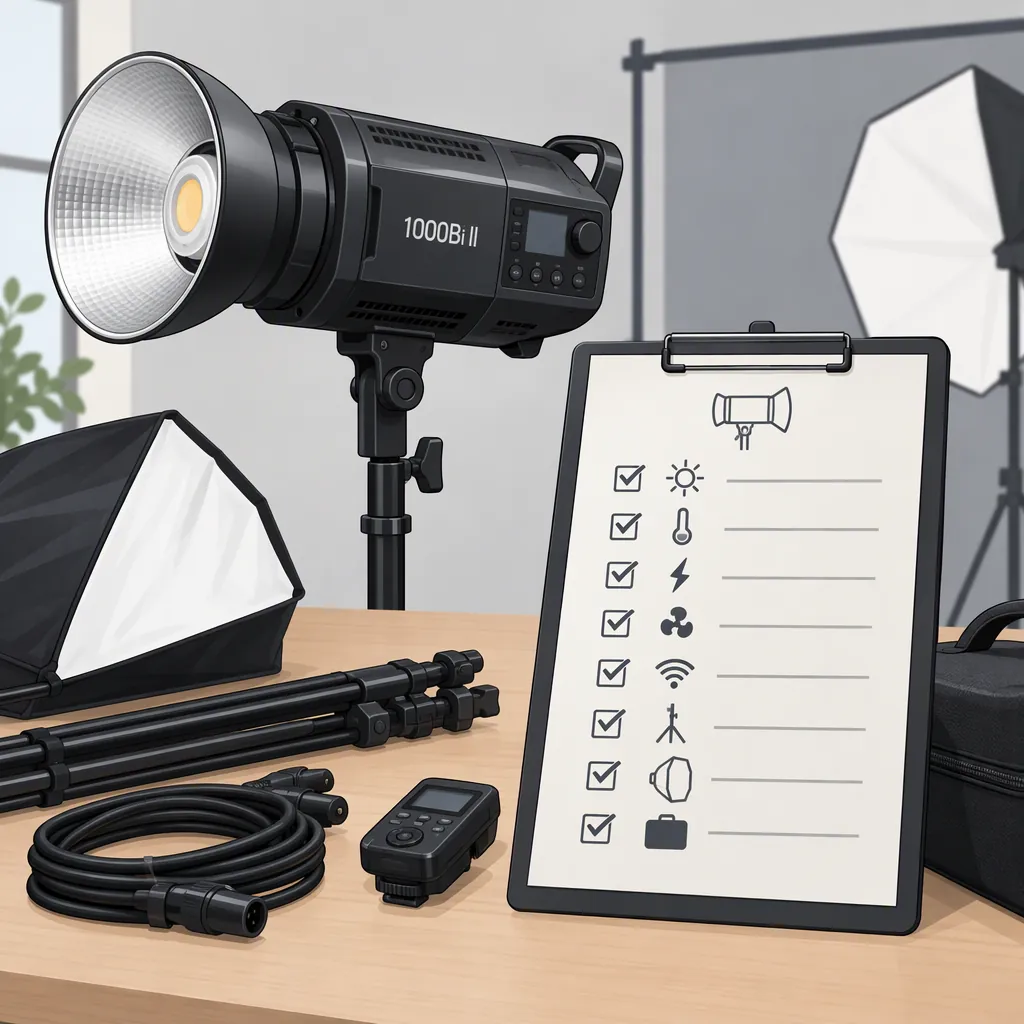
Choosing the Godox 1000 Bi Ii for a Filming Setup
Evaluate the Godox 1000 Bi II against your shooting distance, camera settings, color requirements, power plan, and mounting arrangement. The supplied reference identifies it as the Godox LED1000Bi II Bi-Color Video LED Light Panel, but it is a retailer listing—not an independent performance test or proof of suitability for your production. [source_1]
The selection process is to define your must-have requirements, gather evidence for the exact model, and test the intended setup where possible. If an essential requirement fails, the fixture does not fit that setup. If an essential requirement remains unresolved, defer the suitability decision. This guide provides a selection method, not a product recommendation.
Confirm the Exact Model and Evidence
The search phrase “godox 1000 bi ii” is abbreviated; the supplied retailer page uses the name Godox LED1000Bi II Bi-Color Video LED Light Panel. Use that full designation when checking documentation and equipment labels. [source_1]
Before evaluating a particular unit, record its model designation, the accessories actually present, and any available operating documentation. Do not assume that a similarly named fixture or a different package has the same capabilities or contents.
Evidence limitation: The supplied material consists of one retail listing. No manufacturer manual, independent measurements, or comparative test results were provided. This article does not validate advertised specifications, current availability, or package contents.
Model Verification Record
- Model name on fixture: ______
- Model name in documentation: ______
- Accessories physically present or documented for the specific package: ______
- Power requirements confirmed from operating documentation: ______
- Mounting instructions available: ______
- Unresolved differences between listing, documentation, and unit: ______
Define the Shot Before Comparing Lights
Write down what the light must accomplish before judging it. For an interview, specify the subject position, framing, desired shadow pattern, and background exposure. For tabletop work, specify the object size, surface reflections, and camera angle.
Separate must-have requirements from preferences. A required power arrangement or acceptable recording behavior may determine whether the fixture can be used at all; a preference such as shorter setup time can help distinguish candidates that already meet the essentials.
Set acceptance criteria before reviewing results. These criteria should come from your production requirements, not from an assumed universal threshold. For example:
- Exposure: At the planned light position, aperture, and ISO, the subject reaches the project's predetermined monitoring exposure target, with any required adjustment margin.
- Appearance: Skin tones or object colors, reflections, and shadows meet the project's reference or review criteria under the intended white balance and ambient lighting.
- Recording behavior: No banding or brightness variation that would affect delivery is observed at the planned frame rates, shutter settings, and light settings.
- Audio: The working microphone recording meets the project's noise requirements with the lighting setup operating.
If you compare alternatives, give each candidate the same task. Record placement, camera settings, fixture settings, and modifiers so differences in the results are interpretable.
Shot Requirements Worksheet
- Scene and subject: ______
- Intended lighting role: key / fill / background / other
- Camera, lens, and framing: ______
- Frame rate and shutter setting: ______
- Target aperture and ISO: ______
- Available placement distance and clearance: ______
- Desired shadow and reflection appearance: ______
- Exposure target and required adjustment margin: ______
- Must-have requirements: ______
- Preferences: ______
- Acceptance criteria agreed before testing: ______
If You Cannot Test the Fixture Yet
Not having access to the Godox 1000 Bi II does not prevent an initial assessment, but it limits the conclusion you can draw. Use a documentation-and-evidence check rather than treating missing information as a pass.
- List the essentials. Identify the exposure task, permitted placement, power arrangement, support equipment, recording settings, operating duration, and controls your production requires.
- Request documentation for the exact model. Ask the equipment provider for operating instructions, power requirements, interface details, mounting instructions, and an itemized account of the accessories supplied with the particular unit.
- Request relevant test records. For image or recording requirements, ask for records that specify subject distance, camera settings, white balance, fixture settings—including dimming and color settings where applicable—and modifiers used. A demonstration without those conditions is not enough to reproduce the result.
- Check how closely the evidence matches your setup. Record differences in distance, ambient light, camera settings, modifiers, and intended use. Treat unmatched conditions as limitations, not as proof of performance in your scene.
- Assign unresolved checks to a planned verification stage. State what must be checked, when it will be checked, and what happens if it fails.
Resolve safe power and mounting questions before operating the unit. Resolve essential interface or accessory compatibility before depending on it in a production plan. Image appearance, recording artifacts, and audio suitability can remain scheduled for a pre-production or setup test only if there is time to evaluate them and a workable fallback.
An essential check deferred to a later test is still unresolved. It does not justify an unconditional suitability conclusion. If there is no opportunity to verify a must-have requirement before relying on the fixture, the appropriate decision is “insufficient evidence.”
Evidence Request Checklist
- Exact model and operating documentation: ______
- Power and mounting details: ______
- Required interfaces and compatible accessories: ______
- Contents of the specific package or unit: ______
- Test footage or measurements with recorded conditions: ______
- Differences between supplied evidence and planned use: ______
- Essential gaps to resolve before selection: ______
- Checks scheduled for setup, with fallback plan: ______
Check Exposure, Color, and Recording Behavior
If access to the fixture is possible, evaluate it in the intended setup rather than relying on a general demonstration.
- Position the subject, camera, and light as planned.
- Select the intended exposure settings and lock white balance for each comparison.
- Record a baseline without the fixture, then record with it at the settings you expect to use.
- Repeat with any intended diffusion or other modifier in place.
- Review exposure, skin tones or object colors, reflections, shadow edges, and background balance against your prewritten criteria.
- Record at the frame rates, shutter settings, and dimming levels relevant to the production. Inspect the footage for visible banding or brightness variation.
- With the microphone in its working position, record room tone and listen for unacceptable noise against the project's audio criteria.
- Record the result and any limitation of the test, including conditions that were not checked.
Treat the result as evidence for the conditions tested, not as a universal performance verdict. If a test is not possible, use the evidence-request process above and leave the requirement unresolved.
Repeatable Test Log
Fill in the acceptance criteria before testing. The examples below are not claims about this model and do not set universal performance thresholds.
| Test item | Conditions to record | Acceptance criterion | Observed result | Requirement result |
|---|---|---|---|---|
| Subject exposure | Distance, aperture, ISO, fixture settings | Subject reaches the project's monitoring target with required adjustment margin | ______ | Meets / Does not meet / Unresolved |
| Color and appearance | White balance, ambient light, subject, fixture settings | Recorded colors, reflections, and shadows meet the agreed project reference | ______ | Meets / Does not meet / Unresolved |
| Modified light | Modifier, placement, exposure settings | Intended appearance and exposure criteria remain satisfied | ______ | Meets / Does not meet / Unresolved |
| Recording artifacts | Frame rate, shutter, dimming and other relevant settings | No observed banding or brightness variation that affects delivery | ______ | Meets / Does not meet / Unresolved |
| Audio suitability | Microphone position, recording settings, room conditions | Recording meets the project's noise requirements | ______ | Meets / Does not meet / Unresolved |
Check Power, Mounting, and Workflow
Separate image requirements from operational requirements. A satisfactory test frame does not complete the evaluation.
Verify the permitted power arrangement and mounting procedure against documentation for the exact unit. Check the support equipment's load rating, cable routing, placement clearance, and stability before use. Do not infer compatibility from connector appearance alone.
For the intended operating duration, document the proposed power source and how duration will be verified. Do not assume that a brief demonstration establishes suitability for a full session.
List the controls your workflow requires, such as local adjustment or integration with an existing control system. Confirm the necessary connections, accessories, and operating procedures rather than assuming the fixture supports them.
Also record practical constraints: space for the fixture and support, access to controls, transport requirements, and setup time. These should be assessed separately from the recorded image.
Selection Decision Record
Keep evidence status separate from requirement result. Having documentation does not necessarily mean a requirement is met; a documented limitation may show that it is not.
| Requirement | Must-have or preference | Evidence and conditions | Requirement result |
|---|---|---|---|
| Exposure and appearance | ______ | ______ | Meets / Does not meet / Unresolved |
| Recording behavior | ______ | ______ | Meets / Does not meet / Unresolved |
| Audio suitability | ______ | ______ | Meets / Does not meet / Unresolved |
| Power compatibility and duration | ______ | ______ | Meets / Does not meet / Unresolved |
| Mounting and support | ______ | ______ | Meets / Does not meet / Unresolved |
| Required controls and accessories | ______ | ______ | Meets / Does not meet / Unresolved |
| Transport and setup constraints | ______ | ______ | Meets / Does not meet / Unresolved |
For each evidence entry, note whether it comes from exact-model documentation, a relevant test, or an unverified description.
Turn the Checks into a Selection Decision
Use the same rules for the Godox 1000 Bi II and any alternative:
- A must-have requirement does not meet the criterion: The fixture is not suitable for the current plan unless the plan is revised and reassessed.
- A must-have requirement is unresolved: Defer the suitability conclusion and identify the evidence or test needed.
- All must-have requirements meet their criteria: A conditional conclusion is appropriate: “suitable for the documented and tested setup.”
- Only preferences differ: Compare those trade-offs without treating them as proof of overall superiority.
Record the conditions attached to the decision, including placement, camera settings, modifiers, power source, and any remaining checks. If those conditions change, reassess the affected requirements.
The supplied retailer listing alone does not establish comparative superiority or a tested fit for your production. [source_1]
FAQ
What Model Does “Godox 1000 Bi Ii” Refer to Here?
This guide uses the supplied reference titled “Godox LED1000Bi II Bi-Color Video LED Light Panel.” Confirm that exact designation on the unit and its documentation before applying the checklist. [source_1]
Is It Suitable as an Interview Key Light?
That remains unverified from the supplied evidence. Assess it at your intended subject distance, exposure settings, placement, and diffusion arrangement, using acceptance criteria set before testing.
If you cannot access the fixture, request exact-model documentation and relevant test records with their shooting conditions. Keep exposure, appearance, recording behavior, and audio suitability unresolved until the evidence addresses your requirements. The retailer listing identifies the model but does not establish that it meets your interview setup's criteria. [source_1]
How Should I Compare It with Another Fixture?
Use the same scene, framing, camera settings, and acceptance criteria. Document each fixture's placement, settings, and modifiers. Compare both the recorded result and practical requirements such as power, support, controls, and setup time.
Evaluate must-have requirements first, then preferences. Leave untested requirements unresolved rather than declaring an overall winner.
Which Checks Can Wait Until Setup?
Scene-dependent appearance, recording artifacts, and audio checks may be scheduled for setup if there is enough time to test them and a fallback is available. They remain unresolved until that test is complete.
Power and mounting safety must be established before operation. Essential compatibility questions should be resolved before relying on the fixture. If a must-have check cannot be completed before use, do not describe the fixture as confirmed suitable.
Does the Retailer Listing Replace an Operating Manual or Test?
No. The supplied source is a retail product listing, not an operating manual or independent performance test. Use it to identify the referenced model, then seek exact-unit documentation and evidence appropriate to the planned use. [source_1]