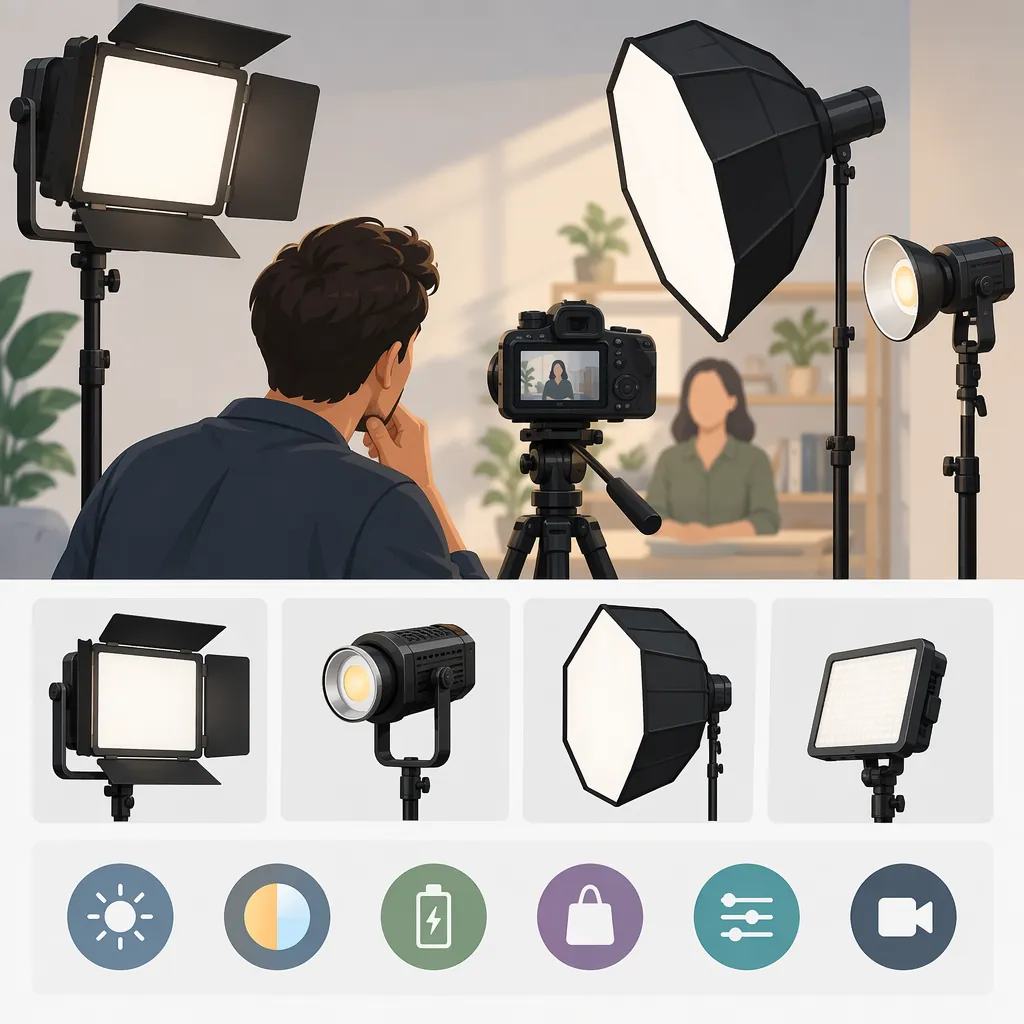
How to Choose the Best Godox Light for Video
The best Godox light for video is the one that meets your filming requirements—not necessarily the one with the strongest review headline. The available references do not establish an overall winner across the Godox range. [c1] [c2] Start with your scene, recorded audio, available space, modifiers, and power access; then compare candidates against the same requirements.
Define What “Best” Means for Your Video
Before comparing model names, identify what your setup must accomplish and which constraints you cannot change.
| Filming Task | Selection Priorities |
|---|---|
| Seated interviews | Repeatable face lighting, room for the intended modifier, and acceptable operating noise at the actual microphone position |
| Desk videos | A light, modifier, and support arrangement that fits outside the frame without blocking the workspace |
| Product filming | Suitable coverage, reflection control, and shadow placement across the object |
| Location filming | Documented power options, transport requirements, setup time, and safe mounting |
| Combined photo and video work | Separate acceptance criteria for still photography and video |
These are selection criteria, not findings that any particular Godox model meets them.
Filming Requirements Worksheet
Complete this before building your shortlist:
- Main filming task: ____
- Subject size and framing: ____
- Available light-to-subject distance: ____
- Existing room or window light: ____
- Camera settings you need to maintain: ____
- Required color adjustment or matching: ____
- Microphone position and acceptable recorded noise: ____
- Power available and required recording duration: ____
- Modifier and stand space: ____
- Maximum total budget, including accessories: ____
- Nonnegotiable requirements: ____
Separate hard requirements from preferences. A setup that cannot meet your required exposure, audio, power, space, or budget conditions should not advance to the final comparison. Preferences help distinguish candidates that pass those requirements.
Godox Candidates: What the Evidence Supports
The supplied Amazon page names the P120C, FV150, M32, and SL-200W. It provides starting points for investigation, not a standardized comparison of video performance. [c1]
| Candidate | Supplied Source | Evidence Type | What Still Needs Verification |
|---|---|---|---|
| P120C | Amazon listing [c1] | Retailer-page mention | Exact-version documentation, required exposure, color controls, power arrangement, mounting, and recorded noise |
| FV150 | Amazon listing and Erin Donahue article [c1] [c2] | Retailer-page mention plus an individual studio-use account | Exact-version documentation, accessory compatibility, and performance in your intended video configuration |
| M32 | Amazon listing [c1] | Retailer-page mention | Exact-version documentation, required exposure, color controls, power arrangement, mounting, and recorded noise |
| SL-200W | Amazon listing [c1] | Retailer-page mention | Exact-version documentation, required exposure, color controls, power arrangement, mounting, and recorded noise |
The table is not a ranking or a complete catalog of Godox video lights. Use each name as a candidate record, then check it against your worksheet.
Evidence Limits
The Amazon page includes availability labels, but the supplied extract is not a live inventory check. It also does not establish which listed model performs best for video. [c1]
Erin Donahue’s FV150 article describes the author’s home-studio use for still photography and video and discloses possible affiliate links. Its favorable assessment is an individual account, not comparative proof. [c2]
No manufacturer manuals, standardized test reports, or broad model comparisons are included here. This guide therefore does not verify individual models’ current specifications, compatibility, measured output, or operating noise.
Turn Candidate Information into a Shortlist
For each candidate, record the exact model and version, then assign every hard requirement one of three statuses:
- Pass: Documentation or a relevant test establishes that the requirement is met.
- Fail: Documentation or testing shows that the requirement is not met.
- Unknown: Evidence is missing, unclear, or does not cover your intended configuration.
Keep unknown candidates in a verification queue—not in the final shortlist. If a hard requirement cannot be verified, set that candidate aside until the gap is resolved. This is an evidence decision, not a claim that the model is unsuitable.
| Decision Area | Requirement to Set Before Comparing | Decision Rule |
|---|---|---|
| Exposure | Intended distance, modifier, framing, and camera settings | Pass only if the tested setup delivers the exposure you need without changing required conditions |
| Light shaping and space | Required modifier, attachment, support, and usable footprint | Fail if the documented assembly cannot fit or be safely supported; mark unclear compatibility as unknown |
| Color control | Required adjustment or matching and an acceptable recorded result | Pass only when the necessary controls are verified and the footage meets your criterion |
| Audio | Microphone placement, recording levels, and acceptable operating noise | Fail if recorded noise exceeds your acceptance criterion in the intended setup |
| Power | Available supply and required recording duration | Pass only when the documented arrangement covers the location requirements; leave unverified duration unknown |
| Handling | Mounting, positioning, transport, and setup constraints | Fail if the complete assembly cannot meet a hard handling requirement |
| Total cost | Maximum cost of the light and all required accessories | Fail if the complete setup exceeds the budget; mark missing accessory costs as unknown |
For video-only work, do not give extra weight to still-photo functions you will not use. For mixed work, maintain separate photo and video checklists. The FV150 article’s mixed-use context may make it relevant to investigate, but it does not replace those checks. [c2]
Use a Repeatable Camera and Audio Test
For candidates you can evaluate, test the intended filming configuration rather than judging brightness by eye.
- Build the actual setup. Position the subject, camera, microphone, light, and intended modifier.
- Fix the comparison conditions. Keep camera exposure settings, white balance, framing, and ambient light consistent.
- Record the configuration. Note the light’s exact version, position, distance, operating settings, and accessories.
- Capture representative footage. Include the frame rates and shutter settings you plan to use, including any slow-motion mode.
- Review the image. Check exposure, shadows, reflections, color appearance, and visible flicker against your acceptance criteria.
- Compare recorded sound. Record with the light operating and with it off, keeping microphone position and recording levels unchanged.
- Repeat relevant settings. Test other output or color settings that the shoot requires.
A pass applies only to the tested configuration. It does not establish performance at every distance, frame rate, modifier, or operating mode.
Candidate Test Log
- Candidate and exact version: ____
- Camera, frame rate, shutter setting, aperture, and ISO: ____
- White balance and ambient-light conditions: ____
- Modifier and mounting arrangement: ____
- Light position and distance: ____
- Output and color settings: ____
- Exposure: pass / fail / unknown
- Shadows, reflections, and coverage: pass / fail / unknown
- Color appearance: pass / fail / unknown
- Visible flicker: pass / fail / unknown
- Recorded operating noise: pass / fail / unknown
- Power arrangement and duration tested: ____
- Complete setup cost: ____
- Untested conditions and remaining questions: ____
Make the Final Selection
Use the completed records in this order:
- Remove candidates that fail a hard requirement.
- Resolve unknowns before treating a candidate as qualified.
- Compare candidates that pass under equivalent conditions.
- Use preferences to break ties: available workspace, setup convenience, transport, or total cost within budget.
- Record why the selected setup fits the task and which conditions remain untested.
The useful outcome is a task-specific choice—for example, a setup that passes your interview exposure and audio tests within the available space and budget. That is more defensible than declaring a universal model winner.
FAQ
Which Godox Light Is Best for Video?
The available references do not establish an overall winner: they provide a retailer listing and an individual FV150 studio-use article. [c1] [c2] Choose the candidate that passes your exposure, audio, power, space, and budget requirements in the intended configuration.
Should I Put the Fv150 on My Shortlist?
It is a candidate to investigate, particularly if you need both still photography and video, because that is the workflow discussed in Erin Donahue’s article. The article does not prove that it is better than other Godox models or that it meets your setup’s requirements. [c2]
How Should I Compare the P120c, M32, and Sl-200w?
The supplied Amazon page names these models but does not provide a standardized performance comparison. [c1] Create a separate record for each, verify exact-version documentation, and use the same pass/fail/unknown checklist. Do not infer suitability from the model name alone.
What Should I Do When a Specification or Test Result Is Missing?
Mark it unknown, not pass. Keep the candidate out of the final shortlist until a hard requirement is verified. Missing information does not prove poor performance; it means the selection decision is not yet supported.
Can the Amazon Listing Confirm Current Availability?
Not from the supplied extract alone. Its availability labels are not a live inventory check. Use it to identify candidate names, not to confirm current stock or suitability. [c1]