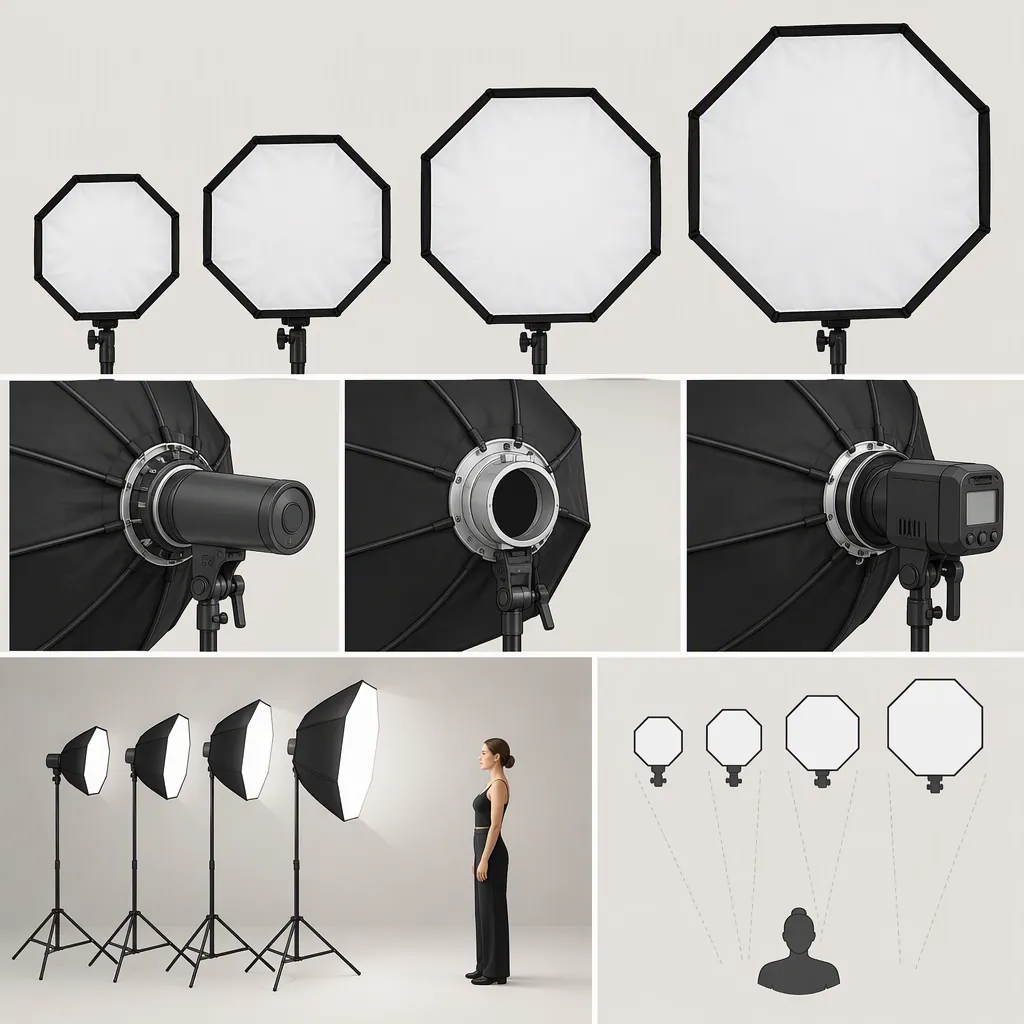
Choosing an Elinchrom Octa for Your Lighting Setup
Choose an Elinchrom Octa by its exact model, mounting arrangement, and assembled dimensions—not the Octa name alone. The supplied sources cover a 69-inch Rotalux softbox, a 150 cm Rotalux Indirect Deep Inverse Octa, and a 190 cm Indirect Litemotiv Octa. They do not establish universal compatibility with continuous video lights or provide a controlled performance comparison. [c1] [c2] [c3]
Identify the Modifier Before Choosing a Light
The products discussed here are lighting modifiers, rather than complete light-source recommendations. Pro Photo Supply identifies its 69-inch Rotalux Octa as a softbox. Roberts Camera describes the 150 cm Indirect Deep Inverse Octa as accepting a flash unit. Tom Bol’s article describes a flash head mounted inside the 190 cm Indirect Litemotiv Octa. [c1] [c2] [c3]
Start with two separate questions: which light source does the production need, and which modifier is documented to work with that exact source? A listing for an Octa does not, by itself, settle the choice of lamp or flash head.
For filming, treat continuous-light compatibility as an unresolved requirement. The supplied references do not verify compatibility with a particular LED fixture, permitted operating temperatures, or video-specific performance.
Compare the Documented Sizes and Mounts
| Modifier | Documented size | Mounting or setup detail | Remaining question |
|---|---|---|---|
| Rotalux Octa Softbox | 69 inches | The rental listing excludes a speedring and says an Elinchrom speedring is required for Bowens, Broncolor, or Profoto. [c1] | Which exact ring and light-head combination is appropriate? |
| Rotalux Indirect Deep Inverse Octa | 59 inches / 150 cm | The retailer describes indirect internal flash mounting and an included extra Elinchrom Speed Ring for conventional direct mounting. [c2] | Does the specific package and head support the intended configuration? |
| Indirect Litemotiv Octa | 190 cm / 75 inches | Tom Bol describes an indirect arrangement with the flash head aimed back into the modifier. [c3] | What are the current model’s complete mounting and support requirements? |
These are different products with different documented arrangements. Do not transfer the 150 cm model’s included-ring statement to the 69-inch rental package, or assume that all three share the same mounting hardware. [c1] [c2]
The sources also differ in purpose: one is a rental listing, one a retail listing, and one a photographer’s article dated October 3, 2016. They are not a matched technical comparison. [c1] [c2] [c3]
Check Depth and Support, Not Just Diameter
For the 150 cm Indirect Deep Inverse Octa, Roberts Camera lists a depth of 73 cm and an approximate total depth of 96 cm with the tilt head and handle. It also specifies an EL-Tripod 31043 or heavier. These details make diameter alone an incomplete basis for planning the setup. [c2]
Before selecting a configuration, record the available working area, ceiling clearance, intended modifier position, and space needed for the support. Compare those measurements with the assembled dimensions of the exact model.
The supplied excerpts do not provide equivalent full-depth and support specifications for the 69-inch Rotalux or the 190 cm Litemotiv. Missing details should remain open checks, not be treated as evidence that either setup needs less space or lighter support.
Setup Verification Worksheet
- Exact modifier model: ______
- Exact light-head or continuous-fixture model: ______
- Documented mounting hardware: ______
- Hardware included in this package: ______
- Assembled diameter and total depth: ______
- Documented support requirement: ______
- Available floor and ceiling clearance: ______
- Continuous-use and thermal approval, if filming: ______
- Unresolved compatibility questions: ______
Keep Light-Quality Claims in Context
Roberts Camera describes the 150 cm model as offering a more directed look without its diffuser and softer shadows with the included diffuser. That is a retailer’s description, not a controlled comparison against the other two modifiers. [c2]
Tom Bol reports even illumination and softened light from the indirect Litemotiv arrangement. His article is a photographer’s account, not independent measurement data establishing uniformity, output, or superiority. [c3]
Use those descriptions to define a test rather than to declare a winner. For a comparison, keep the subject, camera settings, light source, and modifier placement documented; record the diffuser and mounting configuration; and assess the result against the production’s requirements.
No supplied reference establishes which of these modifiers is best for every portrait or filming setup. A defensible shortlist depends on verified compatibility, sufficient space and support, and the intended lighting result.
FAQ
Is an Elinchrom Octa a Complete Light?
The referenced products are modifiers. The 69-inch product is listed as a softbox, while the 150 cm and 190 cm descriptions discuss flash units or heads used with the modifier. Do not assume a light source is included without checking the exact package. [c1] [c2] [c3]
Does an Elinchrom Octa Include a Speedring?
It depends on the model and package. Pro Photo Supply’s 69-inch rental listing says no speedring is included. Roberts Camera’s 150 cm Indirect Deep Inverse listing describes an included extra Elinchrom Speed Ring for direct mounting. Neither statement should be generalized to every Octa package. [c1] [c2]
Can These Elinchrom Octa Modifiers Be Used for Video?
The supplied references do not verify a specific continuous-light setup. Two discuss flash configurations, and the rental listing provides only limited mounting information. Before using one for filming, verify the exact fixture, adapter, support, and continuous-use requirements; a mounting reference alone is not evidence of thermal suitability. [c1] [c2] [c3]