How to Choose a Backscatter Video Light for Underwater Filming
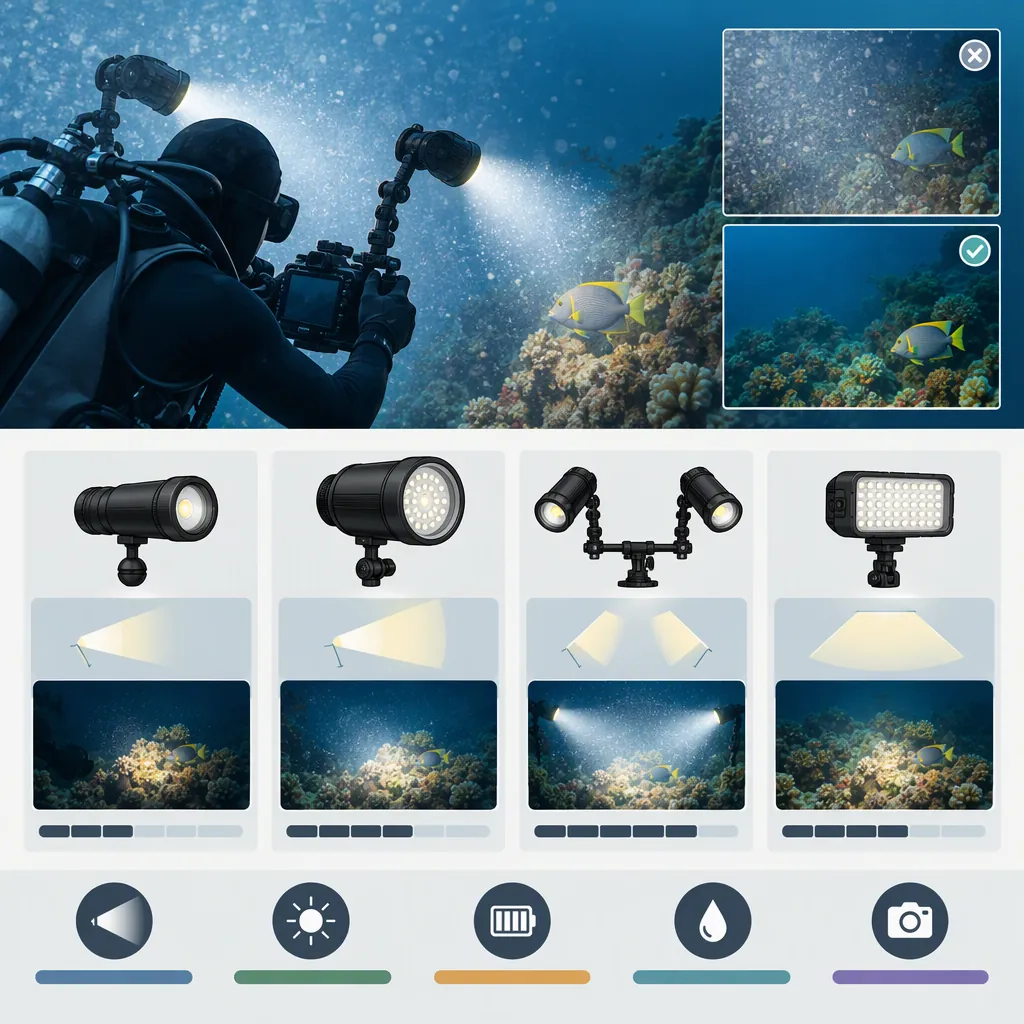
Choose a Backscatter video light by matching it to your subject, framing, and working distance—not by a brightness label alone. Check whether the configuration provides the coverage and exposure you need, then verify runtime at the intended output, mounting compatibility, and usable controls. Backscatter’s lighting comparison and TG-6 filming interview illustrate why exposure behavior and shot design matter when choosing lighting. [c1] [c2]
The practical goal is a configuration that meets your essential shooting requirements. A candidate with an unresolved essential specification should remain unconfirmed, rather than being treated as suitable.
Define the Shots Before Comparing Lights
Start with a short shooting brief:
- Primary output: video, still photos, or both.
- Subjects: close-up subjects, wider scenes, or a mix.
- Framing and distance: the compositions you need and your expected camera-to-subject and light-to-subject distances.
- Ambient conditions: bright, low-light, or variable.
- Lighting approach: broad illumination, selective subject lighting, or separately positioned backlighting.
- Recording needs: longest uninterrupted take and expected total light-on time between permitted charging or battery changes.
- Operation: output adjustments, beam changes, or accessory changes you need to make during a dive.
Separate essential requirements from optional creative features. For example, coverage for your main composition is essential; a backlighting configuration may be optional if it serves only an occasional shot.
Match Beam Coverage to Framing and Working Distance
Treat coverage as a requirement for the actual shot, not simply a beam-width label. Evaluate whether the light illuminates the intended area at the distance and framing you plan to use.
In a Backscatter-published interview, James Emery describes filming with an Olympus TG-6 and Backscatter Macro Wide 4300 lights. His workflow included wide and narrow lighting approaches, a snoot for selective illumination, one light for most shots, and two for selected compositions, including backlighting. This is a workflow example from a Backscatter-affiliated photographer, not an independent comparison or a universal configuration recommendation. [c2]
Shot-To-Lighting Decision Table
The following table is a suggested screening method, not a claim about any model’s performance.
| Shooting requirement | What to verify | Screening action |
|---|---|---|
| Close-up subject with selective illumination | Can the beam or a compatible beam-shaping accessory illuminate the subject without lighting unwanted areas? | If not, exclude that configuration for the selective-lighting shot or revise the composition. |
| Wider composition | Does useful illumination cover the intended area at the planned light-to-subject distance? | If coverage is insufficient, do not treat the configuration as suitable for that framing. Evaluate another arrangement or candidate. |
| Mixed close-up and wider shots | Can coverage be changed using confirmed controls or compatible accessories? | If the change cannot be made as planned, use separate configurations or narrow the shooting brief. |
| Backlit subject | Can a separate light be positioned, mounted, and controlled for the composition? | If placement or control is unresolved, mark the backlighting setup unconfirmed. |
| Different working distances | Does each representative shot retain acceptable coverage and subject exposure? | Keep only the distances and configurations that meet the requirement; do not assume one successful close-up proves wider-shot suitability. |
The number of lights follows from these requirements. Do not add a second light solely because an example setup uses two; identify the coverage or separately positioned illumination it must provide.
Evaluate Exposure with Your Camera
Backscatter’s Strobes vs. Video Lights for Underwater Photography explains that aperture, ISO, and shutter speed affect continuous-light exposure. Changing shutter speed affects both ambient-light and video-light brightness, unlike the more independent foreground/background control available with strobes for still photography. [c1]
This makes the camera part of the selection process. A light that illuminates a subject visibly still needs to produce acceptable recorded footage at your intended settings and distance.
The TG-6 interview describes using exposure compensation while the camera chooses aperture, shutter speed, and ISO. Those are camera- and scene-specific examples, not universal underwater video presets. [c2]
Repeatable Footage Evaluation
If you can evaluate a candidate setup, use this suggested process. It is not a test performed for this article.
- Choose representative close-up and wider compositions from your shooting brief.
- Record camera mode, frame rate, exposure settings, light output, framing, and working distances.
- Keep the scene and camera settings consistent where possible while comparing lighting configurations. If automatic exposure changes, record that change.
- Review subject exposure, background brightness, coverage, and visible camera movement.
- Change one variable at a time, such as output, beam setting, or light position.
- Note which configuration meets the shot requirement and which does not.
If acceptable exposure requires camera settings you are unwilling to use, treat that configuration as unsuitable for the tested conditions. A higher brightness label alone does not resolve an untested exposure requirement.
Check Runtime, Mounting, and Underwater Operation
Compare the complete configuration: light, battery, mount, arms, accessories, and controls. The checks below are selection criteria, not verified specifications for current Backscatter models.
| Requirement | Evidence or check needed | Screening action |
|---|---|---|
| Longest uninterrupted take | Confirmed runtime at the output needed for the shot | If the take exceeds that runtime, revise the take or use a configuration that meets it. Do not rely on runtime quoted for another output level. |
| Total planned light-on time | Runtime at intended settings and a documented charging or battery-change plan | If the plan exceeds available runtime, revise the power plan according to the equipment documentation or reduce light-on time. |
| Planned depth | Current depth rating and operating limits for the light and relevant accessories | Do not use a configuration outside its documented limits. If limits are unknown, leave suitability unconfirmed. |
| Installation on the camera rig | Confirmed tray, arm, clamp, and mounting-interface compatibility | An unconfirmed interface is not a ready-to-use configuration. Resolve every required connection. |
| Output or beam changes during use | Documented control functions and a handling check where feasible | If you cannot make required changes as planned, revise the workflow or exclude the configuration for that use. |
| Beam-shaping accessories | Confirmed compatibility and attachment requirements | Do not assume a snoot or other accessory fits because it appears in another setup. |
| Battery and maintenance needs | Current battery, charging, seal-care, and maintenance instructions | Keep the configuration unconfirmed until these requirements are understood. |
For a handling check, assess whether you can reach the controls with the rig assembled and with the gloves you expect to wear. Check any required beam or output changes without assuming that a topside handling check proves underwater usability.
Also record color characteristics, output consistency, beam uniformity, and thermal operating limits when they matter to your work. Mark missing evidence as unknown rather than inferring it from output or price.
Keep Still-Photo Requirements Separate
If you also shoot photographs, assess that use separately. Continuous lights provide an illumination preview and can be useful in low ambient light or close-up macro situations, but they do not offer the same foreground/background exposure separation or motion-freezing behavior as photographic strobes. Advertised LED burst modes should not be assumed to behave like conventional flash. [c1]
A configuration that meets your video requirements is therefore not automatically a replacement for your still-photo lighting.
Evidence Boundaries and Final Screening
The cited materials are all published by Backscatter. They provide lighting principles and a filming workflow, not a consistent independent comparison of current video-light models. Backscatter’s underwater-lighting video library lists footage examples, light-control guidance, and O-ring and battery-safety material, but the index itself is not a technical specification sheet. [c3]
These materials do not support an overall model ranking by runtime, beam uniformity, color rendering, thermal behavior, or mounting compatibility. Resolve those questions using current documentation for each candidate. This guide concerns equipment selection, not a detailed method for reducing particle backscatter through light placement.
Give each candidate configuration one of three outcomes:
- Meets the brief: essential specifications are confirmed, and any available evaluation supports the required shots.
- Does not meet the brief: a confirmed limitation conflicts with an essential requirement.
- Unconfirmed: an essential specification, compatibility detail, or shooting condition remains unresolved.
Optional features should not outweigh a failed essential requirement.
FAQ
Which Backscatter Video Light Is Best?
The cited evidence does not establish an overall winner. Use the lighting principles and workflow examples to define your needs, then screen candidates against coverage, exposure, runtime, mounting, and operation requirements. [c1] [c2]
Do I Need One Video Light or Two?
There is no universal requirement established here. James Emery’s TG-6 filming example used one light for most shots and two for selected compositions, including backlighting. Choose the number according to the illumination your planned shots require. [c2]
Is a Higher Brightness Label Enough to Choose a Light?
No. Continuous-light exposure depends on camera settings, and the filming example also illustrates different coverage approaches. Evaluate exposure and coverage for your actual composition and working distance rather than treating brightness as a complete selection rule. [c1] [c2]
Can a Video Light Replace a Strobe for Underwater Photos?
Sometimes, particularly in low ambient light or close-up macro work. It is not an equivalent replacement when you need the exposure separation or motion-freezing behavior of a photographic strobe. [c1]
Can the Underwater-Lighting Video Library Verify Runtime or Compatibility?
Not by itself. It lists relevant demonstrations and guidance, but its index does not establish technical specifications. Verify runtime, mounting, battery, and maintenance requirements in the candidate’s current documentation. [c3]