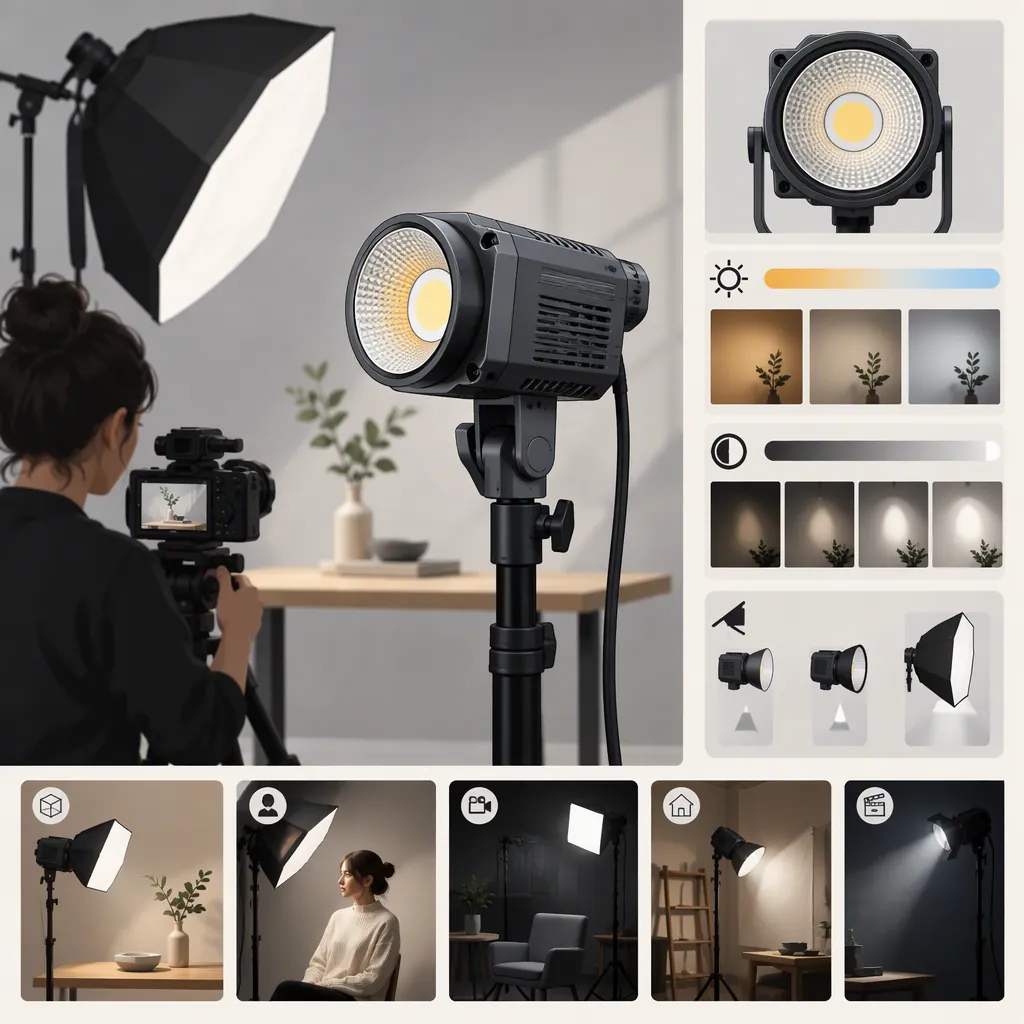
Choosing the Amaran Cob 60D for Your Filming Setup
Evaluate the amaran COB 60d against your intended framing, light placement, color needs, and audio setup—not its headline brightness alone. First confirm whether you mean the original 60d or the 60d S: the provided sources describe different models, both specified at 5600 K. Treat their published measurements as planning references, not proof that either will deliver the exposure or coverage your scene requires. [c1] [c2]
Confirm the Model Before Comparing Specifications
The original amaran COB 60d and the amaran 60d S should not be treated as interchangeable specification sheets. Newsshooter’s announcement covers the original 60d, while the Aputure Help Center reference explicitly covers the 60d S. [c1] [c2]
The sources list these model-specific figures:
| Published Specification | Original COB 60d | 60d S |
|---|---|---|
| Lamp output power | 65 W | 65 W |
| Color temperature | 5600 K | 5600 K |
| Bare-source illuminance at 1 m | 3,310 lux | 2,940 lux |
| Hyper Reflector illuminance at 1 m | 45,100 lux | 37,800 lux |
The original figures are reported in Newsshooter’s announcement; the S figures come from the manufacturer’s technical page. These are not results from a shared independent test and should not be used alone to rank the models. The S page also states that its measurements are averaged and individual units may vary. [c1] [c2]
Evaluate Coverage Alongside Brightness
For the original 60d, Newsshooter reports a 15° beam angle with the Mini Hyper Reflector and a 120° bare-source beam angle. The 60d S technical page lists 14° with its reflector and 108° without it. The high reflector readings therefore describe a different beam configuration from the bare-source readings. [c1] [c2]
For filming, define the area that must be illuminated before deciding which number matters. A seated close-up, a two-person interview, and a moving full-body shot should each have their own placement and exposure test.
The original 60d announcement identifies a full-size Bowens mount and names several compatible modifiers. However, the provided references do not give softbox illuminance measurements. Do not present the reflector figure as expected output through a softbox. Verify the exact modifier’s compatibility, support requirements, coverage, and exposure in the intended setup. [c1]
Check Color, Power, and Audio Requirements
Color: Both 60d models are specified at 5600 K. If your filming plan requires adjustable color temperature, evaluate that requirement separately rather than assuming either 60d provides it. The same Newsshooter article describes the original COB 60x as adjustable from 2700 K to 6500 K; that specification belongs to the 60x, not the 60d. [c1] [c2]
Power: Newsshooter reports AC power, an included dual NP-F battery plate, and a separately sold D-Tap cable option for the original fixtures. The S technical page lists its own power specifications. Confirm the exact model, adapter, cable, and battery configuration before planning a location shoot. Neither reference supplies a battery-runtime test for your intended setup. [c1] [c2]
Audio: The original announcement describes fan cooling, and the S specification lists active cooling. Neither provided source establishes measured noise at your microphone position. Record a quiet dialogue test with the light operating at the intended placement and output; do not infer recording suitability from a cooling description. [c1] [c2]
Use a Scene-Based Selection Test
Use the following checklist as a practical evaluation method, not as a claim that either model will pass. A useful decision should document the complete setup rather than just the fixture name.
Keep the published reflector and bare-source measurements as separate reference conditions. For the 60d S, also retain the manufacturer’s stated measurement-variation caveat. [c2]
Filming Light Evaluation Checklist
- Record the exact model: original COB 60d or 60d S.
- Define the shot, subject movement, and required illuminated area.
- Record the modifier, light position, and distance to the subject.
- Set the intended camera exposure and white balance; avoid automatic changes during comparisons.
- Check exposure and coverage at every planned subject position.
- Record dialogue and room tone with the light operating.
- Verify power accessories and test the required operating duration.
- Check the assembled stand and modifier against their support instructions.
- Mark the setup as suitable, unsuitable, or unresolved for this specific scene.
FAQ
Are the Amaran Cob 60D and 60D S the Same Model?
The supplied references cover different model names and publish different specifications. Use the original 60d announcement for the original model and the 60d S technical page for the S model; do not combine their measurements into one specification list. [c1] [c2]
Does the Reflector Lux Figure Predict Softbox Output?
The provided sources do not establish that. They report bare-source and Hyper Reflector measurements, not softbox measurements. Evaluate the actual modifier, distance, framing, and camera exposure together. [c1] [c2]
Is the Amaran Cob 60D Suitable for Recording Dialogue?
That remains setup-dependent. The references describe active cooling but provide no measured noise at a recording microphone. A dialogue and room-tone test at the intended light and microphone positions is needed before making that judgment. [c1] [c2]