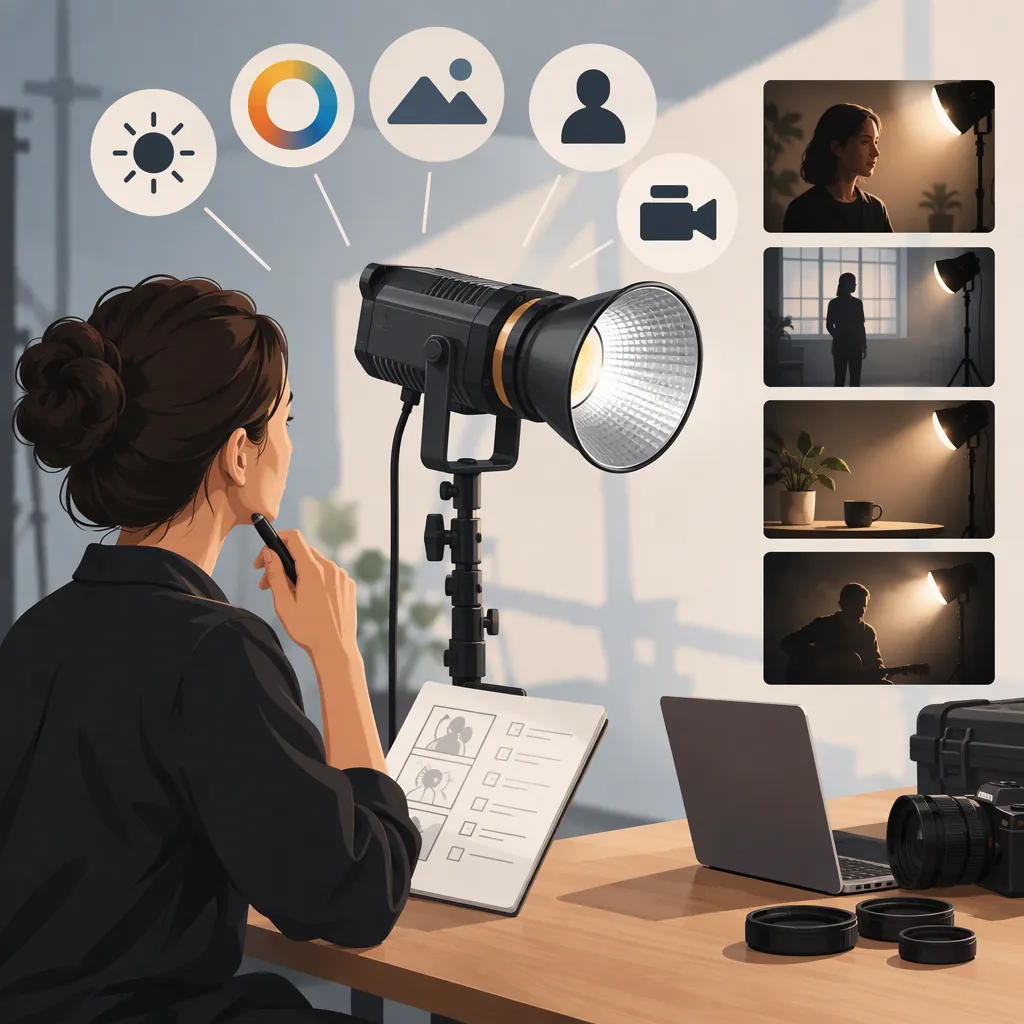
Amaran 200D Lux: How to Evaluate It for Filming
The supplied reference does not establish a verified lux value for the amaran 200d. It describes a review covering brightness and other filming considerations, but provides no measured results or test conditions. [ref_1] To assess the light for filming, look for a reading documented with its distance, modifier, and output setting, then evaluate whether the intended setup meets your exposure, coverage, sound, and placement requirements.
What the Available Source Establishes
New Layer’s review description identifies the amaran 200d, Godox SL200W II, and Nanlite Forza 200 as comparison subjects. It lists brightness, color accuracy, build quality, and fan noise among the review topics. The supplied excerpt contains no lux table, measurement conditions, or findings, so it supports neither a numerical brightness ranking nor a conclusion about which light is better for filming. [ref_1]
When checking brightness evidence:
- Confirm the exact model tested.
- Find the actual measurements rather than relying on a review title or description.
- Check whether distance, modifier, output setting, and measurement procedure are documented.
- Mark missing information as unknown rather than filling it in from assumptions.
What Lux Means for a Filming Decision
Lux is a unit of illuminance: the amount of light reaching a surface. One lux equals one lumen per square meter.
A lux reading describes illumination at the measurement location under the stated conditions. It is not, by itself, a measure of the light’s suitability for your shot. A single center reading does not describe illumination across the entire subject area, the appearance of the light, or the resulting camera exposure.
For example, if your shot includes two people, check both intended positions rather than judging only the brightest point between them. Decide whether you want even illumination or a deliberate difference between the subjects; the useful test is whether the setup produces that intended result.
Conditions to Check Before Comparing Lux Readings
| Condition | What to record | Question it answers |
|---|---|---|
| Exact model | Full model name | Are the readings for the same product being considered? |
| Distance | Meter-to-light distance and reference point | Were the measurements taken at matching distances? |
| Modifier | Reflector, softbox, diffusion, or other configuration | Does the test represent the setup you intend to use? |
| Output setting | Setting used during measurement | Were the lights tested at comparable settings? |
| Measurement position | Center and other relevant subject-area points | Does the evidence describe coverage, not just one point? |
| Ambient light | Other light present during the test | Was the fixture measured separately from the room’s illumination? |
| Documentation | Source, test date, meter, and procedure | Can the conditions be checked or repeated? |
Do not assume that an unspecified reading applies to your intended softbox or working distance. If important conditions differ, treat the readings as setup-specific evidence rather than a direct comparison.
Evidence Comparability Record
Use this compact record for each candidate measurement:
| Record | Entry |
|---|---|
| Source and exact model | |
| Reported lux, distance, and reference point | |
| Modifier and output setting | |
| Measurement positions and ambient conditions | |
| Meter, procedure, and missing information | |
| Evidence conclusion | Comparable / partly comparable / insufficient information |
Keep this conclusion separate from a filming decision. Comparable measurements can help evaluate brightness evidence, but they do not replace checking the intended shot.
Evaluate the Intended Filming Setup
Start by defining what the light needs to accomplish. Record the subject area, available placement distance, intended modifier, ambient conditions, and camera settings. Also define the desired lighting appearance and, if recording dialogue, the acceptable sound result.
Use camera settings you can accept for the production—not settings chosen solely to make a candidate light appear adequate.
A Repeatable Setup Test
If a test unit is available:
- Recreate the intended placement. Use the planned light position, modifier, and subject positions.
- Fix the camera settings. Keep frame rate, shutter setting, aperture, ISO, and white balance unchanged between candidates.
- Check subject exposure. Use your usual exposure-monitoring method and review the recorded image against the intended result.
- Check the full subject area. Inspect all relevant positions, including movement through the shot, rather than only the brightest point.
- Review appearance. Check whether the recorded lighting pattern and color appearance suit the scene. Do not treat this as a measured color-accuracy result.
- Test dialogue where relevant. Record a quiet sample with the intended microphone position and recording settings.
- Check practical fit. Confirm that the planned light position and accessories can be used within the available space.
Brightness, color accuracy, build quality, and fan noise are topics named in the supplied review description, not verified strengths or weaknesses of the amaran 200d. [ref_1]
How to Judge the Results
| Requirement | Pass condition for this shot | If it does not pass |
|---|---|---|
| Exposure | The subject reaches your intended exposure at the fixed, acceptable camera settings | Adjust placement, modifier, or the lighting plan, then retest |
| Coverage | Every required subject position has the intended illumination, whether even or deliberately varied | Revise positioning or the lighting arrangement, then retest |
| Appearance | The recorded light pattern and color appearance match the scene’s needs | Adjust the setup and review another recording |
| Dialogue sound | The recorded sample meets your sound requirement without unacceptable light-related noise | Reassess light and microphone placement, then retest |
| Placement and accessories | The intended setup fits the location and can be used as planned | Revise the layout or consider another configuration |
Define these pass conditions before comparing candidates. Otherwise, a “meets requirement” label can hide a change in expectations between tests.
Filming Suitability Record
Record the setup conditions once, then log the outcomes separately from the lux evidence.
| Test record | Entry |
|---|---|
| Shot and required subject area | |
| Placement, modifier, and ambient conditions | |
| Fixed camera settings and microphone position | |
| Exposure and coverage | Meets requirement / does not meet requirement / untested |
| Appearance and recorded sound | Meets requirement / does not meet requirement / untested |
| Placement and accessory fit | Meets requirement / does not meet requirement / untested |
| Required changes or unresolved questions | |
| Final conclusion | Suitable for this tested scene / adjust and retest / insufficient information |
Turn the Test into a Selection Decision
Use a conditional conclusion rather than a general product verdict:
- Suitable for this tested scene: All essential requirements pass under the recorded conditions. Limit the conclusion to that setup.
- Adjust and retest: A requirement fails, but there is a practical change to evaluate, such as different placement or a different modifier. Record the change; the revised setup is not confirmed until tested.
- Insufficient information: An essential requirement remains untested, or the available measurements lack the conditions needed for your decision.
If acceptable exposure requires camera settings outside your production limits, the tested configuration does not meet the shot’s requirements. If exposure passes but coverage or dialogue sound fails, brightness alone is not enough to select it.
Where no test unit is available, use documented measurements to narrow the uncertainty, but leave untested requirements open. Neither an isolated lux number nor the supplied review description establishes that the amaran 200d will suit a particular room, modifier, or filming style.
FAQ
What Is the Verified Amaran 200D Lux Value?
The supplied excerpt provides no verified numerical lux value or measurement conditions. [ref_1] Evaluate any reading you find alongside its distance, modifier, output setting, and measurement position.
Does the Reference Show That the Amaran 200D Is Brighter than the Alternatives?
No. It names the Godox SL200W II and Nanlite Forza 200 as comparison subjects but provides no results establishing a brightness ranking. [ref_1]
Is One Lux Reading Enough to Decide Whether the Amaran 200D Suits My Filming Setup?
No. A single reading describes one measurement point under particular conditions. Check the intended subject area and test exposure, appearance, sound, and placement. The supplied reference contains no measurements that resolve those requirements for a specific setup. [ref_1]
Does the Reference Verify That the Amaran 200D Is Quiet Enough for Dialogue?
No. Fan noise is listed as a review topic, but no noise findings are included. [ref_1] If possible, assess a recorded sample using your intended microphone position and recording settings.