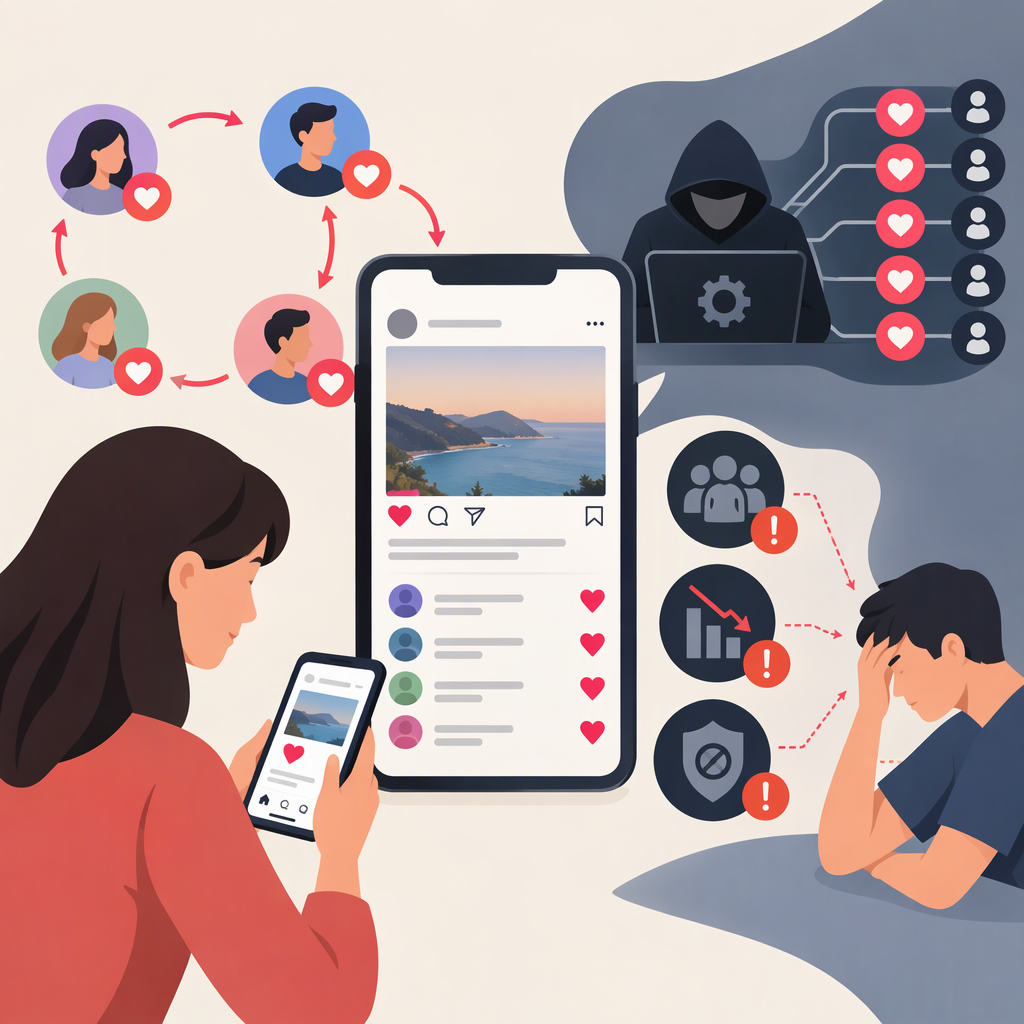
Auto Engagement on Instagram: Risks of Mutual Likes and Engagement Services
Short answer: Mutual-like arrangements and services that artificially generate likes, follows, or comments can create policy, account-security, and measurement risks. Instagram’s Community Guidelines say not to artificially collect likes, followers, or shares. But the guidance does not name every type of mutual-engagement group or specify a predictable penalty for an individual account. A service that asks for your password adds a separate, avoidable security risk. (storage.googleapis.com)
What Does “Auto Engagement Instagram” Mean?
“Auto engagement Instagram” is a broad phrase, not a precise description of one practice. Here, it can refer to three different things:
- Automated engagement: Software or a service performs actions such as likes, follows, or comments automatically. Meta has described fake-engagement providers using bots and automation to deliver likes and followers. (about.fb.com)
- Mutual-engagement groups: Participants agree to like or comment on one another’s posts. The interaction may come from real people, but if the arrangement is intended to inflate engagement counts, it raises the question of whether those likes are being artificially collected. Instagram’s published wording does not specifically name these groups, so applying it to a particular arrangement is an interpretation—not a quoted rule about “pods.” (storage.googleapis.com)
- Paid engagement offers: A seller promises likes, followers, views, or comments in return for payment. Offers differ: some may automate activity, while others may use different methods. Don’t assume every seller works the same way. Meta has publicly described cases involving services that sold fake engagement, including bot-delivered likes and followers. Those cases concerned the providers; they do not establish what will happen to every customer who buys a service. (about.fb.com)
These are distinct from simply scheduling when your own content is published: scheduling a post does not, by itself, describe a service that generates likes or follows. Assess what a tool actually does rather than judging it by the word “automation.”
Main Risks to Consider
1. The Activity May Conflict with Instagram’s Guidance
Instagram’s Community Guidelines say: “Help us stay spam-free by not artificially collecting likes, followers, or shares.” A service that sells likes or followers to inflate counts fits that concern directly. A reciprocal group may raise a similar concern if its purpose is to manufacture engagement, though the published wording does not specifically mention mutual-like groups. (storage.googleapis.com)
Meta has also described taking action against providers of fake-engagement services. That is evidence that Meta has acted against particular providers—not a basis for predicting that every participant will receive a particular warning, restriction, or account penalty. The public material cited here does not establish a universal outcome or likelihood for individual users. (about.fb.com)
2. Sharing a Password Can Put Account Access at Risk
Some offers may ask you to log in through a third-party site or app. Meta says people should not provide their Facebook or Instagram password outside the official websites or apps, except through an authorized third-party “Login with Facebook” flow. Meta has also described free-like and follower offers that sought credentials, and said compromised accounts could be used to collect people’s data. (about.fb.com)
A genuine permission-based connection is different from handing a seller your password, but it still deserves scrutiny. Meta says connected apps and websites may request information from your account and use it according to their own privacy policies. You can review and remove connected apps in your Meta account’s Apps and websites settings. (meta.com)
3. Engagement Counts May Not Show Genuine Audience Interest
A like count records an interaction; it does not establish that the person is part of your intended audience, read or valued the post, or is likely to take another meaningful action. That is a measurement limitation, not a claim about how Instagram’s ranking system works. If participants engage mainly because they expect you to reciprocate, the count can be a poor stand-in for independent interest.
For example, suppose a post receives 50 additional likes from people participating mainly to earn reciprocal likes. The visible count has increased, but that number alone cannot tell you how many viewers found the post useful or would choose to follow your work. Treat the count as an interaction total, not proof of audience fit or business value.
4. Payment and Delivery Terms Can Be Unclear
A paid offer is also a purchase decision. Before paying, look for a specific description of what will be delivered, when it will be delivered, what happens if it is not delivered, and whether a refund is available. A guarantee of a particular engagement total does not, by itself, show that the interactions will be relevant or valuable. These are practical checks for evaluating the transaction—not evidence that every service fails to deliver or is fraudulent.
Checklist: Assess an Offer Before Using It
Ask these questions before joining a group or paying for a service:
- What actions will it take? Distinguish scheduling your content from automatically liking, following, commenting, or supplying engagement.
- Is the activity designed to inflate counts? Compare what is promised with Instagram’s guidance against artificially collecting likes, followers, or shares. (storage.googleapis.com)
- Does it ask for your password or login code? Do not give those to a seller or enter them on an unfamiliar page. Meta specifically warns against sharing account passwords outside official login routes. (about.fb.com)
- Does it request account permissions? Check what information the connection can access, the developer’s privacy policy, and whether you can remove access later. (meta.com)
- Are the price and terms clear? Check the amount, billing or renewal terms, promised deliverables, timing, and refund conditions before paying.
- Can you verify the value beyond the count? Ask whether the interactions are likely to come from people who actually care about your subject, rather than treating a promised number as proof of audience quality.
If You Already Used an Engagement Service
Choose steps based on how you connected it:
- If you gave the service your password or entered it on an unfamiliar page: If you can still access your account, reset your password and log out of devices you do not recognize. Meta recommends these steps when you may have entered credentials through a suspicious link. Turn on two-factor authentication as an additional safeguard. (meta.com)
- If you used a connected app or website: Review connected apps and remove one you no longer trust or use. Removing a connection cuts off that link to your Meta account; it does not establish what information the developer may already have received, so review its privacy policy if that matters to you. (meta.com)
- If you notice unfamiliar logins, changed account details, or activity you did not make: Use Instagram’s account-security or recovery help. Meta advises securing an account promptly if it may be compromised. (meta.com)
- If you paid and the promised service was not delivered: Keep receipts and copies of the offer and contact the seller or your payment provider about the transaction. The outcome depends on the terms and payment method; these steps cannot guarantee a refund or reverse any platform action.
Bottom Line
Before using an “auto engagement” offer, identify exactly what it does. Artificially generated likes and reciprocal activity intended to inflate counts raise policy and measurement concerns; giving a service your password creates an additional account-security concern. Instagram’s guidance supports caution, but it does not let an outside reader predict a specific enforcement result for a particular account. If you have already connected a service, secure your account according to the access method you used and review any third-party permissions.