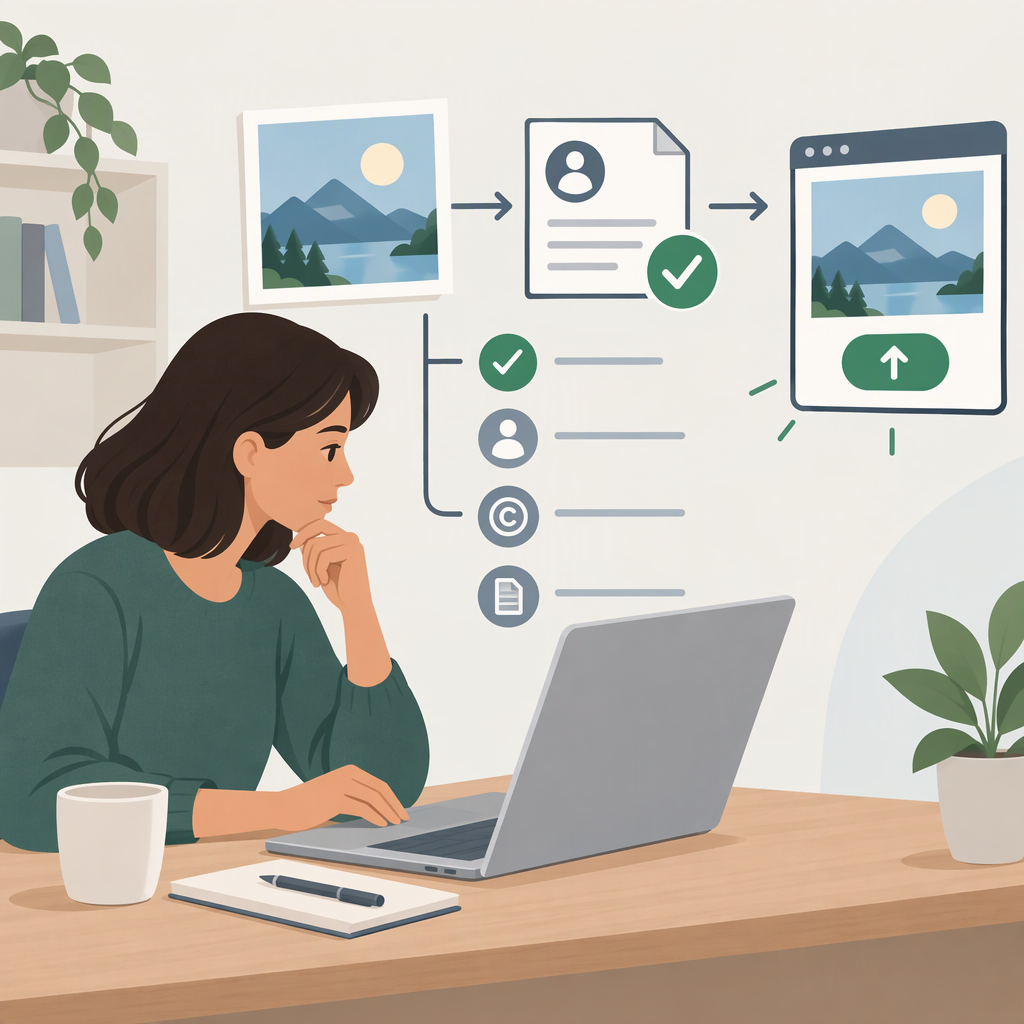
Usage Rights: How to Check Permission Before You Publish
“Usage rights” are the permissions or limits that determine how content may be used. Before you publish someone else’s work, identify the terms that apply and compare them with what you plan to do: for example, whether you will repost it, edit it, use it commercially, or share it on a particular channel. If the permission does not clearly cover your intended use, pause and seek clarification rather than assuming that credit alone is enough.
Usage Rights Versus Ownership
Owning a copy of something is not necessarily the same as owning the rights to reuse the work it contains. For example, in U.S. copyright law, ownership of a physical object is distinct from ownership of the copyright in the work embodied in it. A license is permission to use a work on stated terms; it does not, by itself, mean that copyright ownership has transferred to the licensee. The details can vary by agreement and jurisdiction. (U.S. Copyright Office: 17 U.S.C. § 202)
In the United States, copyright owners may have rights that include reproducing, adapting, distributing, publicly performing, and publicly displaying a work, subject to legal limitations. A license can authorize some uses while leaving others outside its scope. (U.S. Copyright Office: How to Obtain Permission)
How to Check Whether Permission Covers Your Use
Use this practical comparison before you publish:
- Identify the exact material. Record what you want to use and where it came from. A post, collection, or website may contain material credited to someone other than the person who shared it. The U.S. Copyright Office recommends checking credits and acknowledgments, not just the main copyright notice. (U.S. Copyright Office: How to Obtain Permission)
- Find the permission that applies to that material. Look for a license, written permission, or relevant terms. Confirm that they come from someone authorized to grant permission for the material in question. A missing copyright notice does not necessarily mean a work is free to use. (U.S. Copyright Office: How to Obtain Permission)
- Describe your planned use specifically. Note whether you will copy or repost the work, edit or adapt it, use it in a paid or promotional context, and where and how you plan to share it.
- Compare the plan with the actual conditions. Check the license or permission for limits that matter to your plan, such as attribution, commercial use, adaptations, or how modified versions may be shared. Not every permission uses the same conditions; follow the terms that actually apply.
- Resolve gaps before publishing. If the terms do not say whether your intended use is allowed, ask the rights holder or choose material with permission that clearly covers your plan.
Example: Reading a Creative Commons License
Creative Commons licenses show why checking the specific terms matters. For example, CC BY permits commercial use and adaptations when the required attribution is given. CC BY-SA also permits commercial adaptations, but requires adaptations to be shared under the same terms. Other CC licenses include restrictions on commercial use or sharing modified versions. Read the particular license rather than treating “Creative Commons” as one blanket permission. (Creative Commons: license conditions and types)
So, if a creator plans to edit a CC BY-SA image and use it in a monetized post, the license’s listed conditions indicate that commercial adaptation is allowed, provided the creator follows the attribution and ShareAlike terms. That example addresses the copyright-license conditions; it does not establish that every other relevant right or requirement is cleared.
If Permission Is Missing or Unclear
- Ask for permission or clarification. Identify the exact work and describe the use you have in mind. The U.S. Copyright Office says permission may be requested from the owner when known; it also notes that the current owner may differ from the person named in an older notice. (U.S. Copyright Office: FAQ; How to Obtain Permission)
- Choose another source if you cannot resolve the uncertainty. Look for material whose permission clearly matches your intended use, and check its specific conditions.
- Do not assume attribution or a small edit settles the issue. Attribution is a condition of CC licenses, but the license may have other conditions too. Separately, the Copyright Office notes that changing someone else’s work does not, by itself, give you the right to claim copyright in that work. (Creative Commons; U.S. Copyright Office FAQ)
- Treat legal exceptions as a separate question. Some uses may be permitted without a license under applicable legal exceptions. In the United States, fair use depends on the circumstances; the Copyright Office says there is no fixed number of words or percentage that automatically qualifies. Do not treat a general checklist as a ruling on a particular use. (U.S. Copyright Office: Fair Use FAQ)
A useful final check is: Can I point to the permission that applies to this exact material, and show how its terms cover the use I plan to make? If not, get clarification or choose a clearer source before publishing.
Scope: This is general educational guidance, not legal advice. The legal examples above are specifically identified as U.S. sources; rules and exceptions can differ elsewhere. The task’s en-US locale does not establish which jurisdiction applies to an individual reader.