Email vs DM for Brand Collaboration: Which Should You Use?
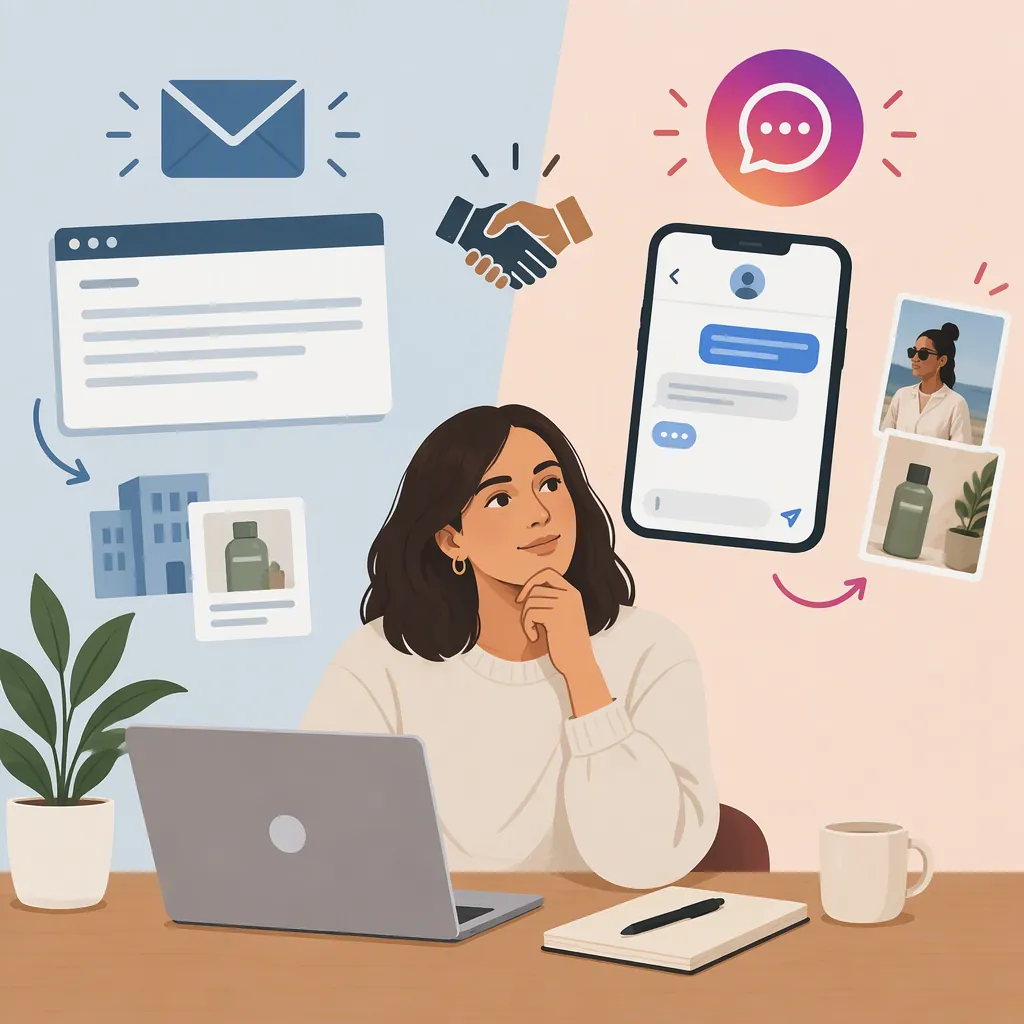
Use email for a substantive brand collaboration pitch when a relevant contact is available. Use a short DM to introduce yourself and ask where to send the proposal when you cannot find that contact. Both supplied guides favor email for the full pitch and treat DM as a way to find the right recipient. This is editorial guidance, not evidence that email produces a higher response rate for every brand.
Email vs DM at a Glance
The useful distinction is the message’s job: DM can route the inquiry; email can explain the proposal. Hypefy explicitly recommends a short Instagram introduction followed by an email pitch. Keep Calm and Chiffon places a DM request for a marketing contact after other contact-finding options. [citation-1] [citation-2]
| Decision Point | DM | |
|---|---|---|
| Best starting situation | A relevant partnerships or marketing contact is available | You cannot find a relevant contact |
| Main purpose | Explain the collaboration idea and audience fit | Introduce yourself and ask where to send details |
| Suggested content | Brief introduction, specific idea, relevant audience information, content example, and next step | Brief introduction, one specific brand reference, and a contact question |
| Level of detail | Concise but substantive | A few sentences rather than the full proposal |
| Main caution | Do not turn the pitch into a long biography | Do not assume the social account is the partnerships decision-maker |
These are recommended uses, not fixed channel rules. Neither supplied reference provides comparative response-rate data or establishes how a particular brand manages its inbox.
Choose Based on the Brand’s Contact Route
Start with the brand’s website and social profile. Both guides identify these as places to look for relevant email contacts. Hypefy specifically recommends using a partnerships email listed in the brand’s bio instead of sending a DM. [citation-1] [citation-2]
A practical decision order is:
- Follow any published collaboration instructions. Treat an explicit route as more relevant than a general preference for email or DM.
- Use a relevant email contact if one is available. A general customer-service address is not necessarily a partnerships contact.
- Use DM to ask for routing if the contact is unclear. Keep the question narrow rather than sending the entire proposal.
- If the brand invites details by DM, respond there. Suggest moving to email when more information is needed, rather than insisting on a switch immediately.
This order is a suggested workflow. The supplied sources do not verify any individual brand’s preferred channel or staffing arrangements.
How the Same Idea Changes by Channel
Keep the underlying idea consistent, but change how much information you include. Hypefy recommends reserving the full proposal and audience details for email. Keep Calm and Chiffon recommends a concise email that explains the idea, creator fit, and a relevant content example. [citation-1] [citation-2]
The examples below are original drafting aids, not messages from an actual creator or brand. Replace each placeholder with accurate information. Omit unsupported audience claims, past partnerships, and product-use statements.
DM for Finding the Right Contact
Hi [Brand] team, I’m [Name], a creator focused on [niche]. Your [specific public campaign or product] connects with a content idea about [topic]. What is the best email address for collaboration proposals?
Email for Presenting the Proposal
Subject: [Content Idea] — Collaboration Proposal for [Brand]

Hi [Contact or Brand Team],

I’m [Name], and I create [content type] about [niche] on [platform]. Your [specific campaign or product] connects with my proposed [format] about [topic].

The concept would cover [brief outline]. My audience includes [accurate, relevant audience detail], and [describe a relevant content example] shows the approach I have in mind.

Would this concept be relevant to your current collaboration plans? I can provide further audience information if useful.

[Name]
[Handle]
Follow up Without Duplicating the Pitch
A DM-to-email handoff is different from sending the same full pitch through both channels. Once you receive a contact, use the email to explain the proposal and briefly mention the earlier exchange.
For unanswered outreach, Hypefy recommends one short follow-up after five to seven business days, then moving on. Keep Calm and Chiffon suggests a reminder about a week after the email. Treat these as suggested intervals, not universal response deadlines. [citation-1] [citation-2]
A restrained approach is to send one reminder through the relevant contact route rather than repeatedly copying the proposal into email, DMs, and public comments. Hypefy also advises against pitching in public comments. [citation-1]
FAQ
Does Email Get More Replies than DM?
The supplied references do not establish a comparative response rate. They recommend email for the full pitch and DM for introductions or contact requests. That recommendation should not be read as a guaranteed performance advantage.
Should a Paid Collaboration Pitch Start by Email?
If a relevant email contact is available, that is the recommended starting point. Hypefy specifically presents email as the format for a sponsored collaboration proposal. If no contact is available, a short DM can ask where to send it.
Should I Include a Media Kit in the First Message?
For a first-contact DM, Hypefy recommends leaving out the media kit link and saving details for email. The email guidance differs: Hypefy’s example includes a media kit link, while Keep Calm and Chiffon recommends offering the kit later rather than attaching it initially. A conservative option is a concise pitch with an offer to provide more information, unless the brand requests specific materials.
Sources
-
[citation-1] How to Reach Out to Brands as an Influencer | Hypefy
-
[citation-2] Brand Pitch Email: What to Include for Success