What Is A-Roll Footage? Meaning, Examples, and B-Roll
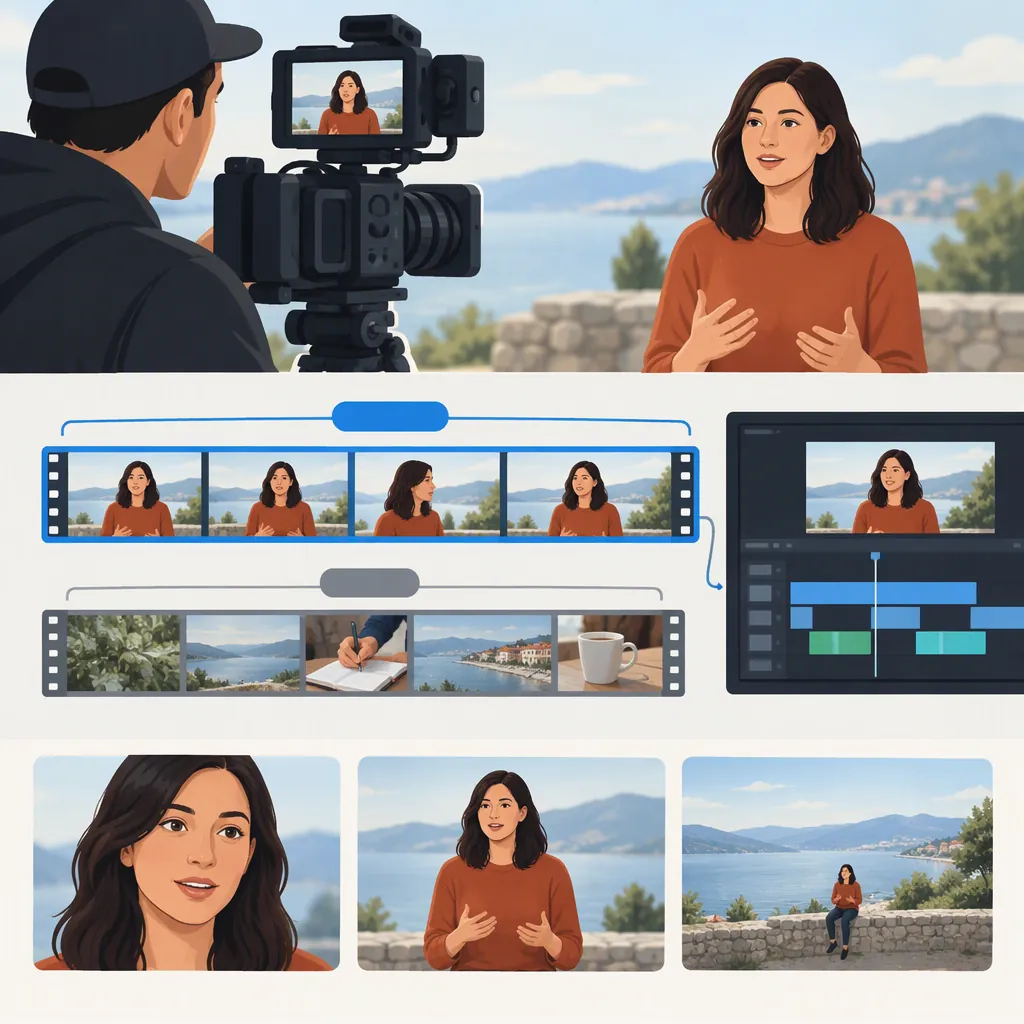
A-roll footage is the primary footage that carries a video's main story or message. It can include an interview, a presenter explaining a topic, essential dialogue, or action that advances the narrative. B-roll is supporting footage that adds context or illustrates that main content. A-roll does not have to show someone talking—or even show a face. [c1] [c2]
What A-Roll Means
A-roll is the core content of a video: the footage viewers rely on to follow its central message, events, or explanation. In an interview-led documentary, that might be the interview. In a narrative scene, it might be the characters' dialogue and essential actions. [c1] [c2]
The useful distinction is the footage's storytelling role, not simply what appears in the frame. A person speaking to camera is a common example, but a demonstration or an important action can also carry the main narrative. [c2]
A-Roll Vs. B-Roll
A-roll delivers the main narrative; B-roll supports it with additional visual information. Supporting footage can establish a location, highlight a detail, illustrate what a speaker describes, or cover a visible edit. [c3]
| Distinction | A-Roll | B-Roll |
|---|---|---|
| Main role | Carries the central story or explanation | Supports or illustrates that story |
| Interview example | The interviewee giving an answer | Relevant footage of the subject at work |
| Cooking example | The chef explaining the recipe | Ingredient close-ups or food sizzling in a pan |
These examples describe how the footage is used, not permanent categories for particular subjects or camera angles. The interview and cooking distinctions follow the examples in Riverside's guide. [c1]
How to Recognize A-Roll
A practical way to classify a clip is to ask: Is this delivering the main content, or supporting content delivered elsewhere? That question follows the primary-versus-supporting distinction used in the references. [c2] [c3]
Consider these hypothetical examples:
- An interview: The speaker's account supplies the main information, so the interview is A-roll. A shot of the workspace illustrating that account is B-roll.
- A product walkthrough: Footage showing the actual demonstration may be A-roll even if the presenter is off camera. An extra detail shot used to illustrate a comment may be B-roll.
- A dramatic scene: An action that changes what happens next may be A-roll, rather than supporting footage merely because nobody speaks.
These are classification examples, not rules that every interview, product shot, or action shot must follow. Context determines the role. [c2]
Common Misunderstandings About A-Roll
A close-up is not automatically B-roll. A close-up containing an essential performance can be A-roll; a close-up illustrating a detail can serve as B-roll. [c2]
A clip's role can change in the edit. TechSmith describes repurposing primary footage as B-roll—for example, using part of a discarded take to support the narrative. The label therefore describes its use in a particular edit, not an unchangeable property of the recording. [c3]
There is no universal A-roll-to-B-roll ratio. The balance depends on the video's format, pacing, and storytelling needs. Treat the distinction as a way to understand each clip's purpose, not as a required percentage or a quality ranking. [c2]
FAQ
Does A-Roll Always Include Dialogue?
No. Dialogue is a common form of A-roll, but essential actions, performances, and demonstrations can also carry the main narrative without someone speaking on camera. [c2]
Can A-Roll Audio Continue Under B-Roll?
Yes. For example, an interviewee's voice can continue while supporting footage illustrates the topic. The interview remains the source of the main narrative even while B-roll replaces its picture on screen. [c3]
Can the Same Footage Be A-Roll and B-Roll?
Yes, in different uses. Footage that carries the main story in one sequence can be repurposed to support another. TechSmith specifically identifies repurposed primary footage as a possible source of B-roll. [c3]