Social Media Competitor Analysis: Interpret Competing Videos
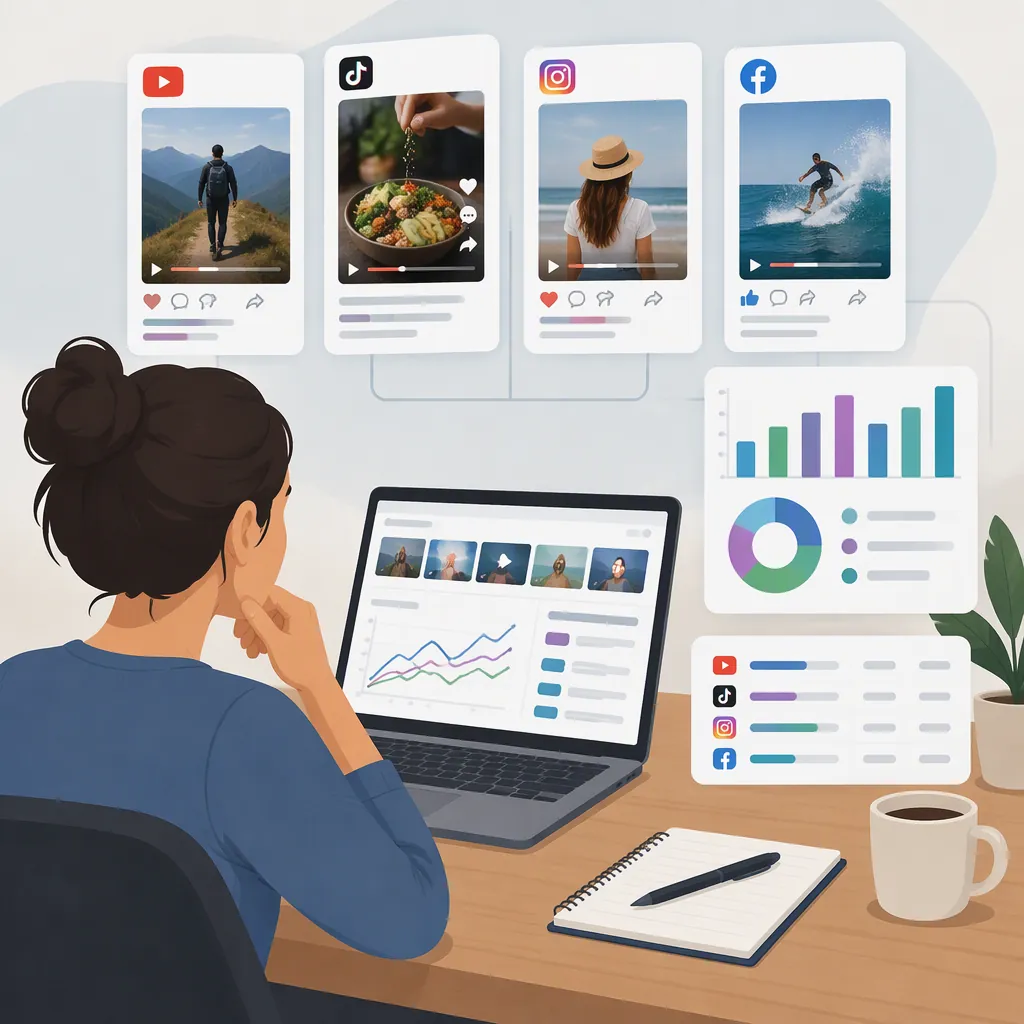
Social media competitor analysis for video means comparing competing accounts’ content choices and observable responses—not simply ranking their most-viewed posts. Examine themes, formats, posting patterns, and comment quality, then identify a pattern worth testing in your own content. Sprinklr’s guide recommends analyzing these dimensions and testing gaps rather than copying competitors. Public observations alone should not be treated as proof of retention, conversion, or the cause of a video’s performance. [c1]
Define What Makes a Video Comparable
Begin with a narrow question: Which approaches to the same audience problem attract visible responses? This is more useful than asking which account is best overall.
Include both direct competitors and creators competing for the same audience’s attention. Sprinklr’s guide distinguishes product competition from attention competition and recommends examining content creators alongside rival brands. [c1]
For a public-only review, use a consistent collection rule:
- Compare videos on the same platform and in a similar format.
- Choose a shared publication window and record each observation date.
- Separate tutorials, demonstrations, commentary, and promotional videos.
- Record every eligible video in the chosen sample, not just apparent winners.
- Mark unavailable counts as unavailable, not zero.
These are recommended sampling rules, not a claim that every account or platform exposes equivalent information. Keep older videos separate from newer ones rather than treating their accumulated counts as directly comparable.
Read Public Metrics Without Overclaiming
Sprinklr’s guide recommends moving beyond follower counts and likes to examine engagement quality, format performance, and audience conversations. [c1] For a public-only video review, restrict that approach to information you can actually observe.
| Observation | Useful Interpretation | Conclusion to Avoid |
|---|---|---|
| Displayed video views | A recorded count to compare within your defined sample | Unique audience size or completed views |
| Visible likes and comments | Observable interaction with the video | Satisfaction, sales, or loyalty |
| Repeated questions in comments | A possible topic or explanation gap | A representative survey of the audience |
| Recurring themes across stronger posts | A candidate pattern for further testing | Proof that the theme caused performance |
| Publication dates | Posting cadence within the sampled window | The account’s staffing or budget |
If you calculate an interaction ratio, name the inputs explicitly—for example, visible likes plus comments divided by displayed views. Do not label it a standardized engagement rate or mix it with a follower-based rate.
Keep paid distribution, watch time, saves, reach, and conversions marked as unknown unless the specific information is publicly disclosed. Do not infer those values from a large view count.
Connect Video Patterns to Audience Needs
Review the video itself alongside its visible counts. Sprinklr’s guide suggests examining format mechanics such as visual hooks, pacing, and narrative structure, then adapting useful principles instead of copying the execution. [c1]
Use three passes:
- Opening: What question, problem, or promise appears first? Does the video show the outcome before explaining the process?
- Explanation: Does it use a demonstration, comparison, story, or step-by-step sequence? Where does the explanation become difficult to follow?
- Response: Do visible comments ask for clarification, describe a use case, challenge the claim, or discuss something unrelated?
Keep observations separate from explanations. “Several sampled demonstrations attracted questions about setup” is an observation. “Showing setup earlier may answer an unmet need” is a hypothesis. “The competitor’s audience prefers demonstrations” is too broad without stronger evidence.
Look for repeated patterns across multiple sampled videos. A single unusually successful post can suggest a question to investigate, but it should not become the whole strategy.
Keep an Observation-To-Hypothesis Worksheet
Use one row per video so that the interpretation remains traceable to a public post and a collection date. The worksheet below is a proposed analysis template, not an export format from a named tool.
Retain both typical posts and apparent outliers. When summarizing, state the sample size, date window, and missing fields before describing a pattern. If comments are sampled rather than reviewed in full, record how they were selected.
Public Video Comparison Worksheet
Account:
Platform:
Public post URL:
Publication date:
Observation date:
Video format and topic:
Opening promise or question:
Explanation structure:
Displayed views, if available:
Visible likes, if available:
Visible comments, if available:
Comment selection method:
Recurring questions or reactions:
Unavailable information:
Observed pattern:
Alternative explanation:
Hypothesis to test:
Confidence and reason:
Turn a Competitor Pattern into a Test
The useful output is a small, measurable experiment—not a declaration that a competitor has discovered the best format. Sprinklr’s guide recommends selecting a content gap, defining a hypothesis and KPIs, and measuring a pilot before expanding it. [c1]
For example, if sampled competitor videos explain an outcome but leave repeated setup questions unanswered, test an original video that shows the setup first. This is a hypothetical application, not a reported customer result.
Choose the success measure before publishing. Use public metrics for public comparisons; evaluate your own test with metrics you are authorized to access. Do not present private performance data as something observed on a competitor’s account.
After the test, record whether the result supported the hypothesis, contradicted it, or remained inconclusive. A content choice worth testing is not necessarily a content choice worth scaling.
Video Experiment Brief
Observed competitor pattern:
Public examples and observation dates:
Unanswered audience question:
Hypothesis:
Original creative change:
What will remain consistent:
Primary success measure:
Comparison baseline:
Review date:
Result:
Limitations:
Decision: repeat, revise, stop, or gather more evidence.
FAQ
Should I Compare Only Direct Competitors?
No. Include relevant creators or publishers competing for the same audience’s attention, while keeping their role distinct from direct product competitors. Sprinklr’s guide makes this distinction between product and attention competition. [c1]
Is the Highest-Viewed Video the Best Model to Follow?
Not automatically. Treat it as an example to inspect, not proof of a repeatable strategy. Compare its topic, format, age, and visible responses with the rest of your sample. Keep distribution and business outcomes unknown when they are not publicly disclosed.
How Do I Use Competitor Insights Without Copying?
Extract a principle—such as answering a recurring question or showing a process more clearly—and test an original execution. Sprinklr’s guide recommends adapting format mechanics and testing content gaps rather than imitating competitors. [c1]