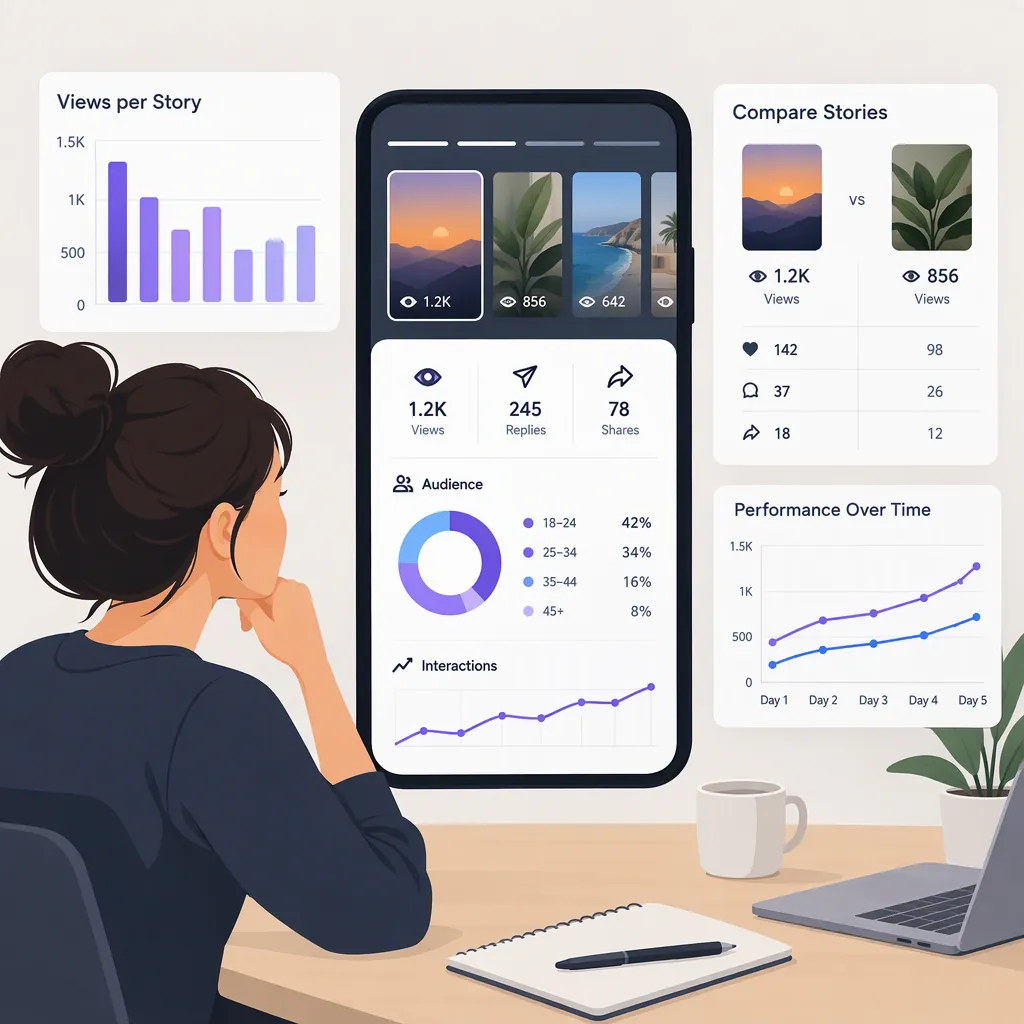
Instagram Story Analyzer: How to Interpret Story Performance
An Instagram Story analyzer should help you evaluate individual Stories, not just follower counts or overall account engagement. Look for explicitly documented Story metrics, clear reporting periods, and usable exports. Minter.io lists Story reach and views, while Adam Connell’s comparison describes several tools with Story analytics. HypeAuditor’s free audit instead lists engagement rate, follower count, and Audience Quality Score; those are not a substitute for a Story performance report. These sources describe capabilities, but do not establish a independently verified ranking. [c1] [c2] [c3]
Start with the Question, Not the Dashboard
Before comparing tools, decide what you want to learn: whether a Story reached its intended audience, whether a sequence maintained attention, or whether a particular frame prompted an action.
Keep account-level analysis separate from Story-level analysis. HypeAuditor describes its free Instagram audit as showing engagement rate, follower number, and its proprietary Audience Quality Score. That can provide account context, but the supplied page does not document frame-by-frame Story performance in the free audit. [c2]
For Story analysis, require an explicit description of the available Story fields. Minter.io’s page names reach and views, but its phrase “all the key metrics” does not enumerate every field. Do not assume that replies, navigation events, or link interactions are included without checking the actual report. [c3]
Analysis Brief
Complete before reviewing a report:
- Question: What do I want to learn about this Story?
- Unit: One frame, one sequence, or a group of sequences?
- Outcome: Exposure, attention, or a specific action?
- Required fields: Which exact metrics would answer the question?
- Comparison: Which similar Stories will I use?
- Evidence boundary: Which fields are unavailable or only estimated?
Compare Documented Capabilities Without Ranking Winners
The supplied references support a shortlist of capabilities to investigate, not a definitive best-tool verdict.
| Tool or Tool Type | What the Reference Describes | What Still Needs Checking |
|---|---|---|
| Minter.io | Story reach and views, retained Story data, and analytics exports. [c3] | Exact Story fields, collection start date, and which exports include those fields. |
| Social Status | Analysis of specific Stories alongside posts and Reels, plus customizable reporting. [c1] | Frame-level detail and the Story metrics included in each report. |
| Pallyy | Story analytics and customized reports; the comparison says automated report delivery is unavailable. [c1] | Current reporting options and the exact Story fields offered. |
| Iconosquare | Story insights, customizable dashboards, and automatic reports. [c1] | Which dashboard widgets and exports apply specifically to Stories. |
| Metricool | Analytics covering Stories and Reels, with reporting described for paid users. [c1] | Story-specific history, export fields, and current plan restrictions. |
| HypeAuditor Free Audit | Account engagement, follower count, and Audience Quality Score. [c2] | Whether a separate offering supplies the Story data needed for your question. |
Adam Connell’s article is an editorial comparison with an affiliate disclosure. Its rankings and usability judgments are the author’s assessments, not independent measurements reproduced here. Minter.io and HypeAuditor describe their own offerings. Treat all three as sources of documented descriptions rather than proof of equivalent coverage or performance. [c1] [c2] [c3]
Interpret Metrics with Explicit Denominators
Use the following as an analysis method, not as a claim about metrics available in every tool.
- Read the field definitions. Preserve the report’s exact labels and definitions. Do not silently replace “views” with “reach” or combine differently defined fields.
- Separate exposure from actions. Review available exposure counts alongside any documented action counts. A larger exposure count alone does not answer whether the intended action happened.
- Name every rate. If you calculate replies divided by reach, call it “replies per reached account,” rather than an undefined engagement rate.
- Keep sequence calculations conditional. If comparable reach values are available for the first and last frames, you can calculate a last-to-first reach ratio. Do not label that ratio as the percentage of people who completed the sequence: the aggregate counts alone do not establish that the same people saw both frames.
- Record uncertainty. Mark unavailable fields as unavailable, not zero. Treat a single result as a hypothesis to investigate rather than evidence of why people behaved a certain way.
The supplied references do not provide a universal Story completion formula or a universal “good” Story engagement benchmark. This guide therefore recommends transparent calculations rather than importing an unsupported target.
Conditional Calculation Sheet
Use only when the required fields are available and comparably defined:

Last-to-first reach ratio (%) = last-frame reach / first-frame reach × 100
Action count per reached account (%) = selected action count / reach × 100

Rules:
- Leave the result undefined when the denominator is zero or missing.
- Name the selected action explicitly.
- Record the reporting window and source field definitions.
- Do not interpret the first formula as verified viewer completion.
- Do not interpret the second formula as unique people taking action unless the source defines it that way.
Build a Repeatable Story Review
For a practical review, group Stories by purpose before comparing their results. Keep sequence length, posting context, and measurement timing visible so that differences are not mistaken for explanations.
Record each frame’s position and content role: opening, explanation, example, or action prompt. Then inspect where available metrics change. Write an observation first, a possible explanation second, and a test third. For example, a lower last-to-first reach ratio is an observation; an unclear opening is only one possible explanation.
History also needs careful treatment. Minter.io says it retains Story insights and updates media data hourly. That statement does not specify that every metric is available from before connection. Adam Connell’s comparison describes differing history and reporting limits across tools. Ask when collection begins and whether older values are observed, estimated, or unavailable. [c3] [c1]
Story Review Worksheet
| Sequence | Goal | Frame Position | Content Role | Measurement Time | Available Metrics | Missing Fields |
|---|---|---|---|---|---|---|
| Enter identifier | Enter goal | Enter position | Enter role | Enter time | Enter labeled values | Enter limitations |

Review notes:
- Observation: What changed in the recorded metrics?
- Hypothesis: What might explain the change?
- Alternative explanation: What else could explain it?
- Next comparison: What single variable will I examine?
- Limitation: What cannot be concluded from these data?
Keep Access and Evidence Limits Visible
A username-based account audit and connected-account Story analytics are different evidence sources. HypeAuditor’s free audit describes a username lookup for account metrics. Minter.io’s setup instructions describe connecting an Instagram Business or Creator account. Neither description establishes that entering someone else’s username reveals all of their detailed Story results. [c2] [c3]
For competitor comparisons, distinguish public observations, estimates, and authorized account data. Minter.io advertises competitor benchmarking that includes Stories, but the supplied page does not define the visibility of each competitor Story field. That is a limitation to verify, not a basis for assuming private-data access. [c3]
No supplied reference provides a shared sample dataset tested across these tools. Accordingly, this article does not rank their accuracy, declare one universally best, or treat current pricing and plan access as independently verified.
FAQ
Is an Instagram Audit the Same as a Story Analyzer?
Not necessarily. HypeAuditor’s free audit lists engagement rate, follower count, and Audience Quality Score. Minter.io separately documents Story reach and views. For Story performance questions, require explicitly documented Story-level data rather than relying on an account score. [c2] [c3]
What Is a Good Instagram Story Completion Rate?
The supplied references do not establish a universal benchmark. Compare similarly structured sequences using consistently defined metrics. If you calculate last-frame reach divided by first-frame reach, label it a reach ratio rather than verified completion by the same viewers.
Can a Story Analyzer Recover Older Story Data?
Do not assume retention means recovery. Minter.io says it keeps Story insights, but the supplied page does not establish complete pre-connection history for every Story metric. Verify the collection start date, available historical fields, and whether values are observed or estimated. [c3]
Can I Analyze Another Account’s Stories by Username?
A username lookup does not, by itself, establish access to detailed Story results. HypeAuditor documents account-level audit metrics, while Minter.io advertises competitor benchmarking without specifying every competitor Story field. Treat detailed competitor Story access as unverified from these references. [c2] [c3]