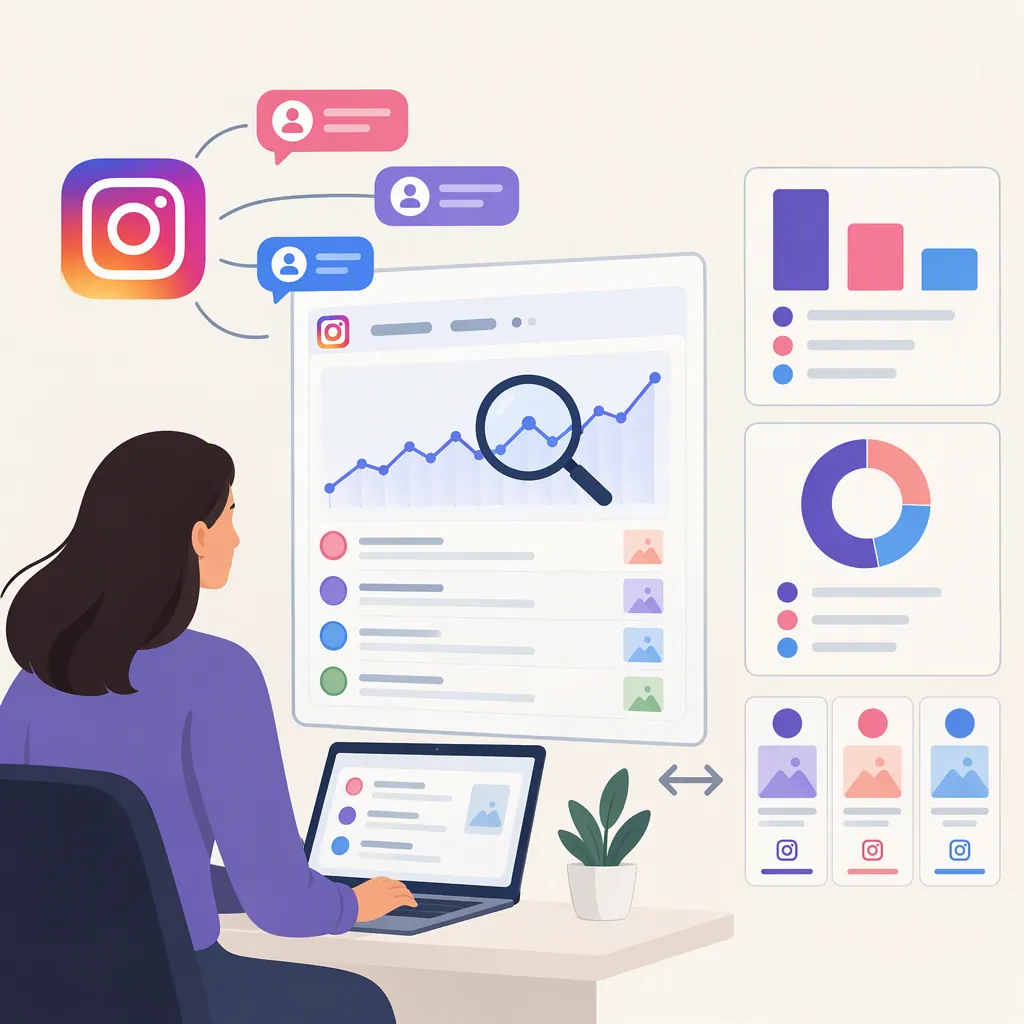
Instagram Mention Tracker: Compare Coverage, Not Just Features
An Instagram mention tracker helps organize references to an account, brand, or keyword. Direct @mentions and untagged keyword references require different checks: notifications are a starting point for direct mentions, while broader monitoring requires evaluating keyword coverage. Compare tools by the public content they actually retrieve, not by an assumption that they capture every mention. The supplied vendor guides describe these approaches but do not independently establish complete Instagram coverage. [c1] [c2]
Define What Counts as a Mention
Before comparing tracking methods, separate the signals you want to collect:
- Direct @mentions: references that explicitly use your account handle.
- Untagged references: a brand or product name written without the handle.
- Hashtag references: posts associated with a selected branded or campaign hashtag.
- Relevant comments: comments that contain a tracked reference, rather than every interaction on your account.
Brand24’s guide distinguishes tagged mentions, untagged references in captions and comments, and hashtag conversations. Awario’s guide describes notifications as one way to find mentions. These distinctions are useful for defining a monitoring brief; they are not proof that any tool retrieves every item in each category. [c1] [c2]
Keep the brief public-only. Exclude private accounts and DMs from the dataset, and do not treat public visibility as a guarantee of third-party access.
Compare Tracking Methods by the Question They Answer
Account performance and public conversation discovery are different tasks. Brand24’s guide presents Instagram Insights as account-focused analytics and distinguishes it from social listening. Iconosquare’s homepage also presents analytics, conversations, and listening as separate feature categories. Neither source establishes that these categories have identical coverage across tools. [c1] [c3]
Use this framework to compare methods without assuming feature parity:
| Method | Evaluation Question | Limitation to Check |
|---|---|---|
| Native notifications | Which direct mentions can I review in Instagram? | Whether the workflow addresses untagged references |
| Account analytics | How is my own content performing? | Whether the metric describes account activity rather than discovered mentions |
| Manual public review | Can I verify a known public reference? | Time required and consistency of the review scope |
| Keyword monitoring | Which public references match my chosen terms? | Supported formats, permissions, exclusions, and retrieval gaps |
Treat a shared label such as “listening” or “mentions” as a prompt for further verification, not as a coverage specification.
Check Coverage Before Comparing Mention Counts
The supplied sources are vendor-authored materials, not an independent coverage audit. They do not provide enough evidence for a reliable product ranking or a promise of exhaustive Instagram tracking. Brand24 describes broad monitoring possibilities, while Awario’s supplied guide gives a general overview of mention discovery rather than a detailed format-by-format coverage specification. [c1] [c2]
For each candidate method, document:
- Match type: handle, exact phrase, hashtag, or another supported rule.
- Content scope: public captions, comments, Reels, and Stories, checked separately.
- Access requirements: account connections and permissions, if applicable.
- Timing: collection start date, available history, and observed retrieval delay.
- Record quality: source URL, timestamp, context, and duplicate handling.
- Unknowns: any scope or behavior that has not been verified.
Use a small set of known public examples to check retrieval. Record a missing example as a gap in that check, not proof of a universal failure. Likewise, finding one example does not establish complete coverage.
Compare counts only after aligning the query, date range, content scope, and counting unit. A post and several matching comments should not silently become one “mention” in one report and several in another.
Public Mention Coverage Worksheet
For each known public example, record:
- Source URL:
- Content format:
- Reference type: @mention / untagged phrase / hashtag
- Expected matching term:
- Publication time, if visible:
- Review date and time:
- Tracking method:
- Retrieved: yes / no / not checked
- Retrieval time, if available:
- Required connection or permission:
- Duplicate status:
- Limitation or unresolved question:

Summary rule: Report results only for the examples and scope checked. Mark unverified coverage as unknown.
Build a Repeatable Public-Only Review Workflow
Brand24’s guide recommends defining keywords, filtering results, configuring alerts, and reviewing changes over time. Use those ideas as workflow options rather than guarantees of retrieval or alert speed. [c1]
A practical review sequence is:
- Write a narrow keyword brief. Include the handle, brand name, product names, common spelling variants, and relevant hashtags.
- Review ambiguity. Identify unrelated meanings and define exclusions where the chosen method supports them.
- Verify context. Open the available public source before assigning a topic, priority, or sentiment label.
- Separate relevance from urgency. A matching term is not automatically a complaint or a reason to respond.
- Assign a disposition. Use categories such as informational, review needed, duplicate, or irrelevant.
- Report observed results. Preserve the query, date range, coverage notes, and any changes to collection settings.
If automated sentiment is available, use it as a preliminary label and review context before acting. Keep DMs and private-account content outside this public-only workflow.
Report Captured Mentions, Not Total Conversation
Prefer “captured public mentions matching this query” to “all Instagram mentions.” The supplied guides describe monitoring methods, but they do not establish a complete platform-wide dataset. [c1] [c2]
A useful report should state its collection window, included content types, keyword rules, duplicate policy, and known gaps. Keep account-performance metrics separate from mention-discovery metrics.
If mention volume changes, first check whether the query or collection scope changed. Treat any explanation for the change as a hypothesis until the retrieved content supports it. This keeps a monitoring report useful without overstating what the dataset represents.
FAQ
Can an Instagram Mention Tracker Find Untagged References?
Keyword monitoring is intended to find references that do not use an @handle, as described in Brand24’s guide. That does not guarantee retrieval of every public reference. Verify the supported content types and matching rules, then check known public examples. [c1]
Is Instagram Insights the Same as a Mention Tracker?
No. Brand24’s guide describes Instagram Insights as analytics for your own account and distinguishes it from broader monitoring of references elsewhere. Account performance and public mention discovery should be evaluated separately. [c1]
Can These Sources Identify the Best Instagram Mention Tracker?
Not reliably. The supplied references are vendor-authored guides and a product homepage, not an independent comparison using a shared test dataset. They support an evaluation framework, but not a verified ranking, complete coverage claim, or like-for-like performance comparison. [c1] [c2] [c3]