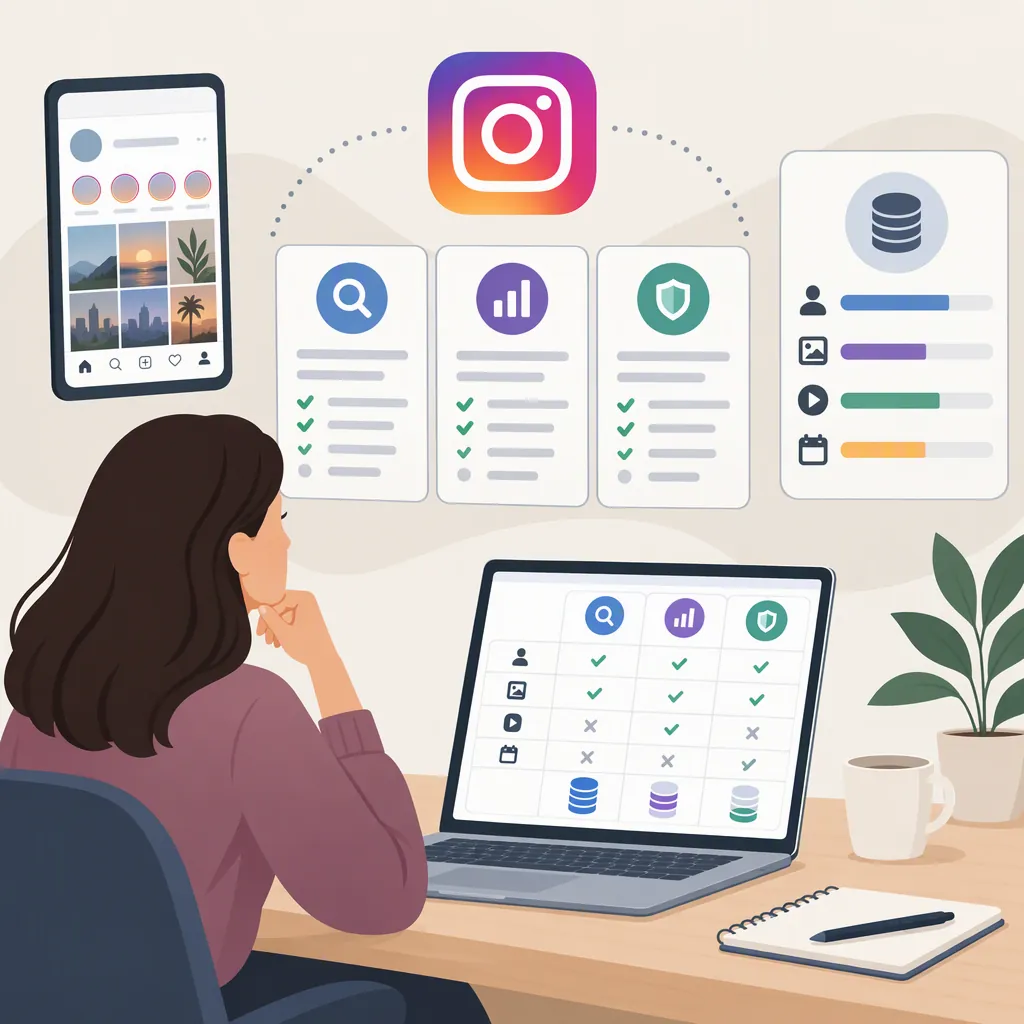
How to Choose and Use an Instagram Tracker
Choose an Instagram tracker by the question you need answered: public account growth, changes in following relationships, or downloadable follower lists. These are different workflows, not interchangeable features. The supplied sources describe each category, but they do not independently establish accuracy, completeness, or safety. Treat vendor descriptions as starting points for evaluation, not verified performance guarantees.
Match the Tracker Type to Your Question
Before comparing tools, write down the decision the data should support. A useful comparison separates account-level trends from relationship-level changes and list exports.
| Your Question | Relevant Workflow | What to Check |
|---|---|---|
| Is a public account growing? | Account statistics over time | Observation dates, missing days, and metric definitions |
| Which accounts appeared in a following list after monitoring began? | Following-list change detection | Starting snapshot and first-seen timestamps |
| How do two follower lists differ? | List export and snapshot comparison | List direction, collection dates, and completeness |
| Which posts received more visible interaction? | Public engagement comparison | Included posts, observation window, and calculation method |
OwlStat's page describes public account statistics and daily history. DolphinRadar's page describes new following entries detected after an initial snapshot. LinkedRadar's page describes follower and following exports. These descriptions indicate different intended workflows; they are not evidence that the tools deliver equivalent coverage. [source_owlstat] [source_dolphinradar] [source_linkedradar]
Decision Statement Template
Question: What decision am I trying to make?
Public account: Which profile is relevant?
Required data: Counts, post interactions, relationship changes, or list exports?
Observation period: What start and end dates will I use?
Acceptable limitations: What missing data would make the result unusable?
Compare Source Descriptions, Not Promises
The following comparison summarizes the supplied pages. It is not a hands-on review or a ranking.
| Source | What Its Page Describes | Evaluation Priority |
|---|---|---|
| OwlStat | Public follower, following, and post counts; engagement rate; daily growth history | Confirm when history starts and how engagement is calculated |
| DolphinRadar | A starting following list, followed by newly detected entries | Distinguish detection time from actual follow time |
| LinkedRadar | Public follower and following lists downloadable as CSV or Excel | Check whether the export is complete and when it was collected |
| Followers & Unfollowers | An app listing covering follower relationships, unfollowers, and post analysis | Examine access requirements and evidence behind each label |
These are source-reported descriptions, not independently verified capabilities. [source_owlstat] [source_dolphinradar] [source_linkedradar] [source_followtech]
The Followers & Unfollowers listing also uses labels such as secret admirers and profile visitors. The supplied material does not establish a reliable method for identifying those people. Do not treat such labels as verified evidence of private activity. [source_followtech]
This source set contains vendor pages and one app-store listing, not independent testing or official Instagram documentation. It cannot establish which tool is most accurate, safest, or best value.
Tool Evaluation Record
Tool name:
Source URL:
Relevant workflow:
Source-reported features:
Access or permissions requested:
Data collection timestamp available: Yes / No / Unknown
Metric definitions available: Yes / No / Unknown
Export completeness explained: Yes / No / Not applicable
Independently verified performance: Not established by these references
Unresolved questions:
Separate Observations from Event History
A timestamp needs a definition. DolphinRadar's FAQ says its displayed time is when an account was first seen by the tool, not the exact time the Instagram follow occurred. It also says the starting following list does not reconstruct earlier follow activity or place existing entries in chronological order. [source_dolphinradar]
For analysis, keep three concepts separate:
- Current snapshot: What the tool observed during a particular collection.
- Detected change: A difference between observations.
- Actual event time: When the underlying action happened, which an observation timestamp does not necessarily establish.
Likewise, a change in total follower count does not identify the accounts responsible for that change. Use count history for aggregate trends and separately collected lists for relationship comparisons.
OwlStat describes its public engagement rate as interactions on recent posts divided by follower count. That definition does not make engagement an independent test of audience authenticity. Before comparing accounts, document the included interactions, post window, and denominator. Do not infer private reach, saves, or audience demographics from a public engagement ratio. OwlStat's page distinguishes public statistics from metrics it says require a connected account. [source_owlstat]
Observation Log
Profile | Metric or list direction | Observation time and time zone | Value or file name | Previous observation | Detected difference | Missing-data notes

Interpretation rule: Describe a difference as detected between observations unless the source explicitly supplies and supports an actual event timestamp.
Use a Consistent Public-Only Workflow
For a modest comparison project, prioritize repeatable observations over a large feature list.
- Define one question. For example, compare follower-count trends across public creator accounts during a fixed period.
- Record a baseline. Save the first observation date, metric definitions, and any available export.
- Keep collection consistent. Use the same tool, list direction, and reporting window where possible.
- Log gaps. Mark unavailable observations as missing rather than silently treating them as zero.
- Check completeness before comparing lists. An absent entry in a partial export is not sufficient evidence of an unfollow.
- Report the limits. State the observation period, collection method, and unresolved coverage issues.
LinkedRadar's page describes both follower and following exports in CSV or Excel. That supports considering an export workflow, but its completeness and unlimited-export language remain vendor assertions. [source_linkedradar]
Keep the direction explicit: a followers list concerns accounts following the profile; a following list concerns accounts the profile follows. Do not merge them into one undifferentiated connection count.
Public-Data Report Template
Research question:
Public profiles included:
Observation period and time zone:
Tool and source page:
Metrics and definitions:
Baseline date:
Collection gaps or partial exports:
Observed results:
What the results do not establish:
Retention or deletion date:
Review Access, Privacy, and Uncertainty
For a public-only project, prefer a workflow that stays within public-profile data and does not require account credentials. This is a selection criterion, not a safety guarantee. DolphinRadar, OwlStat, and LinkedRadar describe no-login public-data workflows, but those descriptions do not independently establish their security or privacy practices. [source_dolphinradar] [source_owlstat] [source_linkedradar]
Before using any tool, review its requested permissions, data handling, retention, deletion options, and current costs. A public profile is not a reason to collect more personal information than the analysis needs. Avoid private-account access claims, attempts to bypass privacy settings, and unsupported conclusions about an individual's intentions.
The Google Play listing's Data Safety section identifies its information as developer-provided and notes that practices may vary and change. Treat that disclosure as information to examine, not independent security certification. The supplied references do not establish Instagram-policy compliance or zero account risk for any tool. [source_followtech]
Pre-Use Checklist
- The task uses public accounts only.
- No private-access claim is needed for the task.
- Requested credentials and permissions have been reviewed.
- Collection timestamps and coverage limits are documented.
- Privacy, retention, and deletion terms have been reviewed.
- Pricing and renewal terms have been checked if applicable.
- Unsupported identity or intent labels will not be reported as facts.
FAQ
Which Instagram Tracker Is Best?
The supplied sources do not support an overall winner. Match the workflow to your question: public growth statistics, newly detected following entries, or list exports. Compare timestamp definitions, coverage, access requirements, and reproducibility rather than choosing by the number of advertised features.
Can a Tracker Show Exactly When Someone Followed an Account?
Do not assume it can. DolphinRadar says its timestamps represent first detection, not the exact Instagram follow time. Its starting list also does not reconstruct earlier follow history.
Can These Public-Data Workflows Track Private Accounts?
The public-data pages supplied for DolphinRadar, OwlStat, and LinkedRadar specify public accounts. They provide no basis for recommending private-account access or bypassing privacy settings.
Should I Trust Secret-Admirer or Profile-Visitor Labels?
Not as verified identities based on these references. The Followers & Unfollowers listing advertises those labels, but the supplied material does not establish how they are determined or whether they are reliable.
Does No Instagram Login Mean a Tracker Is Safe?
No-login language describes an access requirement; it does not establish overall safety. Several supplied pages advertise no-login workflows, but the references do not independently verify security, privacy, or platform-policy compliance.
Sources
-
[source_dolphinradar] See Instagram Recent Follows – Track Followers & Following
-
[source_followtech] Followers & Unfollowers - Apps on Google Play
-
[source_owlstat] Instagram Stats Tracker: Check IG Stats for Any Account | OwlStat
-
[source_linkedradar] Free IG Follower Export Tool - Easy, Anonymous & Unlimited