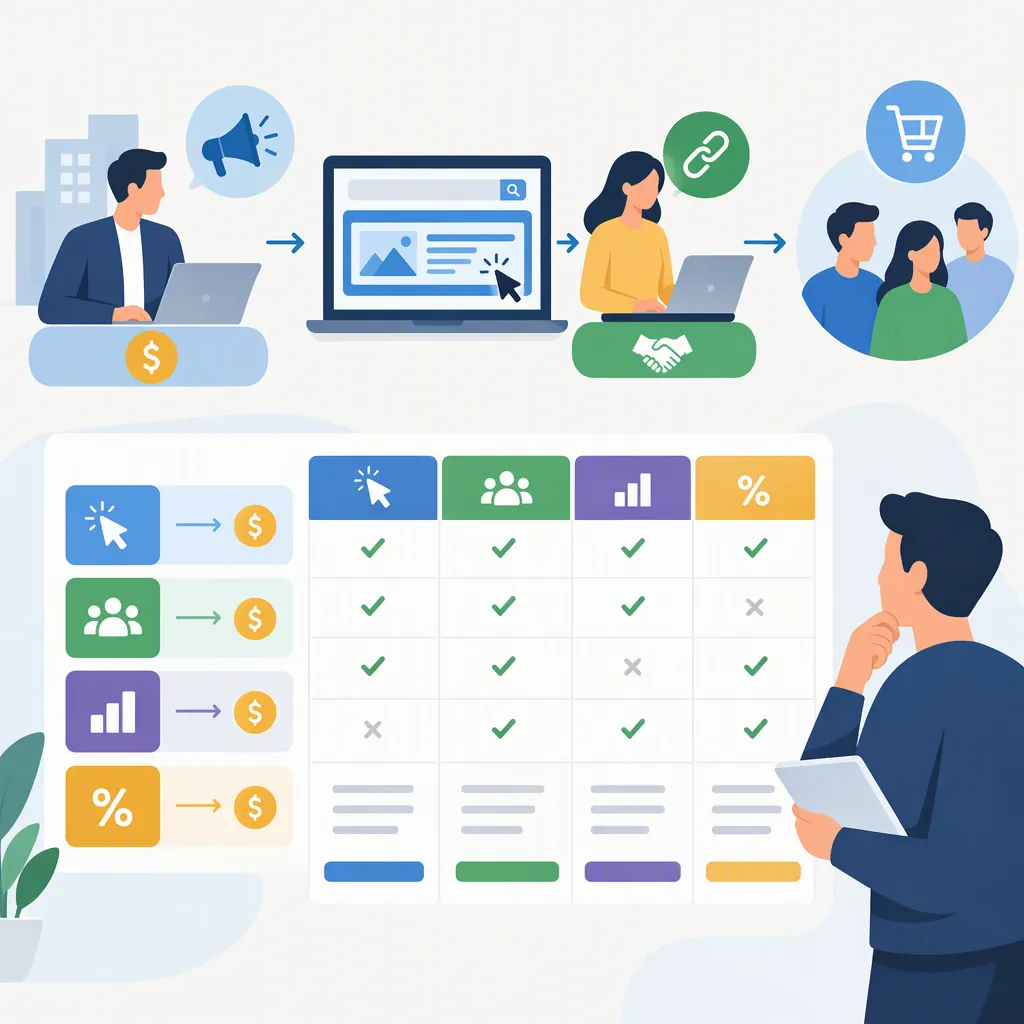
Ppc Affiliate Programs: How to Compare Click-Based Offers
A PPC affiliate program compensates a publisher for clicks on tracked ads or promotional links, rather than requiring a completed purchase. However, lists labeled “PPC affiliate programs” can also include ad networks, ad-management services, and other affiliate arrangements. Compare the actual payment trigger, eligible traffic, and payout terms—not just the label. The supplied sources explain these models but do not establish current terms for every named provider. [cpc] [shopify]
What a Ppc Affiliate Program Pays For
In a click-based affiliate arrangement, a publisher places promotional materials such as banners or text links. A tracked click sends a visitor to the advertiser’s site and generates compensation under the agreement. A purchase or another downstream action is not the payment trigger in a pure CPC model. Post Affiliate Pro describes a typical arrangement with an agreed amount per click. [cpc]
PPC means pay per click; CPC means cost per click. The terms describe related aspects of click-based advertising: the payment model and the cost associated with a click. From an advertiser’s perspective, CPC can also be calculated by dividing campaign cost by clicks. That advertising expense should not be mistaken for the publisher’s earnings per click. [cpc]
Before evaluating an offer, write its payment trigger in one sentence: “The publisher earns when ______.” If the blank requires a sale, signup, or installation, evaluate it as an action-based offer rather than assuming it pays for clicks alone. Shopify identifies pay-per-lead and pay-per-install as alternatives to click-based compensation. [shopify]
Compare the Business Model Before the Brand
Shopify’s article, published July 24, 2024, groups several kinds of services under its PPC affiliate-program heading. Its examples include publisher advertising networks, commerce-link monetization, ad management, and a workflow that combines affiliate offers with purchased advertising traffic. These are not interchangeable arrangements. [shopify]
The following table summarizes how that source describes selected examples. It is a classification aid, not a verified list of current click-paying offers.
| Arrangement | Examples in the Supplied Article | What to Establish Before Comparing |
|---|---|---|
| Publisher advertising networks | Google AdSense, Media.net, Infolinks, Adsterra | Whether the specific product pays for clicks, impressions, actions, or a combination |
| Commerce-link monetization | Skimlinks | Which merchant offers qualify and what event generates a commission |
| Ad-management or publisher technology services | Raptive, Mediavine, Ezoic | How revenue is generated, shared, and reported |
| Native advertising | Outbrain | The applicable publisher product, ad formats, and payment basis |
| Affiliate offers combined with paid traffic | Zeydoo and PropellerAds | The offer’s conversion requirement and the separate cost of acquiring traffic |
These groupings reflect the supplied article’s descriptions, not independently verified current product terms. [shopify]
A reporting metric is not necessarily a payment trigger. For example, Shopify describes Ezoic reporting compensation using earnings per thousand visitors. That metric alone does not establish a fixed payment for each click. Likewise, an advertised revenue-share percentage is not a per-click rate. [shopify]
The practical distinction is between earning from traffic you publish and spending money to acquire traffic for an affiliate offer. For the latter, assess both the offer’s compensation rules and the advertising expense; a click purchased from an ad platform does not itself prove that the affiliate offer pays for clicks.
A Practical Program Comparison Checklist
Shopify recommends evaluating program requirements, compensation details, audience niche, and ad formats. It also notes that payout thresholds, payment methods, and schedules vary. Those are useful comparison categories, but its dated examples should not be treated as current contractual terms. [shopify]
For each candidate, record the following from its current agreement or application materials:
- Payment trigger: What event creates earnings, and which clicks or actions qualify?
- Eligibility: What traffic volume, content, audience location, or site requirements apply?
- Traffic permissions: Are website, social, email, search, or purchased traffic permitted for the specific offer?
- Payment calculation: Is compensation a fixed click rate, a variable amount, a revenue share, or an action-based commission?
- Payout conditions: What threshold, schedule, currency, payment method, and fees apply?
- Ad presentation: Which formats are available, and how much control does the publisher retain?
- Contract restrictions: Are there exclusivity requirements, termination conditions, or rules affecting unpaid balances?
- Measurement: Can reports separate recorded activity from payable activity?
Treat these as questions to resolve, not as claims that every provider imposes the same rules. If a term is unclear, mark it “unverified” instead of assuming that a directory description supplies the answer.
A useful comparison begins with compatibility: whether the program accepts the intended content and traffic. Only then compare potential earnings and payment timing.
Program Comparison Worksheet
Copy and complete one record per candidate:

Program or product:
Source URL and date checked:
Payment trigger:
Definition of payable activity:
Eligible content and audience:
Permitted traffic sources:
Rate or revenue-share calculation:
Minimum payout:
Payment schedule and method:
Ad formats and placement control:
Exclusivity and termination terms:
Unverified terms:
Assessment: compatible / incompatible / insufficient information
Estimate Earnings Without Assuming a Rate
For an agreement that specifies a fixed amount per payable click, a basic planning calculation is:
Estimated gross earnings = payable clicks × agreed earnings per click.
This follows the fixed-rate CPC arrangement described by Post Affiliate Pro. It is not an earnings forecast for any provider named here. [cpc]
Keep recorded clicks and payable clicks separate in the worksheet until the agreement explains how they relate. Do not apply a fixed-rate calculation to a revenue-share arrangement without knowing how the payable revenue is determined.
If traffic is purchased, use a separate planning calculation:
Estimated contribution = affiliate earnings − traffic acquisition cost − other directly attributable costs.
This is an accounting aid, not a guarantee of profit. Avoid treating advertiser CPC, publisher earnings per click, and visitor-based revenue metrics as equivalent measures.
Evidence limitation: This guide uses only the supplied Shopify overview and Post Affiliate Pro glossary. The Shopify overview is dated July 24, 2024; no current provider agreements were supplied. Consequently, this guide does not verify present-day rates, eligibility thresholds, payout schedules, availability, or permission to use a particular traffic source. The named examples are starting points for classification, not a ranking or endorsement. [shopify] [cpc]
FAQ
Are Ppc and Cpc the Same Thing?
They are closely related. PPC names the pay-per-click model, while CPC names the cost associated with a click. In an affiliate arrangement, confirm the publisher’s compensation separately from the advertiser’s cost. [cpc] [shopify]
Does a Visitor Need to Buy Something?
Not in a pure click-based affiliate arrangement: the click is the payment trigger. A program that requires a purchase, lead, or installation uses a different trigger, even if it appears in a broad PPC-program list. [cpc] [shopify]
Which Ppc Affiliate Program Is Best?
The supplied evidence does not support one universal winner. Compare the payment model, eligibility, audience fit, ad formats, and payout conditions. Shopify identifies these as relevant selection factors, but its overview does not verify current terms for every provider. [shopify]
Do Ppc Affiliate Programs Require Minimum Traffic?
Requirements vary. The supplied Shopify article describes both programs with traffic thresholds and examples without minimum traffic requirements. Because those descriptions are dated, verify the current requirements for the specific product rather than relying on the historical list. [shopify]
Is Buying Ppc Ads the Same as Joining a Ppc Affiliate Program?
No. Buying ads creates a traffic acquisition expense; a click-paying affiliate arrangement generates compensation for qualifying clicks. Shopify includes a Zeydoo and PropellerAds workflow involving affiliate offers and paid traffic, so both the offer’s payment trigger and the advertising cost need separate evaluation. [shopify] [cpc]