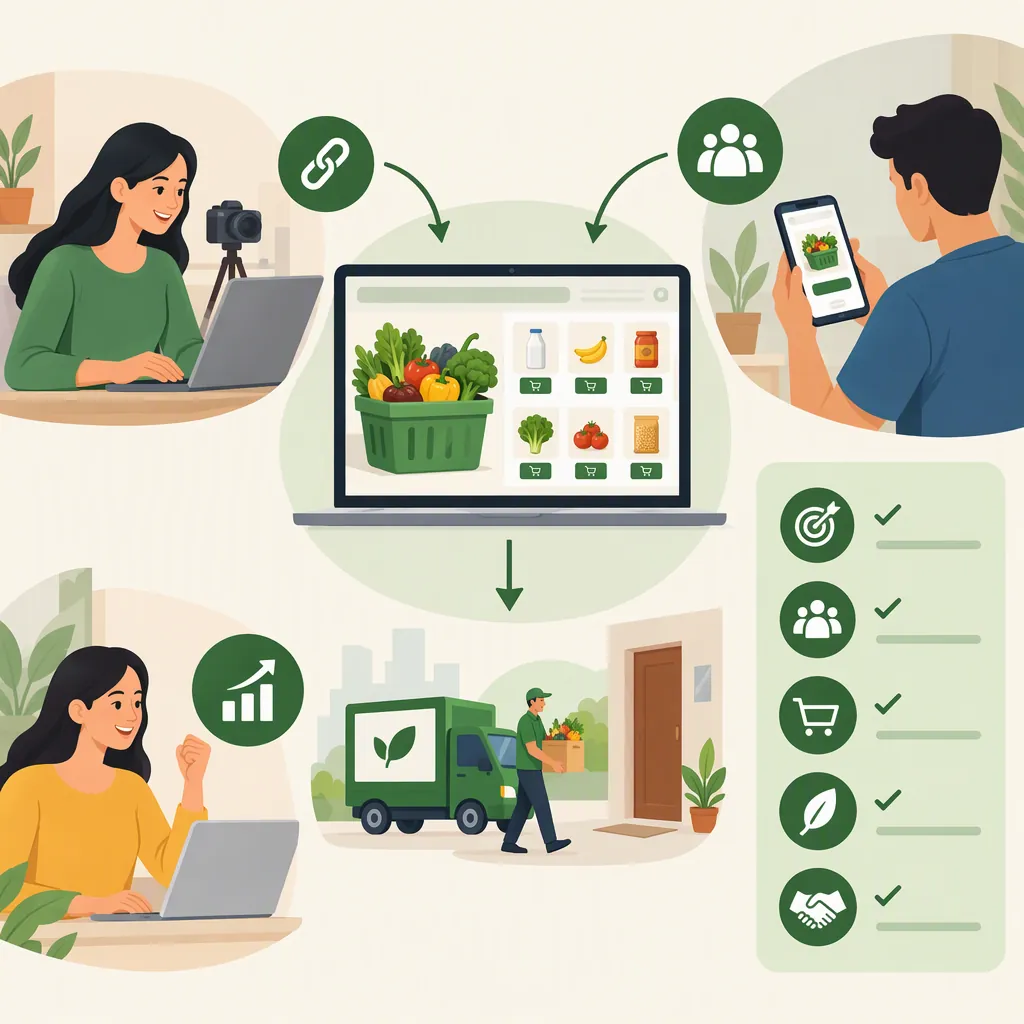
Bigbasket Affiliate Program: Unverified Status and Preliminary Suitability
The reference available for this overview does not confirm an active BigBasket affiliate program, an enrollment route, or publisher payment terms. It describes BigBasket’s grocery business and retail revenue model—not an affiliate offering. The assessment below therefore distinguishes potential content relevance from verified participation and earning conditions. This evidence gap does not establish that no program exists. [reference-1]
Program Overview and Evidence Status
The cited source is an article from Miracuves, an independent software development company, rather than an identified BigBasket affiliate operator. Miracuves explicitly states that it is not affiliated with or endorsed by the companies discussed. Its advertised BigBasket-like software is a separate offering, not evidence of a BigBasket affiliate program. [reference-1]
| Area | What the cited source establishes | Implication for publishers |
|---|---|---|
| Business context | Miracuves describes BigBasket as an online grocery service offering fresh produce, daily essentials, and household products across multiple cities in India. [reference-1] | Grocery and household-shopping content has a plausible topical connection. |
| Program identity and availability | No affiliate operator, current application route, or publisher agreement is identified. [reference-1] | Neither active enrollment nor the absence of a program can be confirmed. |
| Publisher eligibility | Accepted publisher locations, channels, and promotional methods are not established. [reference-1] | A relevant audience does not, by itself, establish permission to participate. |
| Commission and attribution | No affiliate rate, payable action, attribution window, or referral-crediting rules are established. [reference-1] | There is no supported basis for an affiliate earnings estimate. |
| Payment conditions | No affiliate payout threshold, validation period, or payment schedule is established. [reference-1] | Commercial suitability remains undetermined. |
| Consumer coverage | The article provides an Indian, multi-city business context, not verified current delivery coverage for individual locations. [reference-1] | Audience access needs to be assessed separately from publisher eligibility. |
These limits apply to the cited material. They are not a comprehensive finding about every possible BigBasket partnership or offer.
Retail Revenue Is Not Affiliate Compensation
Miracuves discusses grocery sales, private labels, delivery fees, subscriptions, advertising, and bulk supply as ways BigBasket earns retail revenue. Those channels describe the retailer’s business, not what a publisher would receive for a referral. Product margins and customer charges must not be reused as affiliate commission figures. [reference-1]
The distinction also applies to recurring purchases: a business may receive repeat orders without offering publishers repeat-purchase commissions.
Potential Fit for Grocery-Focused Creators
BigBasket’s described grocery and household-essentials business has a plausible editorial connection to meal planning, pantry organization, grocery budgeting, and household-shopping content. These are assessments of subject relevance, not confirmed commission-eligible content categories. [reference-1]
For creators, suitability depends on three separate questions:
- Topic fit: Does the content help readers make a grocery-shopping decision?
- Consumer access: Can those readers use the service at their actual delivery locations?
- Publisher eligibility: Would applicable program terms accept the creator’s location, channel, and promotional methods?
Miracuves describes BigBasket in an Indian service context. That background does not establish current delivery areas or affiliate eligibility. An English-language article should not be interpreted as evidence of U.S. consumer coverage or acceptance of U.S.-based publishers. [reference-1]
A Conditional Suitability Decision
The following are editorial decision rules, not verified BigBasket program requirements:
| Situation | Preliminary judgment |
|---|---|
| The intended audience cannot use the service | BigBasket would generally be a poor focus for purchase-oriented recommendations to that audience, even if the topic is relevant. |
| The audience can use the service, but publisher eligibility and commercial terms remain unconfirmed | Content relevance may be established, but an affiliate opportunity has not been verified. |
| Audience access, publisher eligibility, payable actions, and payment conditions are confirmed in current terms | A commercial assessment becomes possible, including whether eligible transactions fit the audience’s shopping behavior. |
| Participation is permitted, but the intended promotional channel is excluded | The opportunity would not fit that channel without a different permitted approach. |
This framework avoids treating a grocery-focused audience as sufficient evidence of earning potential. It also separates an audience’s ability to shop from a creator’s ability to receive referral compensation.
What Would Determine Commercial Suitability?
A commercial assessment requires an identifiable offer and current participation terms. Once those are available, the following details matter more than the retailer’s general revenue model.
| Term to establish | Question it should answer |
|---|---|
| Operator and governing agreement | Who administers the offer, and which terms apply to the publisher? |
| Payable action | Is compensation tied to an eligible order, a new customer, or another specified action? |
| Eligible customers and products | Can returning customers qualify, and are any categories or transactions excluded? |
| Attribution rules | How are referrals credited, for how long, and what happens when other referral sources are involved? |
| Permitted promotion | Are the publisher’s intended website, social, email, or other channels allowed? |
| Cancellations and validation | When can a transaction be rejected or compensation reversed? |
| Payment conditions | What thresholds, schedules, deductions, and payment methods apply? |
For example, a hypothetical new-customer-only offer would have a different fit from one rewarding eligible repeat purchases. A creator whose audience already uses the retailer might find the former less relevant. This illustrates how offer terms affect suitability; it does not describe BigBasket’s rules.
Preliminary conclusion: BigBasket has a plausible topic fit for grocery and household-content publishers. On the evidence available here, it cannot yet be classified as a verified affiliate opportunity or a dependable income source. The missing program information is summarized in the status table above. [reference-1]
FAQ
Does Bigbasket Currently Have an Active Affiliate Program?
The cited Miracuves article does not establish current affiliate availability or identify an enrollment operator. This overview therefore confirms neither an active program nor that no program exists. [reference-1]
Are Bigbasket’s Retail Margins the Same as Affiliate Commissions?
No. Retail margins concern the retailer’s earnings from selling products; affiliate commissions concern compensation under a publisher referral agreement. Miracuves discusses the former but does not establish the latter for BigBasket. [reference-1]
Does Bigbasket Delivery Coverage Establish Publisher Eligibility?
No. Consumer access and publisher eligibility answer different questions. Even if readers can place orders, that does not establish whether a creator’s country, channel, or promotional method is accepted. The cited source does not provide current BigBasket affiliate eligibility rules. [reference-1]
Is Bigbasket Suitable for Food Creators Outside India?
There is a plausible subject connection for food and grocery creators, but location-specific suitability cannot be confirmed here. Miracuves describes an Indian grocery business without establishing current consumer coverage or publisher geographic eligibility. A useful assessment would first separate audience access from participation eligibility, then examine any verified commercial terms. [reference-1]