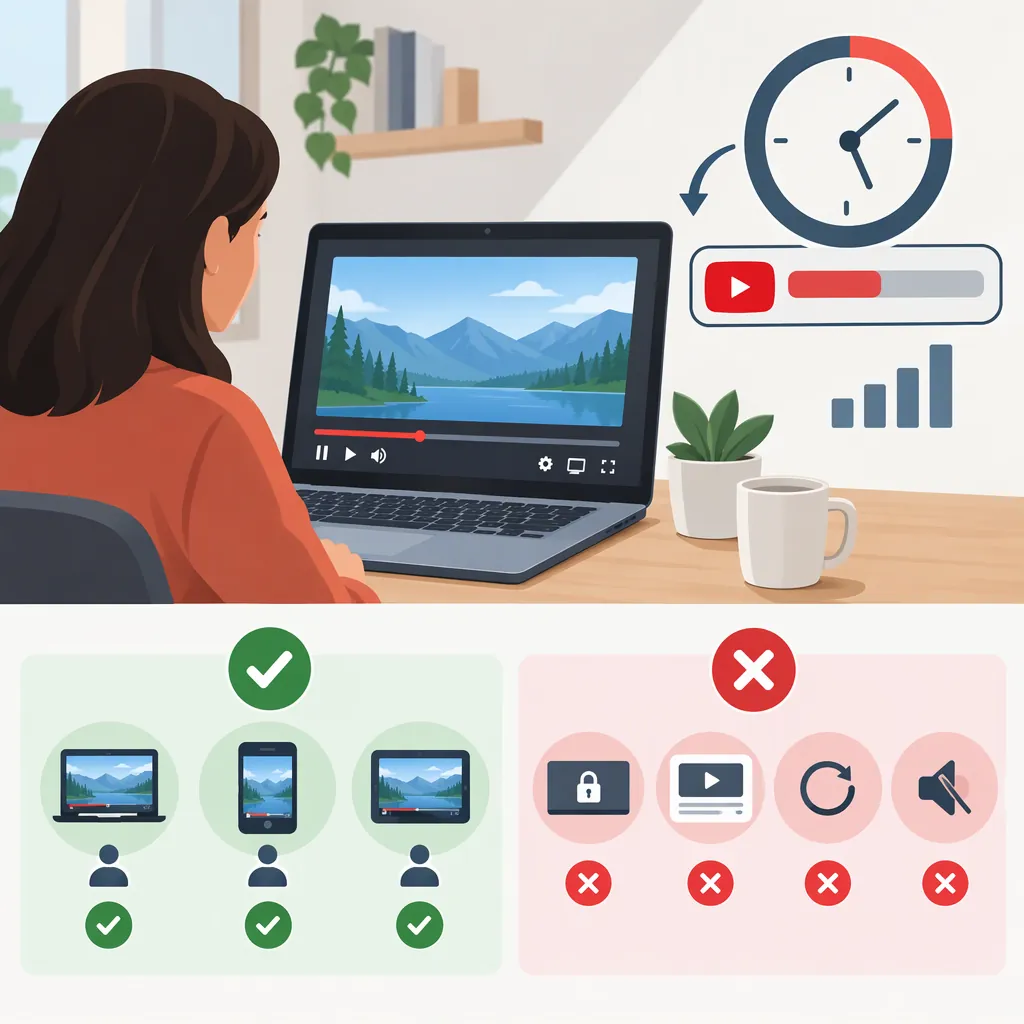
YouTube Valid Public Watch Hours and Monetization Eligibility
To understand YouTube valid public watch hours, separate the amount of time viewers spend watching from whether that time qualifies for monetization. The supplied source defines watch hours as total viewer watch time and mentions a 4,000-hour YouTube Partner Program requirement. However, it does not explain which viewing activity qualifies as valid public watch hours or provide complete eligibility rules. A watch-time estimate therefore cannot establish eligibility by itself. [c1]
How Watch Hours Are Calculated
The supplied SEO.AI article defines watch hours as the total time viewers spend watching your videos. Its calculator uses total views and average view duration to estimate watch time. [c1]
The basic arithmetic is:
Estimated watch hours = views × average view duration in minutes ÷ 60.
For a hypothetical video with 1,200 views and an average view duration of 5 minutes, the estimate is 6,000 minutes, or 100 watch hours. That calculation estimates viewing time; it does not determine how many of those hours qualify for monetization.
Do not multiply an already aggregated watch-time total by the number of viewers again. The source's example table is inconsistent with its stated total-time definition, so the calculation here follows the definition rather than that table. [c1]
Worked Watch-Time Calculation
Hypothetical inputs:
Views = 1,200
Average view duration = 5 minutes

Estimated watch hours = (1,200 × 5) ÷ 60
Estimated watch hours = 100

Interpretation: 100 estimated hours of viewing, not a verified total of valid public watch hours.
Watch Time Is Not a Complete Eligibility Test
A calculation answers how much viewing time occurred. The eligibility question asks which viewing time qualifies toward a requirement. Those are different questions.
The supplied article discusses watch-hour thresholds for monetization, but it does not define the qualifying rules for “valid public watch hours.” It does not establish how private, unlisted or deleted videos, Shorts, livestreams, or advertising-driven views are treated. No inclusion or exclusion rule for those categories is asserted here. [c1]
Consequently, a total-watch-time figure should not be presented as a confirmed qualifying public-watch-hour total on the basis of this source alone.
What the 4,000-Hour Figure Means Here
SEO.AI's calculator description refers to a 4,000-hour requirement for the YouTube Partner Program. The same article says watch-hour thresholds apply within a designated period, but it does not identify that period. [c1]
This is a third-party reference, not a complete statement of YouTube's current requirements. It does not establish the applicable subscriber requirement, other eligibility conditions, or whether the figure covers every monetization route. Treat 4,000 hours as a threshold cited by this source—not as proof that reaching that number alone makes a channel eligible. [c1]
FAQ
Are Watch Hours the Same as Views?
No. Views are a count used in the source's estimator; watch hours measure viewing time. For example, 600 hypothetical views averaging 2 minutes each produce an estimate of 20 watch hours. That estimate does not establish qualifying public watch hours. [c1]
Do Shorts Count Toward Valid Public Watch Hours?
The supplied reference does not establish how Shorts viewing is treated for this requirement. Its general watch-time explanation is not sufficient evidence for either an inclusion or an exclusion rule. [c1]
Does Reaching 4,000 Watch Hours Guarantee Monetization?
The supplied source does not support that conclusion. It mentions a 4,000-hour requirement but does not provide the complete eligibility conditions or define which hours qualify. An estimated total of 4,000 hours is therefore not proof of monetization eligibility. [c1]