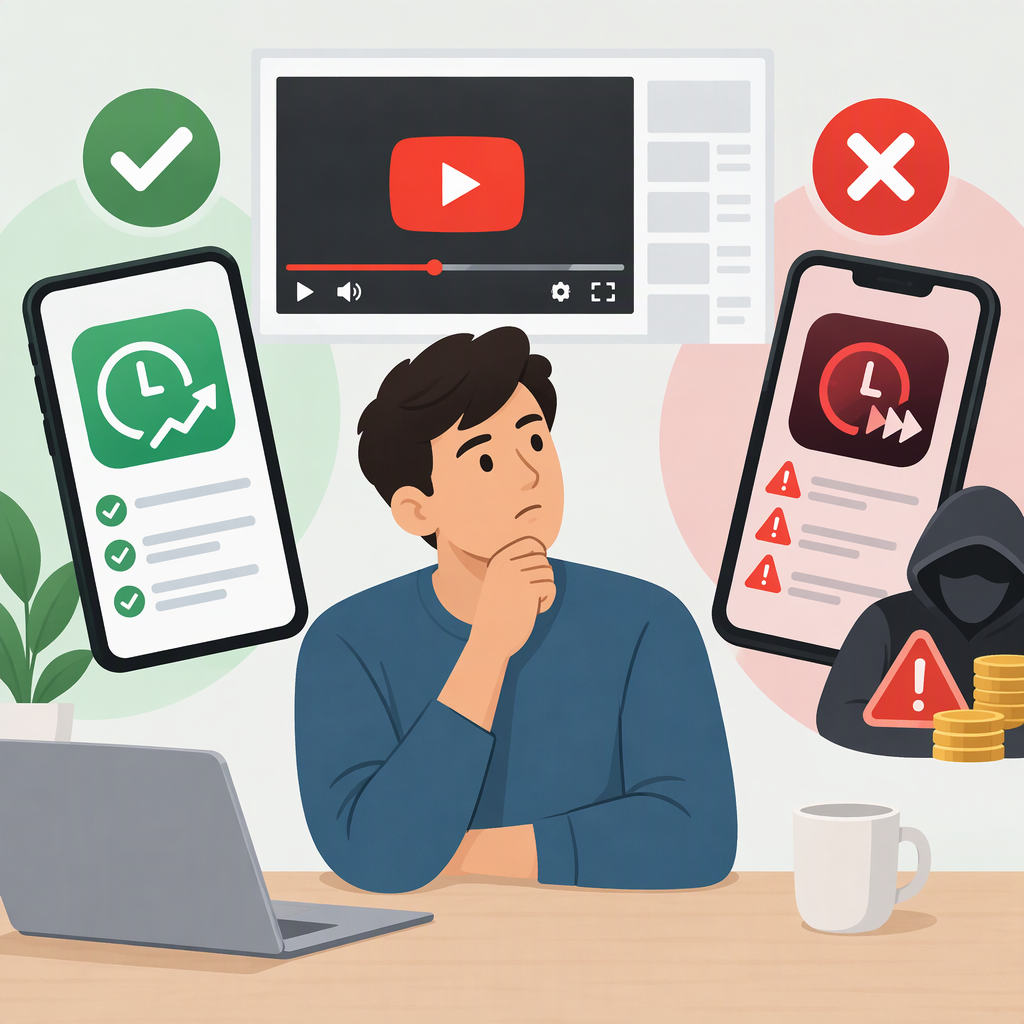
YouTube Watch Time Increase Apps: What’s Legitimate and What’s Risky?
If you’re searching for a YouTube watch time increase app, first find out what the app actually does. A tool that helps you edit or analyze videos is different from promotion intended to reach real viewers—and both differ from a service that sells, exchanges, or artificially generates views or watch time. A promise of more hours is not proof that the traffic is genuine, eligible for monetization, or safe for your channel.
YouTube’s published policies prohibit artificial engagement. They also describe invalid-traffic rules that can affect advertising and monetization. For a safer approach, review the service’s delivery method, avoid giving out your account password, and use retention analytics to investigate how real viewers respond. No tool or content change can guarantee more watch time.
First, Identify What the App Actually Does
“Watch time increase” can refer to very different things:
- Creation or analytics tools help with tasks such as editing, planning, or reviewing channel performance. Their purpose is not, by itself, evidence that they generate views or watch time.
- Promotion aims to show a video to potential viewers. Paid promotion is not the same thing as buying artificial engagement, but YouTube says watch hours and subscribers gained through ad campaigns don’t count toward YPP eligibility thresholds. Promotion is therefore not a shortcut to those thresholds, and it does not guarantee that viewers will stay. (support.google.com)
- Purchase, exchange, or artificial-traffic services promise views or watch time through methods such as automated or incentivized traffic, artificial viewing, or engagement exchanges. YouTube says artificial increases in views and other metrics are prohibited, including through automated systems or by serving videos to unsuspecting viewers. It also identifies automated or incentivized third-party traffic as invalid traffic. (support.google.com)
A product name or marketing claim doesn’t establish which category applies. Ask what the service actually delivers, who watches, how they’re sent to the video, and whether viewing is voluntary and genuine. This article does not assess or endorse any specific app.
What YouTube’s Rules Say About Bought or Exchanged Watch Time
YouTube’s Fake engagement policy says engagement must reflect a person’s authentic interaction with content. It prohibits artificial increases in views, likes, comments, or other metrics, and identifies links to or promotion of services that artificially inflate metrics, as well as content featuring a creator buying views to promote a service. The policy says violations may result in content removal or a channel takedown; it also warns that hiring someone to promote a channel does not remove the creator’s responsibility for that person’s actions. (support.google.com)
There is a related but distinct issue: invalid traffic. YouTube describes invalid traffic as activity that doesn’t come from a real user or a user with genuine interest. It says this can include automated or incentivized traffic from third parties. If invalid traffic is detected, YouTube may temporarily limit ad serving; significant activity may lead to an AdSense for YouTube account being suspended or permanently disabled, or to demonetization. Earnings associated with invalid traffic may be withheld, changed, or offset. These are documented possibilities, not predictions about what will happen to a particular channel. (support.google.com)
These policies do not mean that every app with “watch time” in its marketing is necessarily selling artificial traffic. They do mean you shouldn’t treat a claimed increase as genuine or eligible without understanding how it is produced. YouTube also says it may adjust metrics after reviewing whether engagement is legitimate, so a displayed number is not proof that activity will remain counted. (support.google.com)
A Checklist for Screening a Watch-Time Service
Before using an app or service, ask:
- What does it deliver? Is it editing or analytics assistance, a promotion campaign, or a promised quantity of views or hours?
- Where do viewers come from? Does the provider clearly explain its traffic source and how people encounter the video? Vague sourcing makes it difficult to assess the claim.
- Are views or monetization eligibility guaranteed? Treat guaranteed hours, guaranteed eligibility, or unexplained “watch-time boosts” as claims to verify—not evidence of genuine viewing or policy compliance.
- Does it ask for your password or account access? Don’t share your Google Account password. If you have already connected an app, review which apps have access and remove access you no longer need. (support.google.com)
- Can you check the claim against YouTube’s own rules? Review the Fake engagement policy and, if advertising or monetization is involved, the invalid-traffic guidance. A provider’s assurances do not override YouTube’s policies.
This checklist is a way to spot unanswered questions, not a safety certification. Without reviewing a particular service’s current claims, permissions, and delivery method, it’s not possible to label that service safe, unsafe, or tested.
Improve Retention by Learning from Real Viewers
Instead of trying to manufacture viewing activity, use YouTube Studio to investigate where real viewers keep watching or leave:
- Check the promise. Compare the video’s title and thumbnail with what the video actually delivers.
- Review the opening. Does the first part of the video answer the reason someone clicked? YouTube’s audience-retention guidance says its “Intro” measure reflects what percentage of the audience remained after the first 30 seconds; a strong intro can indicate that the opening matched the title and thumbnail’s expectations. (support.google.com)
- Find one moment to investigate. In YouTube Studio, open Content, choose a video, select Analytics, and look for the Audience retention report under Overview or Engagement. The report is available at the video level, and YouTube says its data typically takes 1–2 days to process. A dip marks a point where viewers abandoned or skipped; it’s a clue to examine, not proof of why each person left. (support.google.com)
- Make one focused adjustment. For example, if a hypothetical tutorial loses viewers while it explains a long setup before showing the result, the creator might test moving a short preview of the result earlier. This is an illustrative idea, not a measured case or promised outcome.
- Compare a later observation. Look at retention on the revised video or a comparable future upload. Treat any change as something to learn from, not evidence that one adjustment will reliably increase watch time.
The point is to make the content clearer or more useful for the audience it is meant to serve—not to chase a guaranteed metric.
If You Already Bought Watch Time or Joined an Exchange
- Stop further purchases or exchanges. YouTube’s invalid-traffic guidance asks creators appealing a disabled account to identify possible causes and explain steps they’ve taken to stop the traffic. (support.google.com)
- Review account access. Remove third-party access you don’t need. If you shared your password or see suspicious activity, follow Google’s account-security guidance; Google recommends changing your password and checking for unfamiliar signed-in devices when someone else may have access. (support.google.com)
- Check official channel and account notifications. Read any notice carefully and follow the relevant instructions rather than relying on a service provider’s interpretation.
- Keep relevant records. Save receipts, messages, service claims, and any steps you took to stop the activity in case they help explain what happened.
- Use the official appeal route if YouTube takes action and you believe it was an error. YouTube provides an invalid-activity appeal process for disabled AdSense for YouTube accounts, but says reinstatement is not guaranteed. (support.google.com)
Stopping the activity and securing your account are practical steps; they don’t guarantee that views or watch time will be restored, that monetization eligibility will be granted, or that YouTube will take no enforcement action.
Bottom line: A tool that helps you make or analyze content is not the same as a service promising purchased or exchanged watch time. Before using anything that claims to increase hours, verify how it delivers them. To work on retention without artificial traffic, review the audience-retention report, investigate one specific moment, and make a content change without assuming a particular result.