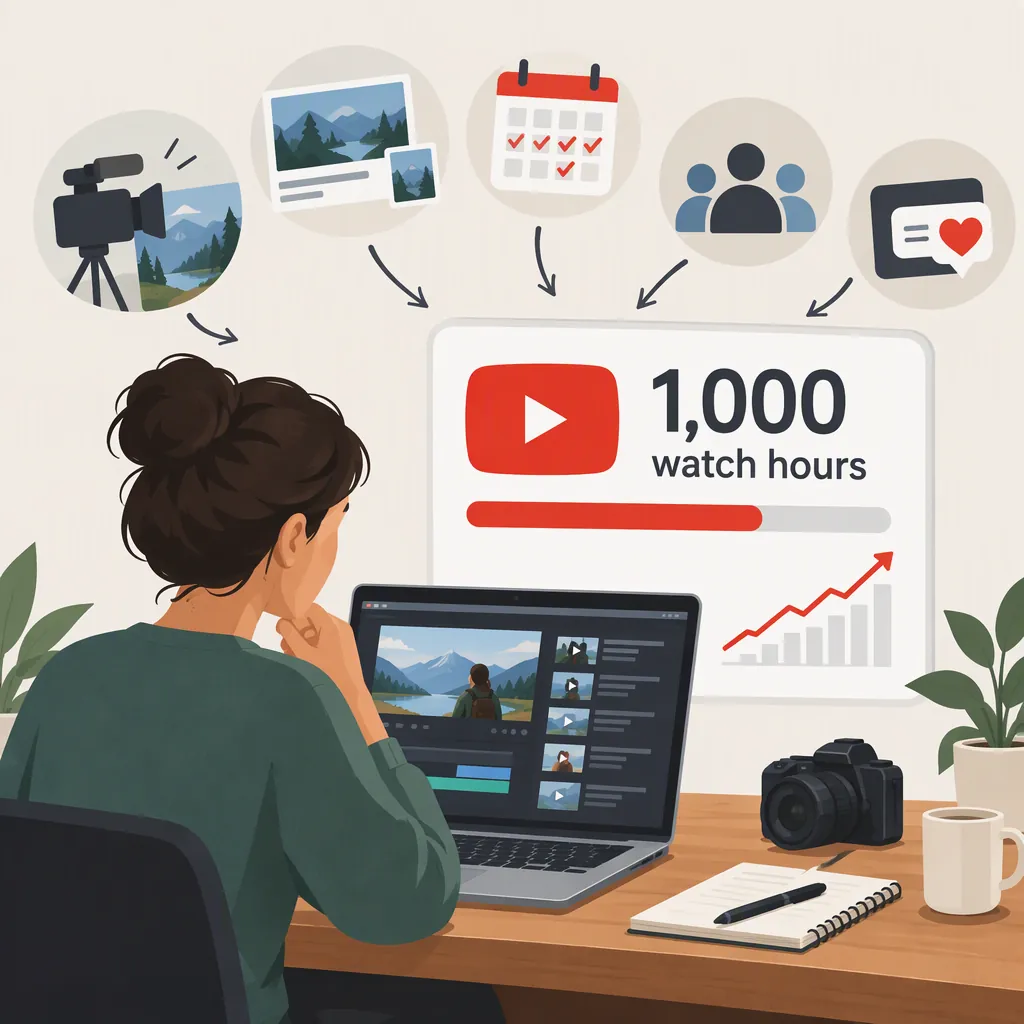
How to Get 1,000 Watch Hours on YouTube Naturally
To work toward 1,000 watch hours on YouTube naturally, focus on attracting interested viewers, delivering the promised answer promptly, and connecting videos that answer related questions. For planning, 1,000 hours equals 60,000 minutes: at an average view duration of five minutes, that would require 12,000 views. This is arithmetic, not a growth forecast or a monetization eligibility calculation. The supplied guide recommends reviewing retention, tightening weak sections, and organizing relevant viewing paths; none of these steps guarantees a particular result. [citation-1]
Turn 1,000 Hours into a Practical Viewing Goal
Start with the relationship between views and time watched:
Watch hours = views × average view duration in minutes ÷ 60.
These hypothetical scenarios all produce 1,000 hours:
| Average View Duration | Views Required |
|---|---|
| 3 minutes | 20,000 |
| 5 minutes | 12,000 |
| 6 minutes | 10,000 |
The examples are calculations, not typical channel results. They show why chasing views alone can leave you short of your target—and why simply making a video longer is not enough.
If you already have watch time toward your goal, subtract it first. For example, a remaining target of 750 hours is 45,000 minutes. At five minutes per view, that means 9,000 additional views under the same assumption.
Keep ordinary watch-time planning separate from monetization eligibility. The supplied reference is a third-party strategy article, not YouTube's eligibility documentation, and it does not establish which hours count toward a current program requirement. [citation-1]
Watch-Time Planning Worksheet
Use comparable measurements from the same reporting period.

Target hours: 1,000
Hours already accumulated toward this planning goal: ___
Remaining hours: 1,000 − accumulated hours
Expected average view duration in minutes: ___
Estimated additional views: remaining hours × 60 ÷ expected average view duration

Label the result as an estimate. Recalculate when your observed average view duration changes. Do not treat this worksheet as a monetization eligibility check.
Make the Opening Match the Viewer’s Expectation
Give each video one clear audience and one clear outcome. Before recording, write down what someone expects after reading the title and seeing the thumbnail. Then check whether the opening begins delivering that promise.
The supplied guide recommends inspecting early retention losses for delayed answers, repeated titles, unnecessary branding, or background that arrives before the payoff. It suggests showing a useful result or beginning the first practical step early. Treat these as editing ideas to test, not universal explanations for every drop-off. [citation-1]
For a tutorial, a useful opening might briefly show the finished result, identify the problem, and begin the first step. Context can follow when it helps the viewer understand that step.
Avoid padding a concise answer into a long video solely to pursue hours. Choose a runtime that supports the explanation: enough detail to solve the problem, without repetition that serves only the clock.
Opening Review Checklist
Before publishing, check:
- What specific result does the title promise?
- Does the opening confirm that promise?
- Where does the first useful explanation or demonstration begin?
- Can any introduction, repetition, or branding be removed?
- Is every retained sentence needed to understand the next step?

Write one opening change to test: ___
Use Retention Patterns to Improve the Next Video
Review total watch time alongside average view duration and the retention curve. The supplied guide recommends comparing similar formats and inspecting the footage at noticeable drop-offs rather than relying on one channel-wide benchmark. [citation-1]
Build a small review group: tutorials with tutorials, short explainers with short explainers, and longer lessons with similar lessons. For each video, record the timestamp of a noticeable decline and watch the surrounding section.
Consider several possible explanations:
- The answer arrived, so some viewers no longer needed the video.
- The explanation became repetitive or difficult to follow.
- A tangent no longer served the title's promise.
- A transition delayed the next useful step.
A graph alone does not identify the cause. Choose one plausible improvement—such as replacing a lengthy explanation with a demonstration—and test it in a future comparable upload. Do not assume that one edit caused a change when the topic or traffic mix also changed. The reference explicitly cautions against attributing improvement to an edit without isolating the variable. [citation-1]
Retention Review Log
Video: ___
Format and topic: ___
Reporting period: ___
Views: ___
Watch hours: ___
Average view duration: ___
Timestamp to inspect: ___
What happens at that point: ___
Possible explanation: ___
One change for a future comparable video: ___
Result and other differences that may explain it: ___
Give Interested Viewers a Relevant Next Video
Organize related videos around a learning sequence rather than upload order. For example, a beginner lesson can lead to a worked example, then a troubleshooting lesson. This is an illustrative structure, not evidence that any particular sequence will increase hours.
The supplied guide recommends intent-based playlists and relevant next-video destinations in descriptions, pinned comments, and end screens. Its central advice is that the next video should answer a natural follow-up question—not simply be the channel's most popular upload. [citation-1]
Audit a small group of existing videos. Ask what viewers are likely to need after each one, then select the closest available follow-up. If no suitable video exists, note the gap as a possible future topic.
Keep the current video complete and useful on its own. Do not withhold the promised answer to force another view.
Three-Video Viewing Path
Video 1 — Introduce the problem: ___
Question the viewer may have afterward: ___
Video 2 — Demonstrate the next step: ___
Question the viewer may have afterward: ___
Video 3 — Troubleshoot or extend the result: ___

Check that each video delivers its own promised answer and that every next-video destination is relevant.
Use a Four-Week Routine Without Promising a Deadline
Use four weeks to establish a repeatable process—not as a promise to reach 1,000 hours.
- Week one: establish your baseline. Calculate remaining hours and review a few existing videos with enough viewing activity to inspect.
- Week two: improve delivery. Choose one recurring issue, such as slow openings, and address it in your next upload.
- Week three: connect related lessons. Review a small viewing path and check that its destinations match the viewer's next question.
- Week four: review and revise. Compare watch time, average view duration, and retention patterns. Record what changed and what remains uncertain.
This routine adapts the supplied guide's audit, editing, playlist, and testing approach while leaving out its commercial attribution focus. The source cautions that a month is not enough to declare a permanent winner and advises against buying artificial watch time. [citation-1]
Evidence limitation: The recommendations here draw on one third-party strategy article. Its platform-wide statistics, product claims, and growth benchmarks are not used as targets. Your calculations are planning assumptions; your results must come from your own observed viewing data.
Weekly Progress Note
Week ending: ___
Watch hours gained during this period: ___
Remaining hours toward the planning target: ___
Videos reviewed: ___
One change implemented: ___
Observed response: ___
Other factors that changed: ___
Next action: ___

Do not project a completion date from a single unusually strong or weak week.
FAQ
How Many Views Do I Need for 1,000 Watch Hours?
It depends on average view duration. The planning formula is 60,000 minutes divided by average minutes watched per view. At five minutes per view, the result is 12,000 views; at three minutes, it is 20,000. These are hypothetical calculations, not guaranteed outcomes. The supplied guide recommends considering retention and average view duration rather than views alone. [citation-1]
Should I Make Longer Videos to Reach 1,000 Hours?
Not solely for that reason. A longer runtime is not the same as more time actually watched. Use the length needed to deliver the promised explanation, then review where viewers leave. The supplied guide recommends aligning runtime with substance and removing material that does not advance the viewer toward the outcome. [citation-1]
Can I Reach 1,000 Watch Hours in 30 Days?
The supplied evidence cannot establish that timeline for your channel. Reaching 1,000 hours in 30 days would require an average of about 33.3 hours watched per day, but that arithmetic says nothing about whether the audience demand exists. Use a month to establish a baseline and test improvements; the supplied guide also warns against treating a month of results as a permanent conclusion. [citation-1]
Are 1,000 Watch Hours the Same as Monetization Eligibility?
Do not treat this planning target as an eligibility rule. The supplied reference distinguishes watch-time totals from eligibility but is not authoritative documentation of current YouTube requirements. This article does not verify thresholds, qualifying formats, exclusions, or eligibility periods. [citation-1]
Sources
- [citation-1] YouTube Watchtime Increaser: Proven Strategies