Paid YouTube Watch Hours: What Counts Toward Monetization?
Paid YouTube Watch Hours: The Short Answer
A seller’s promised watch-hour total is not proof that those hours will count toward YouTube Partner Program (YPP) eligibility. What matters is how the views are obtained and whether they meet YouTube’s current rules. YouTube says watch hours from ad campaigns do not count toward YPP thresholds; it also prohibits artificial engagement, including activity generated through automatic systems or views served to unsuspecting people. (support.google.com)
As of November 13, 2026, the main long-form route to YPP ad-revenue eligibility is 1,000 subscribers and 4,000 qualified watch hours in the previous 12 months. Meeting the numbers is not automatic approval: YouTube reviews the channel against its policies, and other requirements apply. (support.google.com)
What an Offer for “Paid Watch Hours” Might Mean
The phrase can describe different arrangements. Ask which one is actually being offered:
- Buying a watch-time total: A provider promises a set number of hours, but does not clearly explain who watches or how viewers are reached. A promised total alone does not establish that the viewing is genuine or eligible.
- Exchanging views or watch time: Participants agree to watch one another’s videos, sometimes for a reward or reciprocal viewing. YouTube says engagement is illegitimate when its sole purpose is financial gain, or when it results from coercion or deception. An exchange arrangement therefore deserves careful scrutiny; the label “real viewers” does not settle whether it complies. (support.google.com)
- Paying to advertise a video: YouTube Promote is an advertising tool for reaching new audiences. YouTube states that watch hours and subscribers gained through ad campaigns do not count toward YPP eligibility thresholds. This is a specific eligibility rule—not a statement that every paid promotion is artificial engagement. (support.google.com)
These categories are not interchangeable. A campaign may introduce a video to potential viewers, while a metric-selling or exchange offer may be organized around delivering engagement itself. In either case, do not assume the resulting hours qualify just because the views appear in a report.
Which Watch Hours Qualify for Ypp?
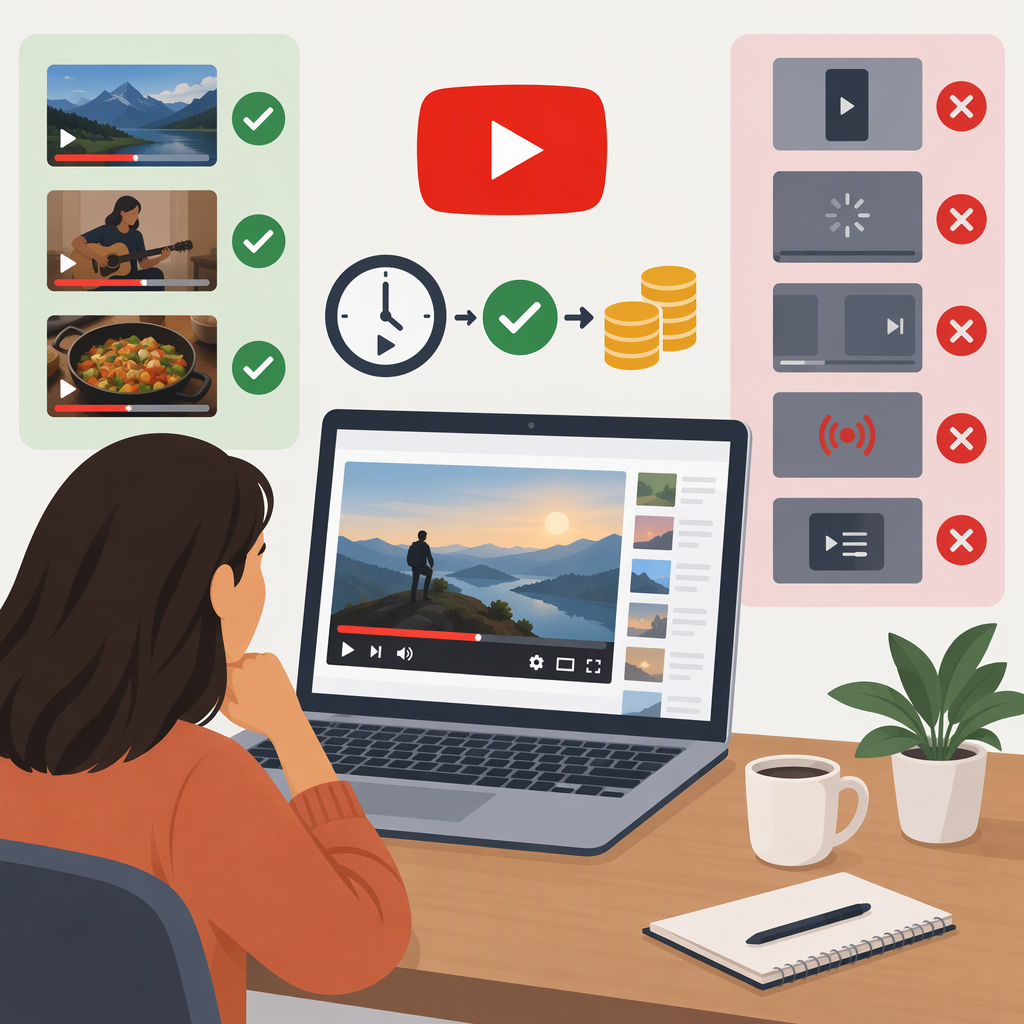
For the 4,000-hour route, YouTube specifies qualified watch hours from public long-form videos during the last 12 months. Watch hours from Shorts views in the Shorts Feed do not count toward that threshold, and YouTube separately says watch hours gained through ad campaigns do not count. (support.google.com)
The threshold is only one part of eligibility. YouTube also requires, among other things, that the channel follow monetization policies and be in a country or region where YPP is available. YouTube reviews an application before admitting a channel. Some eligible countries or regions also have an expanded YPP tier with earlier access to certain features; its thresholds and benefits differ from the 4,000-hour ad-revenue route. Check the Earn tab in YouTube Studio and the current eligibility page for the program available to your channel. (support.google.com)
Example: Suppose a creator has 3,600 qualified public watch hours and buys a promotion that generates another 500 hours through an ad campaign. They should not treat that campaign’s hours as the 400-hour shortfall being met: YouTube says ad-campaign watch hours do not count toward YPP thresholds. If the promotion later leads people to watch other videos organically, assess those views on their own against YouTube’s qualifying criteria; the campaign’s advertised total is not a guarantee of eligibility.
Policy Risks: Artificial Engagement and Invalid Traffic
YouTube’s fake engagement policy prohibits artificially increasing metrics, including through automatic systems or by serving videos to unsuspecting viewers. It says legitimate engagement involves a human viewer whose primary intent is to interact authentically; engagement may be illegitimate if it is coerced, deceptive, or solely for financial gain. The policy also warns that a creator can be affected by a promoter’s policy-violating methods. Depending on the violation, YouTube says content may be removed or a channel may be taken down. (support.google.com)
Invalid traffic is a related but distinct issue. YouTube lists automated or incentivized third-party traffic, including “traffic-boosting” services, as examples. If it detects invalid traffic, it may temporarily limit ad serving. In cases involving significant invalid activity, an associated AdSense for YouTube account may be suspended or permanently disabled; significant invalid-traffic violations may also result in demonetization. These are documented possible outcomes, not a prediction that every paid offer will trigger them. (support.google.com)
How to Assess an Offer Before Paying
Use these questions to decide whether to pause, ask for details, or walk away. This is a screening aid, not an official YouTube compliance test.
- What exactly is promised? Ask whether the offer promises views, watch hours, subscribers, or YPP eligibility. A guaranteed eligibility claim should prompt verification; a provider cannot make YouTube’s decision for it.
- Where will the viewers come from? Ask for a clear description of the traffic source and whether viewing comes from an ad campaign, an exchange, incentives, automation, or another method. Vague or undisclosed sources are a reason to pause, not by themselves proof of a violation.
- Is viewing conditional or rewarded? Ask whether viewers must watch in exchange for money, points, reciprocal views, or another benefit. Compare the answer with YouTube’s rules on artificial and incentivized engagement. (support.google.com)
- Is the provider selling a number or a method? A dashboard screenshot or delivery guarantee does not show that the resulting watch time qualifies. Check the Earn tab and current YPP eligibility guidance rather than relying on a seller’s total.
- Choose a next step: If the method is clear and is a paid ad campaign, budget for reach—not for eligible watch hours. If the traffic source is unclear, engagement is exchanged or incentivized, or eligibility is guaranteed, pause and verify against official rules before spending. If you cannot establish how viewing is obtained, avoiding the offer is the more cautious choice.
For audience development, prioritize reaching people who choose to watch because the content interests them. That does not guarantee YPP approval, but it avoids treating a purchased or promised metric as a substitute for the platform’s eligibility review.