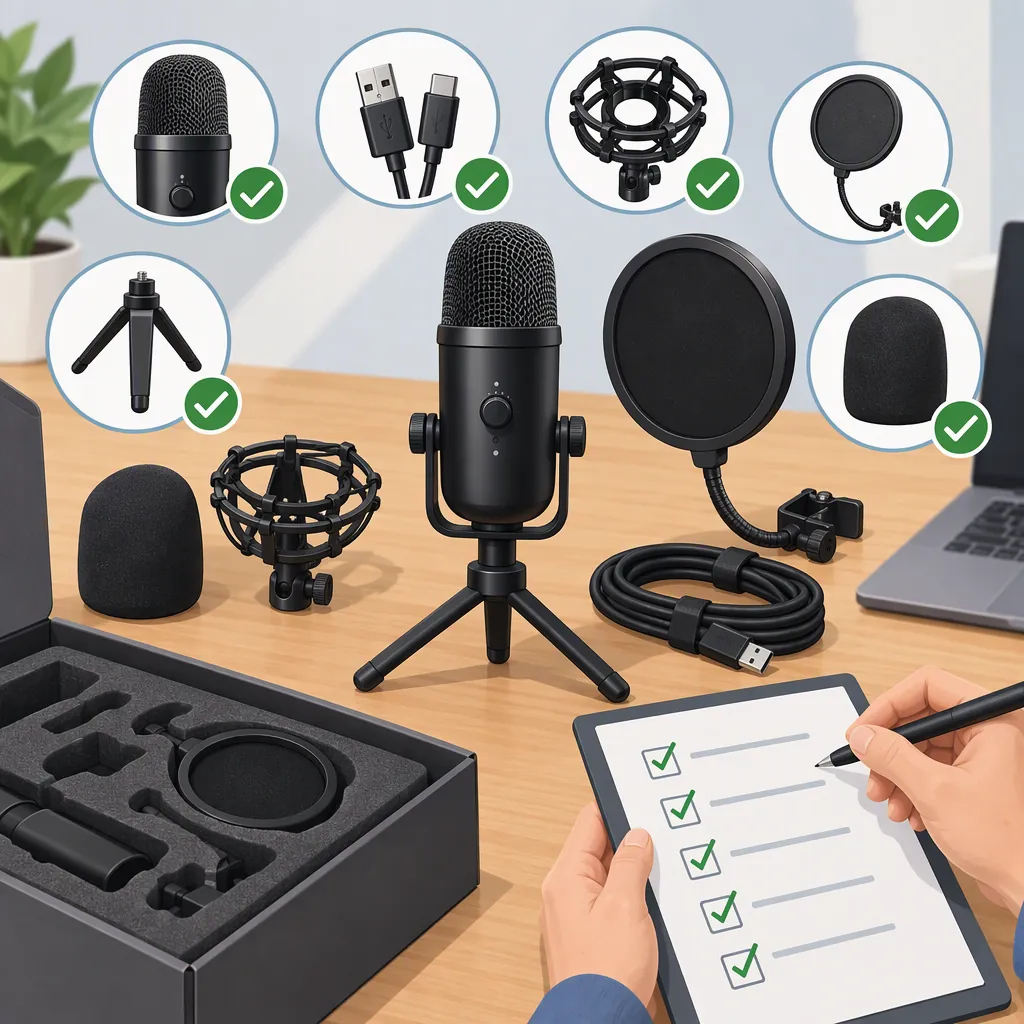
Strmd USB Microphone Streaming Content Creator Superkit: Verification and Setup Checklist
The evidence available here does not verify the STRMD superkit’s contents, controls, or device compatibility. The cited listing identifies a Rockville A-STREAM microphone, not STRMD. [source_1] To assess the STRMD kit, start with its exact model, package identifier, and matching documentation, then test the intended recording and streaming setup separately.
Prepare these details before using the checklist:
- Product identity: brand, exact model name, and model number from the product label
- Package identity: SKU or package-version identifier, if present
- Matching documents: package contents list, manual, and connection instructions
- Intended setup: computer, phone, or tablet; operating-system version; cable or adapter; and recording or streaming application
If a detail cannot be established, mark it unverified. The steps below are general verification and testing guidance, not confirmed STRMD setup instructions.
1. Verify the Exact Kit and Its Contents
Do not infer an accessory list or feature set from the word “superkit.” Compare the items physically present with a contents list tied to the exact model and package version.
| Check | What to record | What to compare it with |
|---|---|---|
| Product identity | Brand, product name, and model number | Product label, packaging, and matching manual |
| Package version | SKU or other package identifier, if present | Package label and corresponding contents list |
| Included items | Each item physically present | Contents list for that exact package |
| Controls and connections | Labels on buttons, knobs, and ports | Matching manual or connection diagram |
| Recording device | Device model and operating-system version | Model-specific device-support documentation |
| Cable or adapter | Connector types and adapter identifier | Documented connection requirements |
| Intended application | Application name and version | Applicable setup instructions and a separate application test |
Keep “present in the box” separate from “documented as included.” Likewise, a connector that physically fits does not, by itself, establish documented support for the intended device and application.
Evidence Boundary
The cited Walmart page is titled “Rockville A-STREAM Live Streaming USB Microphone w Gain+Mute+iPhone/iPad Cable.” It describes a different brand and product. Its references to gain, mute, and an iPhone/iPad cable cannot establish equivalent STRMD controls, accessories, or compatibility. [source_1]
No STRMD package inventory, performance specification, or software-support claim is verified here. Do not use another microphone’s listing to fill those gaps.
2. Establish the Connection Requirements
Write down the complete connection you intend to test:
Exact microphone model → supplied cable → any required adapter → recording device → intended application
Compare each part with documentation for the exact microphone model. Keep three questions separate:
- Physical connection: What cable, port, and adapter does the documented setup require?
- Documented support: Does the documentation cover the intended device and operating system?
- Application operation: Can the intended application select and capture the target microphone?
If a required connection detail is missing, leave it unresolved rather than borrowing another brand’s instructions. Once the connection requirements are established, follow the matching instructions and begin with a short local recording.
3. Confirm the Target Input and Test Local Recording
A recording containing speech is not enough to confirm that the STRMD microphone supplied that audio. First establish which input the application is using.
- Record the displayed input name. Open the intended recording application, inspect its available inputs, and select the target microphone if it appears. Note the exact name shown.
- Make a baseline sample. Speak a short passage from your intended working position, then save the recording.
- Use a controlled comparison. Where supported, switch to another identified input and repeat the passage, then return to the target input. Alternatively, if matching documentation confirms a microphone mute function, compare recordings with that function on and off.
- Check what the comparison establishes. Look for a recording change that corresponds to the selected input or documented control. An application mute alone checks application behavior; it does not identify the physical microphone.
- Review the saved audio. Listen for missing speech, distortion, interruptions, and unwanted background sound.
- Change one setting at a time. Repeat the same passage after each change so the results remain comparable.
Use only controls and connection procedures confirmed by matching documentation. Do not assume the kit has a mute button, headphone connection, or input-level control.
If the displayed name and controlled comparison do not establish the audio’s origin, record “target input unconfirmed” rather than marking the microphone test as passed.
Recording Test Log
| Field | Result |
|---|---|
| Exact microphone model | __________ |
| Device and operating system | __________ |
| Application and version | __________ |
| Displayed input name | __________ |
| Cable and adapter used | __________ |
| Controlled comparison performed | __________ |
| Audio confirmed as coming from the target microphone | Confirmed / Unconfirmed / Not tested |
| Saved recording contains intended speech | Pass / Issue / Not tested |
| Distortion, interruptions, or unwanted sound | __________ |
| Documented control tested and result | __________ |
| Single change made before retesting | __________ |
| Unresolved issue | __________ |
A successful local test applies only to the device, application, connection, and settings tested. It does not establish that the streaming application uses the same input or produces the same output.
4. Test the Intended Streaming Workflow
After the local recording check, open the application you intend to use for streaming and verify its setup separately.
- Input selection: Record the displayed input name and confirm that the intended microphone is selected.
- Mute state: Check application mute settings and any documented microphone mute control.
- Input activity: Speak and inspect the input-level indicator, if the application provides one.
- Test output: Use a local recording or non-public streaming test feature, if available.
- Playback: Review the resulting output for the intended voice audio, distortion, interruptions, and unwanted sound.
- Audio and video alignment: If using a camera, check whether speech aligns with the visible speaker.
- Retesting: Change one setting at a time and repeat the test.
These checks do not establish STRMD compatibility with any particular application or streaming service.
Keep Each Result Within Its Tested Scope
| Test stage | What a successful result establishes | What remains untested |
|---|---|---|
| Local recording with confirmed target input | The target microphone supplied usable audio in the tested recording setup | Streaming-application settings and live delivery |
| Streaming application’s local recording | The reviewed local output contains the intended audio | Delivery through the streaming service |
| Non-public streaming test, if available | The reviewed test output contains the intended audio and video | Reliability in every later session |
If a stage cannot be tested, keep that limitation visible. Do not label the whole workflow ready based only on an input meter or a successful local file.
5. Use Failed Results to Narrow the Next Check
The following are general troubleshooting directions, not confirmed STRMD fault explanations.
| Observed result | Next check | How to record the status |
|---|---|---|
| Target microphone does not appear as an input | Recheck model-specific connection instructions, required adapters, device support, and application input requirements | Input unavailable; connection or application requirements unresolved |
| Speech is recorded, but its source is unclear | Recheck the selected input name and repeat a controlled input comparison | Target input unconfirmed |
| Input meter responds, but the saved test file has no intended audio | Check application mute state and which audio source or track is included in the recording output | Input activity observed; recorded output failed |
| Local recording passes, but the streaming application’s recording fails | Recheck that application’s input selection, mute state, and output-recording settings | Local test passed; streaming-application output unresolved |
| Streaming application’s local recording passes, but a non-public stream test fails | Review the application’s streaming-output settings and the available service-side test result | Local output passed; streaming delivery unresolved |
Retest after one change and preserve the earlier result. This helps distinguish an input problem from an application-output or delivery problem without assuming a specific cause.
Optional: Review Mobile-Video Output
Use this check only after establishing the intended phone or tablet connection requirements. Mobile compatibility for the STRMD kit remains unverified here.
Create a short video sample in the intended setup, then inspect it in the intended editor:
- Confirm that the sample contains audio from the target microphone.
- Check whether speech aligns with the visible speaker.
- If cropping, preview whether the speaker, captions, and essential on-screen content remain in frame.
- Export a short file and play it back.
- Record audio, alignment, framing, and export issues separately.
An editing preview is not a substitute for reviewing the exported file. Keep crop or export findings separate from microphone connection and input findings.
FAQ
What Comes in the Strmd USB Microphone Streaming Content Creator Superkit?
The cited evidence does not verify a STRMD inventory; it identifies a different product. [source_1] Use a contents list matching the exact STRMD model and package identifier, then compare it with the items physically present. Do not infer accessories from “superkit.”
Does the Strmd Microphone Work with an iPhone or iPad?
That compatibility is unverified here. The cited iPhone/iPad cable reference concerns Rockville, not STRMD. [source_1] Look for documentation covering the exact STRMD model, device, operating system, cable, and adapter, then test the intended application.
How Can I Tell Whether the Recording Uses the Target Microphone?
Record the application’s displayed input name and perform a controlled comparison, such as switching between identified inputs or testing a documented microphone mute function. If you cannot establish that the audio came from the target microphone, keep the result marked unconfirmed, even if the speech sounds clear.
Is a Successful Local Recording Enough to Confirm Streaming Readiness?
No. Test input selection and output in the actual streaming application separately. Review its local recording and a non-public streaming test if those features are available. A successful local file does not establish successful live delivery.
What Should I Do When Documentation Is Missing?
Record the specific unresolved question, such as package contents, adapter requirements, or device support. Keep it marked unverified until you have documentation matching the product and package. Another brand’s listing is not a substitute.
How Should I Describe a Successful Test?
State the exact setup and result: the device, application, selected input, connection, settings, and output reviewed. For example, “The target input was confirmed, and the saved test file contained usable speech” is narrower than “fully compatible.” Include untested stages and unresolved issues in the same log.