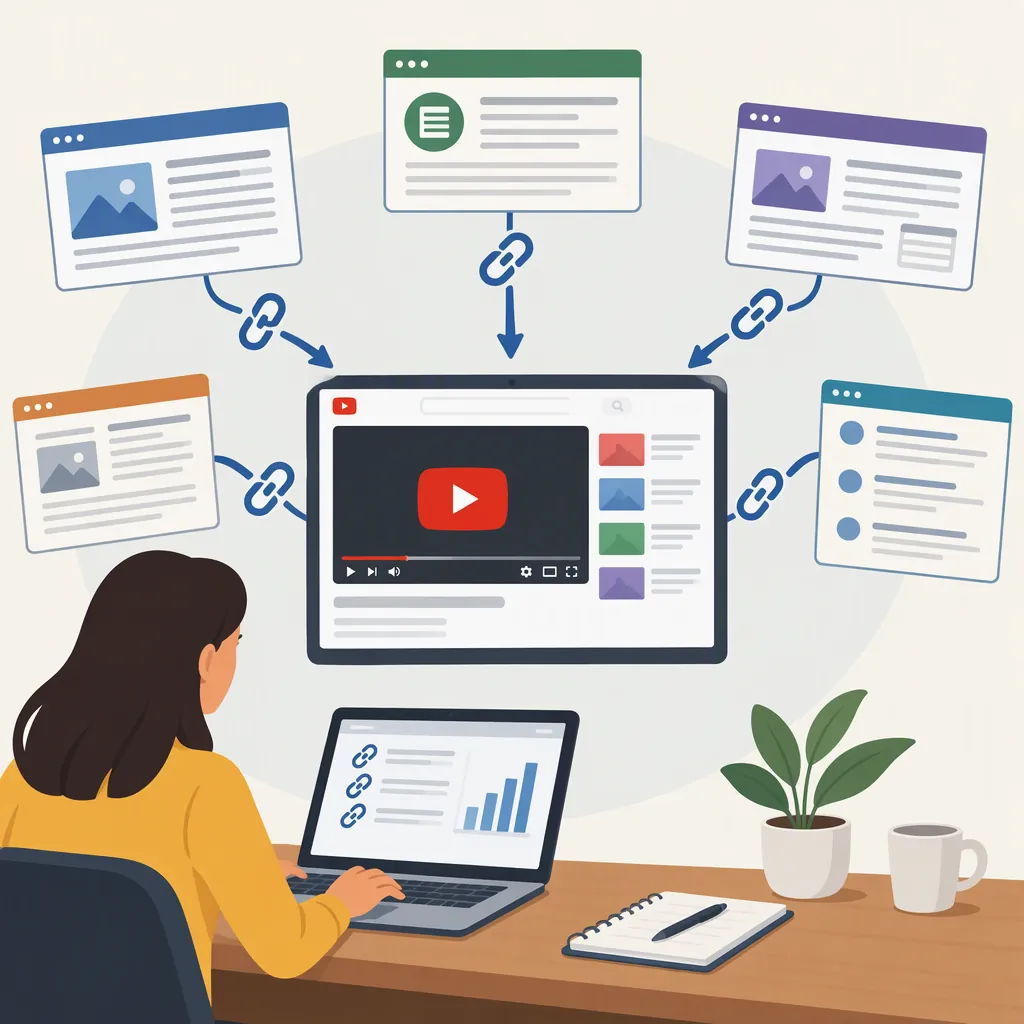
How to Create Backlinks for a YouTube Video
To create backlinks for a YouTube video, link to it from relevant pages you control and identify independent articles where the video would genuinely help readers. Give publishers a clear explanation of what the video demonstrates, while leaving placement decisions to them. Prioritize useful discovery over link volume: a link to your video is different from a link in your YouTube description pointing to your website, and neither guarantees better search rankings. [c1]
Understand Which Direction the Link Goes
The phrase “YouTube backlinks” can describe two different activities. For this article, the goal is links from other websites to your YouTube video, not links from YouTube to your website. The supplied guide explicitly distinguishes those directions and recommends measuring them separately. [c1]
| Placement | Destination | What to evaluate |
|---|---|---|
| An article links to your video | Your YouTube watch page | Whether the placement brings interested viewers |
| Your video description links to a resource | Your website | Website visits and relevant actions |
| An article embeds your video | An on-page viewing experience | Whether the demonstration helps readers |
Treat an embed as a presentation choice, not proof of an editorial backlink to your website. A publisher linking to your video also does not necessarily link to your domain. [c1]
Evidence limitation: This article uses one supplied secondary guide. It supports the distinctions and cautions here, but does not establish a causal ranking benefit from links pointing to a YouTube video.
Prepare a Video Worth Referencing
Before seeking placements, define the specific reason someone would reference the video. Favor a clear demonstration, explanation, or worked example over a general request to “support the channel.” The supplied guide recommends organizing video and website content around a real task and giving publishers an independent reason to cite it. [c1]
Use this preparation workflow:
- Write one sentence describing the question the video answers.
- Identify the part that adds value beyond a written explanation, such as a visible sequence of steps.
- Check that the title and description accurately describe the content.
- Confirm that the intended audience can access and watch the published video.
- Record a relevant timestamp when only one segment supports a proposed placement.
These are editorial preparation steps, not a formula for increasing rankings.
Video Reference Brief
Video title: [Exact published title]
Video URL: [Published YouTube video URL]
Reader question answered: [One specific question]
Relevant segment: [Timestamp and brief explanation]
Reason to reference the video: [What the demonstration adds]
Limitations: [What the video does not cover]
Last checked: [Date]
Place Links Where They Help Readers
Start with relevant pages you control. For example, a written tutorial could link to a video showing the same procedure. Use descriptive wording that explains the destination, such as “Watch the demonstration of the export settings,” rather than inserting unrelated keywords. This follows the guide’s emphasis on contextual relevance and clear link explanations. [c1]
For independent placements, use a selective review process:
- Find articles that address the same question as your video.
- Read the relevant section before proposing a link.
- Explain what the video adds, including any limitations.
- Let the publisher decide whether a link, an embed, or no addition best serves the page.
- Avoid repeated requests when the video is not a useful fit.
A collaboration should have a clear editorial purpose. Do not describe a paid placement as an independent recommendation; the supplied guide makes that distinction explicit. [c1]
Illustrative example: A guide about adjusting microphone levels could reference a video that visibly demonstrates the adjustment process. This is a possible placement, not a reported campaign or result.
Placement Review Checklist
- The page and video answer a closely related question.
- The proposed placement adds information rather than repeating promotion.
- The surrounding sentence accurately describes the video.
- The destination opens the intended video.
- A suggested timestamp matches the relevant explanation.
- Any commercial arrangement is not presented as independent endorsement.
- The publisher retains control over the placement.
Avoid Backlink Generators and Ranking Promises
Do not treat a backlink generator’s output count as evidence of interested viewers, editorial endorsement, or durable value. The supplied guide warns that automated services can create many URLs without delivering those outcomes. It also describes automated link creation for ranking manipulation as a link-spam concern. [c1]
Apply the same caution to offers promising guaranteed ranking gains, faster indexing, or authority based only on the number of placements. The provided evidence does not establish those outcomes for links to a YouTube video.
A practical screening rule is to ask: Would this placement still make sense if there were no search-ranking benefit? If the page is unrelated, the link is difficult to find, or the promised value depends entirely on a ranking claim, exclude it from your plan.
Measure Discovery and Maintain Placements
Set the measurement goal before seeking links. For links pointing to a YouTube video, evaluate discovery, viewing, and audience engagement rather than counting URLs alone. The supplied guide identifies video analytics, audience feedback, and independent mentions as useful evidence, while cautioning that they do not prove guaranteed indexing or authority benefits. [c1]
Keep a placement log and review it alongside the analytics available to you. Do not assume that analytics will identify every referring page or isolate each placement’s contribution. An increase after a link appears may coincide with other activity, including new uploads or sharing elsewhere.
If a video is replaced or becomes unavailable, update links on pages you control and inform relevant publishers when appropriate. Review whether the linked video still matches the surrounding explanation.
Keep website outcomes separate. If viewers later follow a description link to your website, track that journey as a different activity rather than counting it as direct evidence that an external backlink improved the video’s ranking. [c1]
Placement Log Template
Referring page: [Page URL]
Target video: [YouTube video URL]
Placement type: [Text link or embed]
Context: [Reader question served]
Date observed: [Date]
Control: [Own page or independent publisher]
Available evidence: [Analytics observation or audience feedback]
Other activity during review: [Uploads, sharing, or other changes]
Interpretation limits: [What cannot be attributed]
Next review: [Date]
FAQ
Does a Link in My YouTube Description Count as a Backlink to My Video?
No. A description link pointing to your website goes in the opposite direction. A backlink to your video is a link from another page to that video. Keep the two activities and their measurements separate. [c1]
Is Embedding My Video the Same as Getting a Backlink?
Treat an embed and a text link as distinct placements. An embed presents the video within a page, while a text link directs readers to its destination. An embed does not automatically create an editorial backlink to your own website, and the supplied guide does not establish a ranking benefit from embedding. [c1]
How Many Backlinks Does a YouTube Video Need?
The supplied reference provides no validated target count. Choose placements for relevance and usefulness, then assess discovery and engagement. Link volume alone does not demonstrate useful traffic or a ranking benefit. [c1]
Will Backlinks Make My Video Rank Higher?
Do not assume a ranking increase. The supplied guide treats links as potential routes to discovery and viewing, but does not provide causal evidence that external backlinks improve a YouTube video’s ranking. Measure observed outcomes without promising a particular position. [c1]