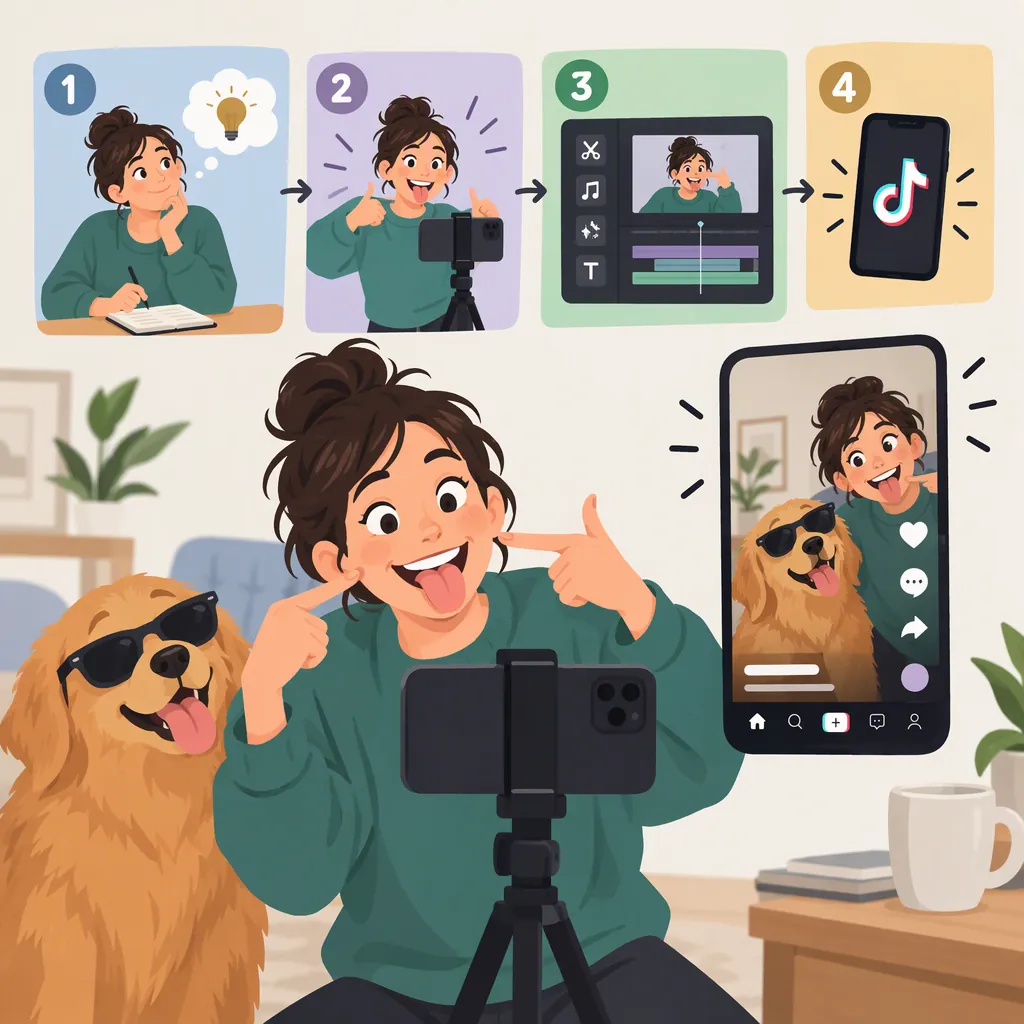
How to Make Funny Videos on TikTok
Start with a familiar situation, establish what viewers expect, and end with an unexpected response or reveal. Write a short original script, film the setup and payoff clearly, then trim anything that does not support the joke. Use captions, sound, or effects selectively rather than relying on them to supply the humor. The provided guide recommends originality, editing, and vertical framing, but humor is subjective and no approach guarantees laughs or reach. [ref_1]
Choose a Familiar Situation with a Twist
Begin with something you can observe and film yourself: a neglected chore, an overly ambitious morning routine, or the gap between what someone says and what they do. Choose one situation rather than combining several unrelated jokes.
Write two sentences:
- Expectation: What does the character believe will happen?
- Reversal: What actually happens, and why is that unexpected?
For example, a character announces a serious productivity session, then spends all their effort arranging the desk instead of doing the task. The joke targets the character’s misplaced priorities, not an unsuspecting person.
The supplied guide emphasizes surprise and original concepts, while acknowledging that different viewers find different things funny. Treat those ideas as creative starting points, not a formula for viral success. [ref_1]
Premise Worksheet
Familiar situation: __________
Character’s goal: __________
What the viewer expects: __________
Unexpected outcome: __________
Visual detail that reveals the joke: __________
What makes this version mine: __________
Can I film it without embarrassing or involving an unwilling person? __________
Write a Setup, Reversal, and Payoff
For a first exercise, use three beats: establish the situation, show the character making a choice, and reveal the consequence. This is a suggested writing structure, not a TikTok requirement.
Make the setup understandable without a long explanation. If the punchline depends on an object, show that object clearly. If it depends on dialogue, remove lines that repeat information the viewer already has.
Here is a sample script written for this article. Adapt the premise to your own habits, props, and delivery rather than treating it as a trend to reproduce exactly.
Sample Script: The Perfect To-Do List
Props: A notebook, a pen, and a closed laptop.

Beat 1 — Setup
Medium shot at a desk. The character says, “Today, I’m finally getting organized.”

Beat 2 — Build
Close-up of the notebook. The character carefully writes: “1. Make a to-do list.”

Beat 3 — Payoff
The character checks off the item, closes the untouched laptop, and says, “Huge day.”

Optional final image
The notebook remains visible with no other tasks listed.

Performance variation
Record one take with sincere pride and another with obvious exhaustion. Compare which delivery makes the reversal clearer.
Film the Details That Make the Joke Clear
Use a small shot list so every clip has a purpose. For the sample script, you need a view of the character, a readable close-up of the list, and a clear reaction or exit.
Record vertically as a practical starting point for phone viewing; the supplied guide recommends vertical framing for TikTok comedy videos. It does not establish current upload limits or detailed technical specifications. [ref_1]
Place the camera where the important action remains visible. Keep the notebook and laptop positions consistent between shots. Record a few versions of the final line with different pauses and expressions so you have options during editing.
Prefer a staged scene with willing participants. If other people appear, explain the premise and agree on what may be shared. You do not need a surprise prank to create a surprising punchline.
Filming Checklist
- Record the setup with the character and desk visible.
- Record a close-up in which the written task is readable.
- Record the check mark and laptop closing.
- Capture at least two deliveries of the final line.
- Listen to a test clip for understandable dialogue.
- Check that props remain consistent between shots.
- Confirm that anyone appearing understands the scene and agrees to sharing it.
Edit Around the Payoff
Build the first cut in story order: announcement, list, check mark, final line. Then review each clip and ask whether it establishes information, builds anticipation, or delivers the joke. Try removing anything that does none of those jobs.
Experiment with the pause before the final line. Make one version with an immediate response and another with a brief beat of silence. Neither is automatically funnier; compare them in the context of the performance.
Use captions to make important spoken words available as text, and check the wording manually. Keep captions away from the notebook if viewers need to read it. If you add a sound effect, zoom, or filter, test a version without it too.
The supplied guide discusses trimming footage and using effects to support comedy. It is a vendor-authored guide, so this article does not treat its promotional descriptions as independent evidence of product quality or results. [ref_1]
Two-Cut Comparison
Cut A: Setup → notebook close-up → check mark → immediate final line.
Cut B: Setup → notebook close-up → check mark → brief silent reaction → final line.

Compare:
1. Is the situation clear before the reveal?
2. Can the viewer read the task?
3. Does the pause build anticipation or merely delay the ending?
4. Does any caption or effect distract from the joke?
5. Can the ending stop immediately after the payoff?
Review for Clarity, Not Guaranteed Virality
Before sharing, watch the video once with sound and once without it. Check whether the key action remains understandable and whether captions communicate any essential dialogue.
If a willing reviewer is available, ask specific questions: “What did you expect to happen?” and “Which moment felt like the punchline?” Those questions can help you locate an unclear setup without treating one person’s reaction as a prediction of audience response.
Revise one element at a time: the opening line, the shot of the prop, the pause, or the ending. Keep the premise stable while comparing versions.
Evidence limits: The only supplied reference is a CapCut how-to article. It supports broad guidance about originality, subjective humor, editing, effects, and vertical framing. It does not establish an ideal duration, guaranteed reach, or an independently tested comedy formula. The worksheets and script here are original instructional examples. [ref_1]
FAQ
How Long Should a Funny TikTok Video Be?
Use the time needed to establish the situation and deliver the payoff, then test removing unnecessary material. The supplied guide recommends keeping comedy videos short, but it does not establish a universally optimal duration. The sample exercise here has no required running time. [ref_1]
Do I Need Filters or Special Effects?
For the exercise in this article, ordinary footage is enough. Add an effect only if it serves a specific part of the joke, and compare the result with an unembellished version. The supplied guide suggests effects as enhancements, but that does not demonstrate that every comedy video needs them. [ref_1]
How Can I Make the Video Original?
Build the scene around a detail you choose yourself: a particular habit, prop, character goal, or unexpected consequence. Write your own dialogue and film your own performance rather than recreating another creator’s punchline. The supplied guide also emphasizes original concepts instead of borrowing other people’s jokes or comedic style. [ref_1]