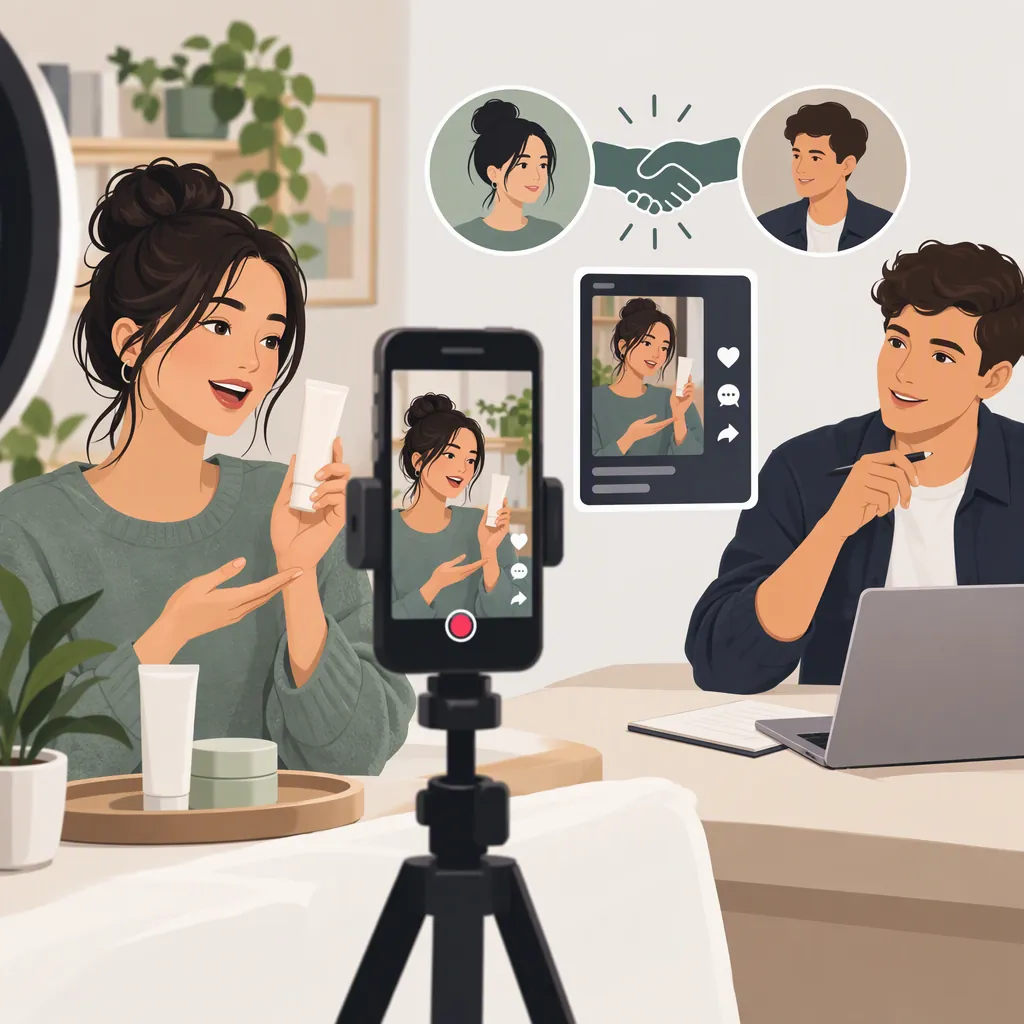
TikTok UGC Ads: A Guide to Content and Creator Collaboration
TikTok UGC ads use customer-made or commissioned creator content in paid advertising. Organic customer content and paid creator work are different sources: hiring a creator does not make a scripted statement a genuine customer experience. A practical workflow is to select the content source, define the deliverables and permissions, brief the creator, review the footage, and test the finished ad. Shopify describes both repurposing user content as ads and hiring creators whose main role is content production rather than audience reach. [c1]
Separate Content Production from Audience Reach
Before selecting a creator, decide what the collaboration is meant to provide.
- Organic customer content: A person posts about their actual experience. A brand may later explore using that material in advertising.
- Commissioned creator content: A creator produces an agreed set of assets for the brand to use. Do not assume the creator will publish them.
- Influencer collaboration: The arrangement includes access to the creator’s audience, usually through publication on their account.
These categories can overlap. Shopify distinguishes UGC creators from influencers by noting that UGC creators focus primarily on making content for brands and do not necessarily have a large following. It also describes Spark Ads as a way to advertise with existing content in partnership with its creator. [c1]
For planning purposes, separate the production fee, any publishing commitment, and any paid-use permission. This makes the scope easier to review without treating follower count as a substitute for content quality.
Evaluate Creators Against the Assignment
Use the planned content format to guide portfolio review. A clear tutorial requires different delivery skills from an unboxing or a conversational explanation.
Envision Horizons recommends reviewing creator portfolios, audience alignment, lighting, speaking skills, and content quality. It also advises testing different formats, including tutorials, reviews, and unboxings. These are useful evaluation dimensions, not evidence that a particular creator will produce profitable ads. [c2]
A practical review can ask:
- Can the viewer understand the demonstration without extensive explanation?
- Is speech clear, and is the relevant action visible?
- Does the creator’s delivery suit the intended audience?
- Can the creator distinguish an observable demonstration from a personal testimonial?
- Are the proposed deliverables, revision rounds, and schedule explicit?
If publication on the creator’s account is part of the assignment, evaluate audience fit separately from production ability.
Write a Brief That Leaves Room for Natural Delivery
A brief should establish what must be communicated without prescribing every sentence. Envision Horizons recommends including objectives, audience, formats, product focus, usage rights, references, prohibited material, creative freedom, and a feedback process. It cautions that overly scripted direction can make delivery feel stilted. [c2]
For a first test, keep the concept narrow: one audience situation, one main message, and one visible demonstration. Treat opening lines and pacing as creative hypotheses rather than guaranteed performance tactics.
The template below is a suggested planning tool, not a platform requirement. Fill in the evidence behind any factual statement before sending it to a creator. Leave personal-experience language out unless it accurately reflects that person’s experience.
Copyable Creator Brief
Objective: [What this asset should help evaluate]
Audience and situation: [Who the video is for and the relevant context]
Content source: [Actual customer experience or commissioned creator production]
Format: [Demonstration, tutorial, unboxing, or another defined format]
Main message: [One supported point]
Required shots: [Actions or details that must be visible]
Opening alternatives: [Two distinct ways to introduce the same concept]
Approved factual statements: [Statement plus supporting material]
Personal statements: [Only experiences the creator can truthfully describe]
No-go material: [Unsupported claims, prohibited visuals, or unsuitable language]
Delivery: [Length, orientation, file format, captions, and raw-footage scope]
Permissions: [Intended channels, paid use, term, editing scope, and publication arrangement]
Review: [Reviewer, due date, revision rounds, and approval method]
Creative freedom: [Where the creator can choose wording and presentation]
Review Content and Permissions Before Paid Use
Content approval and permission approval are separate checks. A video may fit the brief while its intended advertising use remains unresolved.
Envision Horizons includes usage rights as an explicit element of a creator brief. Shopify describes Spark Ads as a creator partnership rather than merely copying a public post into an ad. [c2] [c1]
As a practical review checklist, document the intended channels, duration of use, editing permissions, creator-account publication or authorization, and whether raw footage is included. Also flag music, third-party footage, and identifiable people for permission review rather than assuming they are covered by the creator’s agreement.
Review the finished asset for accurate statements, readable captions, clear audio, and consistency between the video and its destination. Do not rewrite a demonstration into a personal endorsement the creator has not made.
These checks are planning guidance, not a statement of legal sufficiency. The supplied sources do not establish current disclosure rules, music licensing terms, or account-specific ad requirements; verify those separately before publication.
Test a Defined Hypothesis and Record Limitations
Envision Horizons recommends testing content styles and assessing watch time, click-through rates, and sales data. [c2] Use those as different diagnostic views rather than interchangeable measures of success.
A suggested first comparison is two openings attached to the same core demonstration. Keep the audience, destination, and campaign setup as comparable as practical. Define the primary outcome before launch, and record changes that could complicate interpretation.
An organically popular video can be a candidate for paid testing, but popularity alone should not be treated as proof of paid results. Likewise, creator style, production quality, and a clear brief do not establish that an ad will outperform another format.
Evidence limitation: The references used here are commercial educational articles, not independent comparative studies or official TikTok policy documentation. They support workflow guidance and terminology, but do not establish a universal winning format, budget, duration, or performance advantage.
Copyable Creative Test Log
Test ID: [Unique label]
Question: [What the comparison is intended to learn]
Primary outcome: [Metric aligned with the campaign objective]
Variant A: [Opening or other defined change]
Variant B: [Alternative change]
Held comparable: [Audience, destination, offer, and campaign settings]
Asset and permission status: [Approval record]
Observation period: [Start and end]
Delivery context: [Spend, exposure, and relevant setup changes]
Results: [Primary outcome and supporting metrics]
Limitations: [Unequal delivery, tracking gaps, or other confounders]
Decision: [Continue, revise, or stop, with rationale]
FAQ
Are TikTok UGC Ads the Same as Influencer Marketing?
Not necessarily. A UGC creator may be hired to produce assets without posting them to an audience. Influencer collaboration can include distribution through the creator’s account. Shopify distinguishes content-focused UGC creators from influencers who provide audience reach. Define both production and publication in the agreement. [c1]
Do You Need TikTok Shop to Use UGC?
No. Shopify states that TikTok Shop is not required to use UGC, and discusses uses such as reposting and stitching. Those uses are distinct from a paid-ad setup; this article does not establish eligibility for any particular advertising or shopping feature. [c1]
What Should a TikTok UGC Creator Brief Include?
Include the objective, audience, format, supported message, required shots, deliverables, usage scope, prohibited material, and review process. Leave room for the creator’s own delivery. Envision Horizons lists these types of brief elements and recommends balancing clear guidance with creative freedom. [c2]