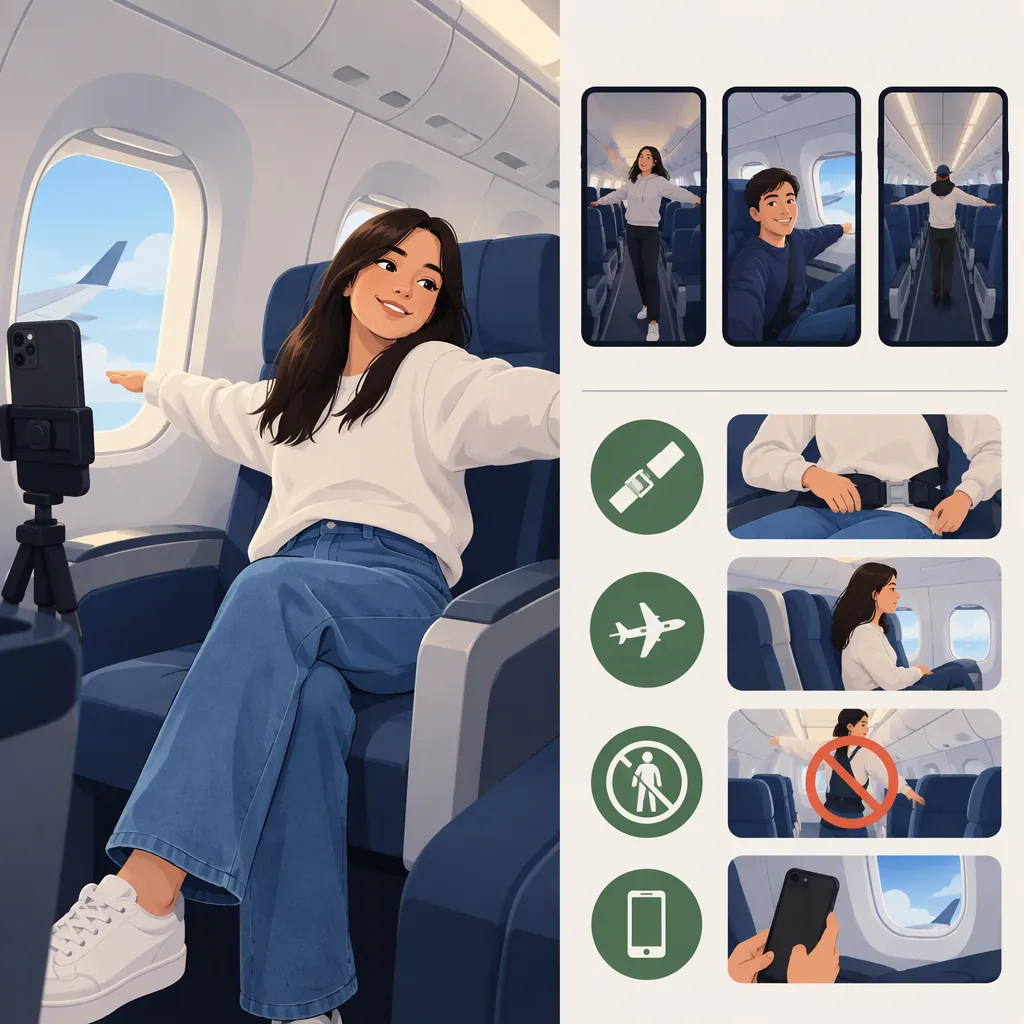
TikTok Airplane Trend: What It Means and How to Evaluate It
The phrase “TikTok airplane trend” is ambiguous in the supplied sources. It may refer to airplane-themed visual content or the travel challenge called “airport theory.” Instagram’s airplane-trend page includes varied captions and an AI airplane-scene prompt; a Yahoo-hosted article describes airport theory as attempting a roughly 15-minute airport-to-gate journey. These sources do not establish one definitive TikTok format, sound, or origin. [ref_1] [ref_2]
Identify Which Airplane Trend You Mean
Start with the specific clip rather than the search phrase. The supplied Instagram page groups together travel captions, airplane-related jokes, dance references, and an AI scene prompt under an airplane-trend label. That variety is evidence of a broad category, not proof that every post follows the same format. It also does not establish how widespread any format is on TikTok. [ref_1]
For a practical classification, ask what drives the clip:
- Visual effect: Does the airplane appear through an edit or a generated scene?
- Travel story: Is the focus a destination, flight experience, or airport journey?
- Dance or joke: Does the airplane reference support a performance or punchline?
- Timed challenge: Is the creator trying to reach a gate unusually quickly?
These are suggested sorting categories, not an official taxonomy. Without the original clip or its sound page, a precise identification remains uncertain.
Recognize an Airplane Visual Effect
One entry on the Instagram page contains a prompt for a vertical scene in which a seated person snaps their fingers and an airplane emerges behind them before taking off. The text references a portrait and an airplane image and includes AI-related hashtags. This supports identifying that entry as an AI scene concept; it does not verify the finished output, its production tool, or its TikTok origin. [ref_1]
If you are planning a similar fictional effect, use a controlled setting rather than trying to stage proximity to a real aircraft. Label generated or composited imagery clearly, particularly when the scene could look like an actual aviation incident. Avoid presenting a fictional stunt as documentary footage.
Fictional Airplane-Effect Storyboard
1. Record a stationary subject in a safe, permitted location.
2. Choose a simple gesture as the edit cue.
3. Add a clearly fictional airplane effect using imagery you have permission to use.
4. Keep the subject away from active aircraft operations.
5. Add an accurate disclosure such as “AI-generated airplane scene” or “Composited airplane effect,” depending on the method used.
6. Review the caption and opening frame for any misleading suggestion of a real emergency.
Separate Airport Theory from Visual Trends
Airport theory concerns real travel timing, not an airplane animation. The Yahoo-hosted article describes the challenge as getting from the airport entrance to the departure gate in 15 minutes or less. It also describes arriving shortly before gates close, so its timing language should not be treated as a precise or reliable travel rule. [ref_2]
The article reports both successful attempts and missed or nearly missed flights. It identifies security queues, checked baggage, terminal distances, and unexpected screening as reasons a short airport transit can fail. It also reports that TSA discouraged the challenge. These are statements from a secondary article, not independently checked airline or TSA guidance here. [ref_2]
Do not use a successful clip as your arrival-time plan. Check your airline’s check-in, baggage, and boarding deadlines and your departure airport’s current arrival guidance. For educational content, explain the challenge or document an ordinary journey with adequate time rather than deliberately cutting arrival margins.
Evaluate the Evidence Before Calling It a Trend
The supplied references are an Instagram aggregation page and a Yahoo-hosted explanatory article. Neither provides a TikTok-wide dataset establishing the leading airplane format, its original creator, a definitive audio track, or current growth. Keep those limitations separate from what an individual example shows. [ref_1] [ref_2]
For your own monitoring, compare multiple original posts and record recurring visual sequences, sounds, captions, and publication dates. Treat a repeated hashtag as a discovery clue, not sufficient evidence that the videos share a format. Keep performance observations limited to the posts actually examined.
Airplane-Trend Review Worksheet
- Review date:
- Original post URL:
- Platform and publication date:
- Format: visual effect, travel story, dance or joke, or timed challenge:
- Sound title or identifier, if available:
- Repeated visual sequence:
- Evidence of editing or generation:
- Safety or misleading-context concerns:
- Similar original posts examined:
- Supported conclusion:
- Remaining uncertainty:

Use “not established” when the evidence does not support an origin, popularity, or growth claim.
FAQ
Is the TikTok Airplane Trend the Same as Airport Theory?
Not necessarily. Airport theory is a travel-timing challenge described in the Yahoo-hosted article. The Instagram airplane-trend page includes several other kinds of airplane-related content. Identify the specific clip before treating the terms as interchangeable. [ref_1] [ref_2]
What Sound Does the TikTok Airplane Trend Use?
The supplied references do not establish a single sound. Check the sound attached to the specific original video and compare it with other examples before naming it as the trend’s audio. [ref_1] [ref_2]
Should I Try Airport Theory for a Video?
It is not a reliable travel plan. The Yahoo-hosted article reports missed-flight risks and explains that security, baggage, and terminal travel can exceed the challenge’s short time window. A safer alternative is to explain the challenge without deliberately arriving late. Check current airline and airport guidance for your itinerary. [ref_2]