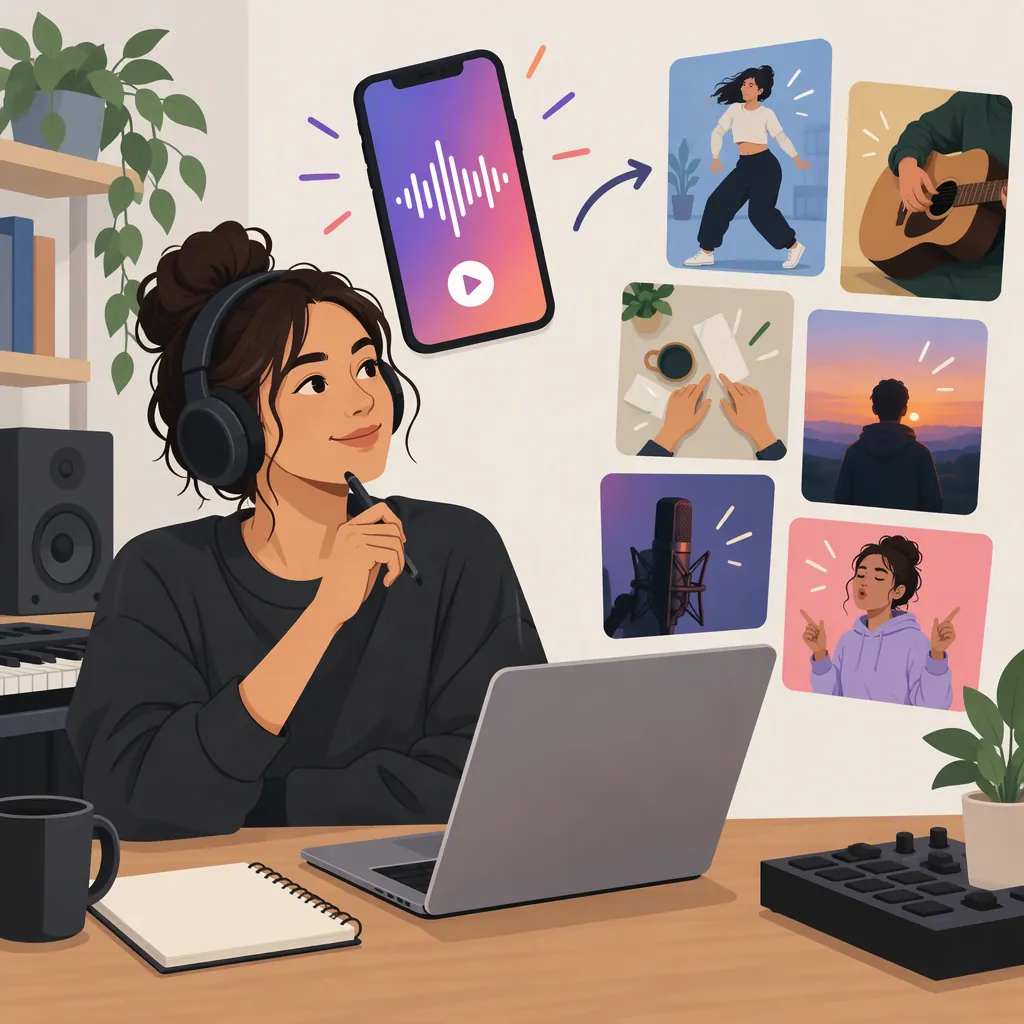
Music Content Ideas: Turn Trending Sounds into Video Concepts
Use a trending sound as a creative prompt, not a complete content plan. Identify what makes the format recognizable—a beat change, lyric cue, contrast, or reveal—then connect that structure to your own music, process, or story. Artist-content guides suggest production comparisons, trend formats using original songs, behind-the-song explanations, and performance clips as starting points. The provided sources do not verify which sounds are trending now. [c1] [c3]
Separate the Sound from the Video Format
For planning purposes, distinguish the sound—the recording used in a video—from the format—the sequence of actions, text, and edits built around it. You can study a format without assuming that you need to use the same recording.
Start with three questions:
- What happens before the musical cue?
- What changes at the cue: the image, performance, caption, or meaning?
- What makes this version specific to the creator?
For example, a quiet-to-loud transition could become a demo-to-final-mix comparison. A lyric-led reveal could introduce the notebook line that became a chorus. These are proposed adaptations, not verified current trends.
Orphiq includes both production before-and-after videos and trend formats using an artist's own song among its content suggestions. That provides a useful starting point for separating an editing idea from a particular audio track. [c1]
Build a Small Sound Observation Log
Before choosing an idea, collect a small set of examples from the platform where you intend to publish. Record the date, the sound identifier or page, and what you actually observed. Keep observation separate from interpretation: seeing several similar videos does not establish platform-wide popularity.
Look for different uses of the same sound rather than copying one video. Note whether the examples revolve around performance, humor, storytelling, or a visual transition. Then ask whether you have something relevant to contribute.
The sources supplied here are content-idea guides, not live trend databases. They cannot establish current sound rankings, trend growth, or regional availability. Treat your log as a dated creative reference, not a prediction of reach.
Sound Observation Worksheet
Platform:
Date observed:
Sound name or identifier:
Examples reviewed:
Repeated video structure:
Musical cue or timestamp:
What was directly observed:
What remains uncertain:
Connection to my music or story:
Possible adaptation using original audio:
Audio-use permissions or restrictions to verify:
Decision: develop, revisit, or skip.
Try Eight Music Content Ideas
The following prompts adapt themes in the supplied guides. Orphiq suggests sound-making explanations, performance clips, lyric stories, and version comparisons; Noble Bison Productions includes gear, behind-the-scenes, behind-the-song, and lyric videos. [c1] [c3]
| Idea | What to Film | How to Use the Musical Cue |
|---|---|---|
| Demo to finished track | A rough recording followed by the finished passage | Switch at the moment the arrangement opens up |
| One sound, three approaches | Three performances of the same short phrase | Use each repeat to introduce a different interpretation |
| Behind one lyric | A notebook detail and a brief explanation | Reveal the sung line after its context |
| Build the beat | Separate shots of percussion, bass, and melody | Add one layer at each clear musical change |
| Unexpected performance setting | A short performance somewhere visually distinctive and appropriate | Let the setting appear before the main phrase |
| Gear in context | One tool or instrument followed by the sound it contributes | Move from explanation to audible demonstration |
| Rehearsal to performance | Two versions of the same passage | Match the transition to a shared beat or lyric |
| Two arrangement choices | A stripped-back version and a fuller version | Give each version a clearly labeled turn |
These are creative prompts, not performance forecasts. Use material you can accurately explain, and avoid presenting a staged reconstruction as spontaneous documentary footage.
Choose an Idea That Fits Your Music
A recognizable format is only one part of the decision. Berklee recommends giving a release visual, emotional, and conceptual cohesion, and tailoring content to its platform. [c2]
Use that advice as a filter. Does the sound's mood fit the story? Can someone unfamiliar with your work understand the video? Does the musical cue serve the idea, or are you forcing an unrelated concept into it?
Draft one sentence before filming: “This video shows ___, and the musical change reveals ___.” If the sentence remains vague, simplify the concept.
Plan a version using your own recording where practical. Before using any third-party audio, verify the permissions and restrictions relevant to the intended platform, account, and use. The supplied sources do not establish licensing permission for individual recordings; an audio choice in this worksheet is not legal clearance.
Short Video Planning Card
Concept in one sentence:
Intended viewer:
Opening image or caption:
Music passage:
Action before the cue:
Reveal at the cue:
Closing image:
What makes this interpretation distinct:
Audio permission status:
One question to evaluate after publishing:
Test the Concept Without Overreading Results
Try a small comparison rather than changing everything at once. For example, keep the music passage and reveal consistent while testing two opening captions. Record what changed so the comparison remains interpretable.
Choose a review question in advance: Did viewers stay until the reveal? Did comments discuss the music or only the joke? Did people ask about the production technique? Use whatever relevant metrics the platform makes available, alongside the substance of responses.
Berklee emphasizes meaningful interaction rather than follower counts alone. [c2] Apply that principle by looking for responses related to the purpose of the video, not just its total views.
Treat results as clues, not proof that the sound caused the outcome. One post cannot isolate audio from the performance, edit, topic, or audience. Keep useful concepts in an idea bank and revisit the sound's relevance before reusing it.
FAQ
Which Sounds Are Trending Right Now?
The provided references do not contain a verified live list. Observe candidate sounds on your intended platform and record the date and examples. Do not treat repeated appearances in your own feed as a platform-wide ranking. [c1] [c2] [c3]
Can I Adapt a Trend Format Using My Own Music?
Yes, as a creative approach: Orphiq explicitly suggests using an artist's own song in a trend format. Preserve the structural idea, such as a timed reveal, while developing your own performance, visuals, and story. This suggestion does not establish that a particular adaptation will gain reach. [c1]
What Can I Post When I Have No New Release?
Consider a sound-making demonstration, a lyric explanation, a gear walkthrough, or a rehearsal clip. The supplied guides include process, behind-the-song, and behind-the-scenes ideas that do not require a release announcement. Choose one specific detail rather than trying to summarize your entire creative process. [c1] [c3]