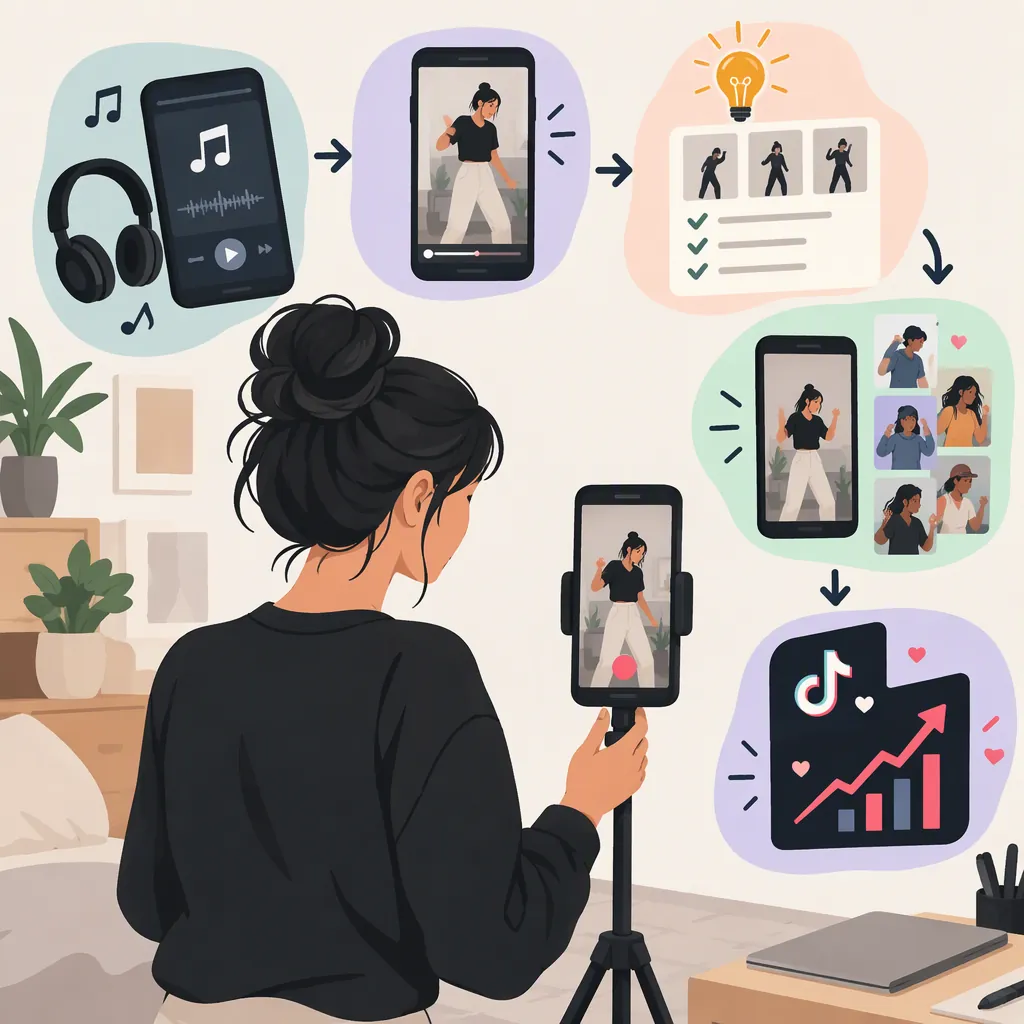
How to Make an Original Song Trend on TikTok
To give an original song a chance to trend on TikTok, make it available for use, select a distinctive excerpt, and test video concepts that other people can adapt. Track whether people create their own videos with the song—not just whether your posts receive views. The supplied sources discuss music-library availability, snippet selection, and sound-based video ideas, but they do not establish a guaranteed formula for virality. [C1] [C2]
Start with a Usable Song, Not a Viral Promise
Separate two tasks: making your song available and giving people a reason to use it. The supplied music-distribution reference explains that songs in TikTok’s music library can be added to other users’ videos. Availability is a starting point, not proof that a song will become popular. [C2]
Before planning a release, confirm permission for the recording, composition, samples, and collaborators’ contributions. Check the current delivery requirements and timing with your chosen distribution route rather than assuming that one provider’s process applies everywhere.
Once the song is available, check how its title, artist name, and usable excerpt appear in the app. For your test posts, use the same intended sound where possible so that your observations concern one identifiable version.
Pre-Test Checklist
- Confirm permission for all included music and recording elements.
- Check current TikTok delivery requirements with the chosen distributor.
- Verify the song and artist identification in the app.
- Check that the intended excerpt is available.
- Record which sound version each test video uses.
Choose an Excerpt with a Clear Video Moment
Do not assume that the chorus is automatically the best excerpt. Compare a few candidate moments: a recognizable lyric, a rhythmic change, an emotional turn, or a pause followed by a strong entrance.
The distribution reference recommends choosing a snippet that could support challenges and trends. That is creative guidance, not evidence that any particular musical feature causes virality. [C2]
For each candidate, ask: What could happen on screen at this exact moment? Could someone understand the idea without knowing the full song? Could the same passage fit more than one person’s story?
Try a short video treatment first, then adjust the length to the idea. Plann recommends concise videos, but its article is framed around 2022; treat that as a testing suggestion rather than a current platform rule. [C1]
Snippet Comparison Worksheet
For each candidate excerpt, record:
- Start and end timestamps.
- The lyric or musical event that anchors the video.
- A possible on-screen action.
- Whether the idea makes sense without extra explanation.
- Whether another person could adapt it.
- What the test actually showed, kept separate from your prediction.
Build a Format Other People Can Adapt
A performance video can introduce the song. For this testing plan, pair it with a concept that leaves room for other people’s experiences.
Possible formats include a before-and-after reveal timed to a beat change, a short personal story matched to a lyric, or an everyday scene whose mood changes when the music enters. These are proposed experiments, not documented success cases.
Keep the structure understandable while leaving the subject flexible. For example, a transformation concept could accommodate artwork, an outfit, or a room rather than requiring an exact copy of your video.
Plann suggests exploring storytelling, tutorials, dance, and other treatments when working with a sound. Applying that approach to an original song means testing which treatment fits your excerpt—not replacing your song with an already-popular track. [C1]
Reusable Video Brief
Song moment: [lyric, pause, or beat change]
Video setup: [what the viewer sees first]
On-screen event: [what happens at the song moment]
Adaptable element: [what another person could personalize]
Caption: [one clear sentence explaining the scene]
Test question: [what this version is intended to reveal]
Study Sound Uses Without Copying the Surface
Look at how people build videos around sounds: where the important musical moment falls, what needs explanation, and which elements change between creators. Plann describes using sound pages to examine different videos made with the same audio. [C1]
Use those observations to form hypotheses about your own song. A dance format is worth testing only if it suits the music and the audience you want to reach. A popular hashtag or visual style is not, by itself, evidence that your song will spread.
The supplied references do not identify sounds trending today or verify current interface labels. Check discovery features directly in the app, and treat what you see in your feed as a limited sample rather than a platform-wide ranking.
Sound Observation Notes
Sound examined: [name]
Observation date: [date]
Repeated video structure: [description]
Musical cue used: [description]
Elements creators personalize: [description]
Possible fit for your song: [hypothesis]
Limitations: [small sample, one feed, or uncertain timing]
Measure Adoption Separately from Views
For this plan, define progress as people using the song in their own videos. Keep that separate from exposure to videos you posted yourself. The distribution reference distinguishes videos created with a song from views of those videos in its discussion of royalties; this article uses that distinction for observation, not to predict earnings. [C2]
Compare tests at consistent intervals and change one major element at a time where practical. Record available viewing and interaction metrics alongside observed sound uses. If a metric is unavailable, mark it unavailable rather than estimating it.
If a post attracts attention but no observed reuse, test whether the format is understandable and adaptable. If independent uses appear, document which parts people preserve and which they change. Neither outcome proves why the platform distributed a video.
Simple Test Log
| Video | Excerpt | Format | Main Change | Observation Window | Available Metrics | Observed Independent Uses | Next Hypothesis |
|---|---|---|---|---|---|---|---|
| [ID] | [timestamps] | [concept] | [one variable] | [elapsed time] | [values or unavailable] | [count observed and limitations] | [next test] |
Keep the Evidence Limits Visible
The evidence here consists of a general TikTok creation guide and a commercial music-distribution page. Plann’s advice largely concerns making videos with existing trending sounds; the distribution page discusses making an artist’s music available and choosing an excerpt. Neither provides controlled evidence for a repeatable method of making an original song trend. [C1] [C2]
The worksheets in this article are an original testing framework, not a proven growth formula. No posting frequency, hashtag set, snippet length, or number of attempts is presented as a guaranteed threshold. A useful result is a clearer understanding of which musical moment and video concept people choose to reuse.
FAQ
Can I Guarantee That My Song Will Trend on TikTok?
No guarantee is supported by the supplied references. They discuss sound availability and creative tactics, but do not demonstrate a repeatable formula that ensures an original song will trend. Treat the process as testing, not a promised outcome. [C1] [C2]
How Long Should the Song Excerpt Be?
The references do not establish a universal optimal length. The distribution page describes a 30-second snippet in its own workflow, while Plann recommends shorter video treatments. Those are different contexts. Check current delivery options and test a passage that contains a complete, understandable video moment. [C1] [C2]
Should I Use an Existing Trending Sound Instead?
That tests a different objective: making a video with an already-popular sound rather than encouraging use of your original song. Plann’s guide primarily addresses the former. For original-song testing, study those formats for ideas while keeping your own excerpt central to the experiment. [C1]