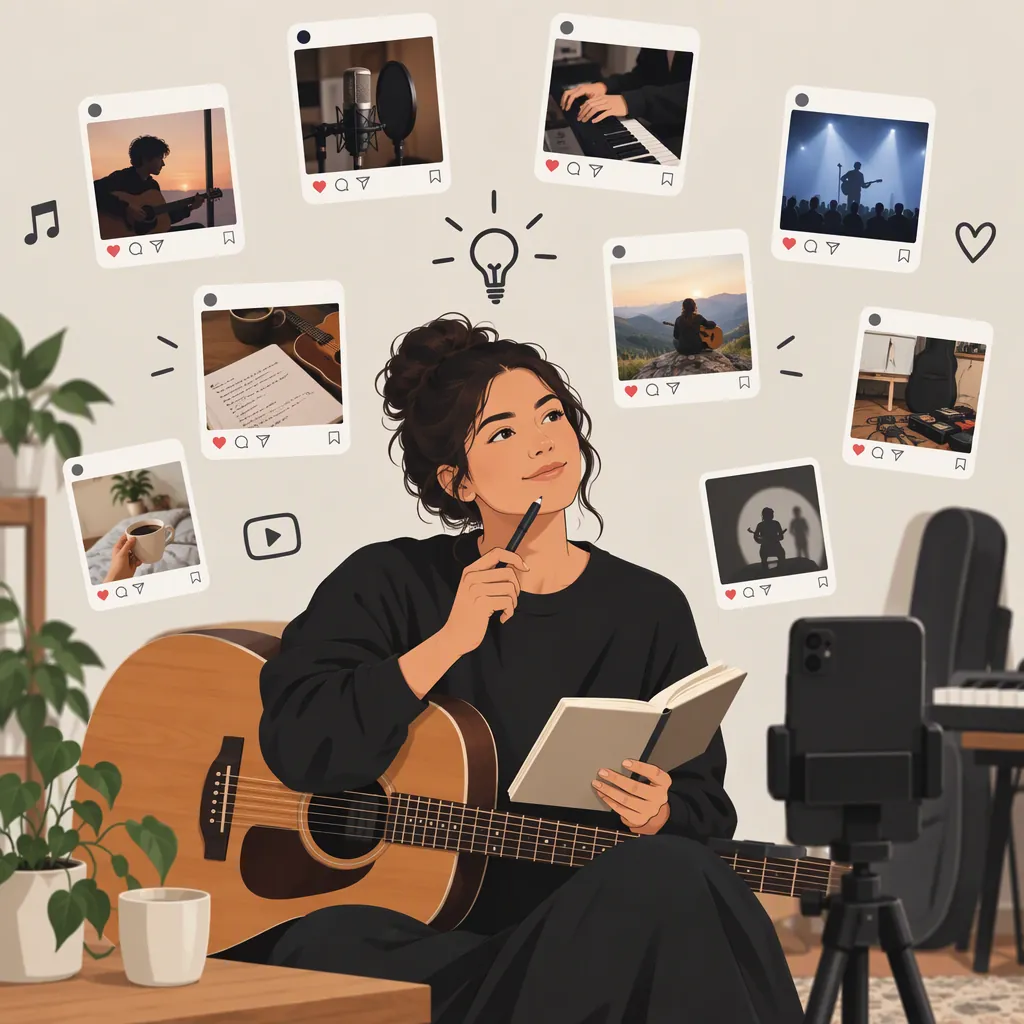
Instagram Content Ideas for Musicians: What to Post
Musicians can build Instagram posts around performances, rehearsals, songwriting decisions, short lessons, musical influences, and audience questions. The supplied guides recommend these themes across social media. Use them as repeatable starting points, then choose a format that fits the material: a Reel for a musical demonstration, a carousel for a step-by-step explanation, or a Story for a question. These are editorial suggestions, not guarantees of reach or engagement. [c1] [c2] [c3]
Choose Themes Before Choosing Formats
Start with what a viewer should hear, understand, or respond to—not simply what you need to publish.
The inClassics guide recommends choosing a clear audience and mixing content types, including educational, entertainment, and behind-the-scenes material. Its examples distinguish the interests of fans, students, fellow musicians, and industry professionals. [c1]
For an Instagram plan, try three recurring themes:
- The music: performances, arrangements, rehearsals, and work in progress.
- The decisions: why you changed a lyric, chose a sound, or interpreted a passage a particular way.
- The conversation: questions about your music, influences, or practice process.
These themes are a planning suggestion, not a required formula. A songwriter might emphasize lyrics and demos; an instrumentalist might emphasize interpretation and technique. Select material you can explain accurately and share comfortably.
One-Post Planning Card
Audience: [Who is this for?]
Theme: [Music / decisions / conversation]
Specific moment: [One passage, choice, or question]
Viewer takeaway: [What should someone hear or understand?]
Format: [Reel / carousel / Story / photo]
Material needed: [Clip, image, or notes]
Boundary check: [What should remain private?]
18 Instagram Content Ideas to Adapt
The following prompts adapt themes found in the supplied guides, including rehearsal footage, raw-versus-finished audio, lyric explanations, tutorials, influences, and audience questions. The suggested Instagram formats are editorial choices rather than platform performance claims. [c1] [c2] [c3]
Performance and Rehearsal
- One passage, two interpretations: Play the same phrase with two different approaches and explain the difference.
- An acoustic arrangement: Present a stripped-back section of your own song and name what changed.
- A rehearsal problem: Show a passage you are working on and the adjustment you are testing.
- A soundcheck detail: Demonstrate one musical or setup decision without exposing private venue information.
Songwriting and Production
- Demo versus finished version: Compare the same section at two stages and identify one specific change.
- A lyric decision: Explain why you replaced a word or line in your own song.
- A sound in isolation: Play one layer, then place it back in the arrangement.
- An unfinished idea: Share a work-in-progress fragment, clearly labeled as unfinished.
Educational Posts
- Teach one phrase: Break a short section of your own music into manageable steps.
- Explain one musical choice: Demonstrate a rhythm, chord, articulation, or production decision using your work.
- Show a practice routine: Describe what you are practicing and why, without presenting your routine as universal advice.
- Explain a piece of gear: Show what you use it for rather than implying that viewers need to buy it.
Stories and Influences
- The story behind a piece: Connect a musical detail to the idea that inspired it.
- An early rehearsal revisited: Compare an archival clip with your current approach, if you are comfortable sharing both.
- An influence explained: Discuss what you learned from an artist, recording, book, or film. You can explain an influence without reproducing its audio or artwork.
Audience Questions
- Answer one music question: Turn a relevant question into a focused demonstration.
- Compare two arrangements: Present two options and ask which difference listeners notice.
- Explain a setlist choice: Describe why two pieces sit next to each other, then invite questions about the musical connection.
These prompts do not require fabricated fan reactions, reviews, milestones, or personal stories. Use only material and experiences you can truthfully describe.
Use Trends as Optional Creative Prompts
Elizabeth Music Group includes viral challenges, trending filters, and relatable skits using an artist’s music in its idea list. That list offers creative prompts; it does not establish which sounds are trending now or whether using them improves results. [c2]
Before adapting a trend, ask:
- Does it have a musical connection? Could it reveal your arrangement, timing, instrumentation, or songwriting?
- Is there a clear idea? Would the post still make sense without familiarity with the trend?
- Can your own music carry it? Could an original passage support the concept instead of an unrelated sound?
- Is it worth the work? Can you make it without displacing rehearsal, recording, or other priorities?
An optional approach is to borrow a comparison structure rather than an audio track: show a rough idea followed by its developed arrangement, with a brief explanation of the change.
Evidence limit: The supplied references do not verify current Instagram trend rankings, audio availability, licensing permissions, or recommendation-system behavior. Treat those questions as unresolved here. Do not interpret an idea in this article as confirmation that third-party audio is permitted for your intended use.
Trend Adaptation Worksheet
Observed format: [Describe the pattern without assuming it is currently popular]
Musical connection: [What does it reveal about the work?]
Original material available: [Your clip or recording]
Explanation: [One sentence that makes the idea understandable]
Unresolved checks: [Audio permissions, availability, or other requirements]
Decision: [Adapt / save for later / skip]
Turn One Session into a Flexible Content Plan
The inClassics guide describes a pillar-content approach: make a substantial piece of material, then adapt it into smaller pieces. It also recommends reusing relevant content rather than starting from scratch every day. [c1]
Apply that principle to a rehearsal or recording session you already intend to hold. Capture a performance excerpt, note one decision, and record an explanation if useful. Give each resulting post a different purpose rather than repeatedly publishing the same clip with a new caption.
A possible sequence is:
| Post | Material | Purpose |
|---|---|---|
| Performance Reel | One self-contained passage | Let viewers hear the music |
| Process carousel | Notes or images about one change | Explain a creative decision |
| Question Story | Two labeled versions | Invite a specific comparison |
| Follow-up video | Your explanation of the versions | Resolve the comparison |
This is a sequence, not a mandatory weekly schedule. Publish at a pace that leaves room for making music. Add readable captions to spoken explanations and label versions clearly so the comparison is understandable.
Reusable Session Capture Checklist
- Identify one passage worth sharing.
- Capture the performance without interrupting the session unnecessarily.
- Note one specific creative decision.
- Label unfinished material accurately.
- Draft a short explanation in plain language.
- Check the frame and audio for private or unintended material.
- Choose distinct purposes for any follow-up posts.
Review Responses Without Overreading Them
Flypaper recommends updating a content strategy based on what resonates with followers. It also cautions musicians to choose which parts of their personal lives they make public. [c3]
For a modest review process, record the post’s theme, format, production effort, and any relevant responses. Where available, note the account metrics that relate to your purpose. A tutorial and a performance excerpt need not be judged by the same question: one is intended to explain something, while the other lets listeners hear the work.
Treat a single post as an observation, not proof that a format always succeeds or fails. Possible next decisions include repeating the topic with a clearer explanation, trying another format, or retiring an idea that takes too much effort.
Keep privacy boundaries separate from performance. A post receiving attention is not a reason to disclose more about your home, collaborators, or personal life. Before including another person’s contribution, seek permission and agree on credit. The sources provide ideas, not evidence that any particular posting cadence or format guarantees growth.
FAQ
What Can Musicians Post When They Have No New Release?
Try a rehearsal excerpt, a practice explanation, the story behind an existing piece, or a discussion of a musical influence. Flypaper specifically frames reusable prompts as useful when there are no upcoming concerts, releases, or video launches. [c3]
Do Musicians Need Trending Audio for Instagram Content?
Trending audio is not required by the planning approach in this article. The supplied guides offer many prompts based on performances, original music, creative processes, and questions. They do not establish that trending audio is necessary or verify current audio trends and permissions. [c1] [c2]
How Often Should a Musician Post on Instagram?
Choose a manageable schedule rather than assuming a universal frequency. The inClassics guide recommends consistency and a schedule that works for the musician, but it does not establish an evidence-based Instagram posting quota. Repurposing session material is one suggested way to support a sustainable plan. [c1]