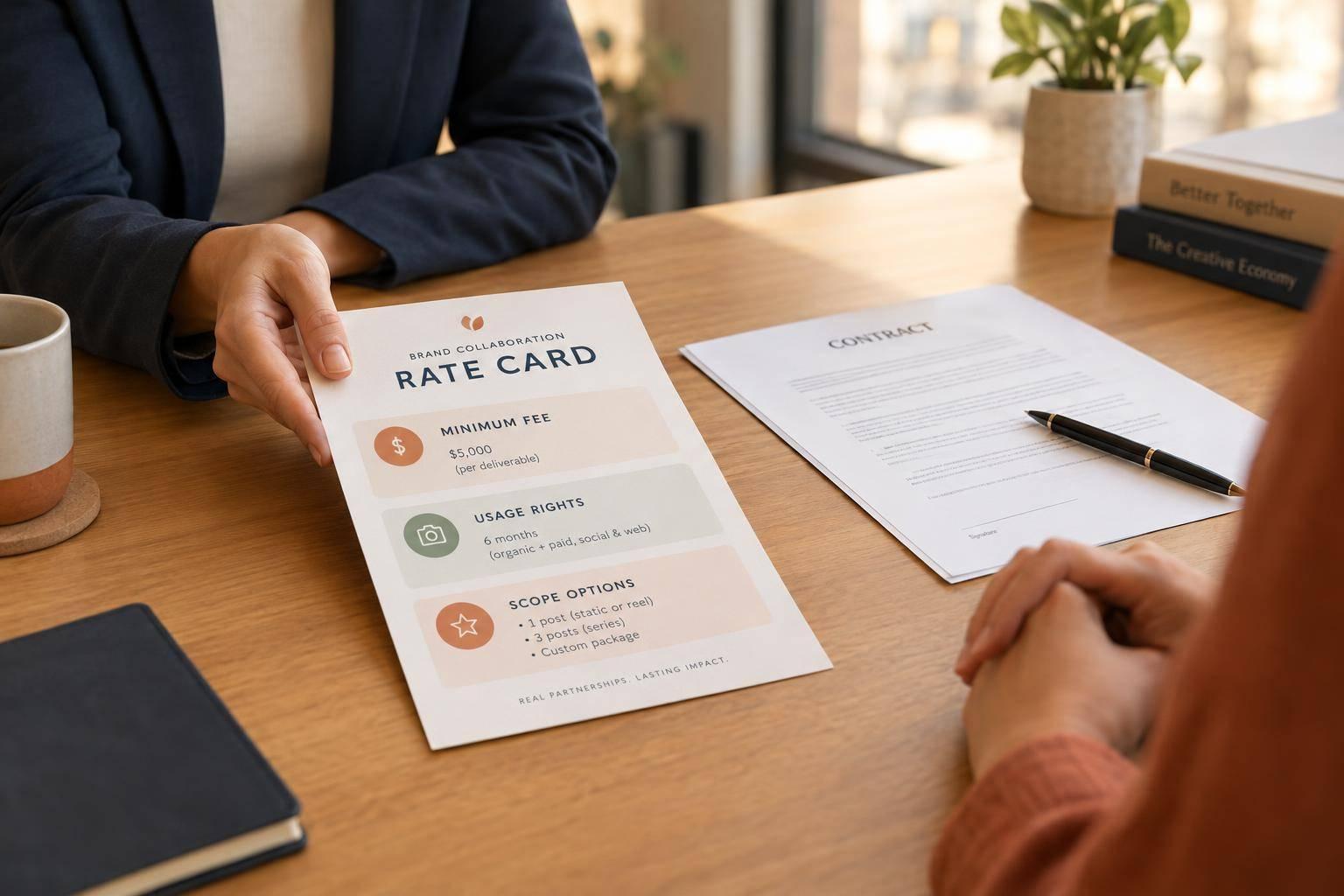
How to Negotiate Brand Deals Without Underselling
Negotiate the work and usage rights, not just the fee. A deal for one video with 30 days of organic reposting should not quietly include paid ads or exclusivity.
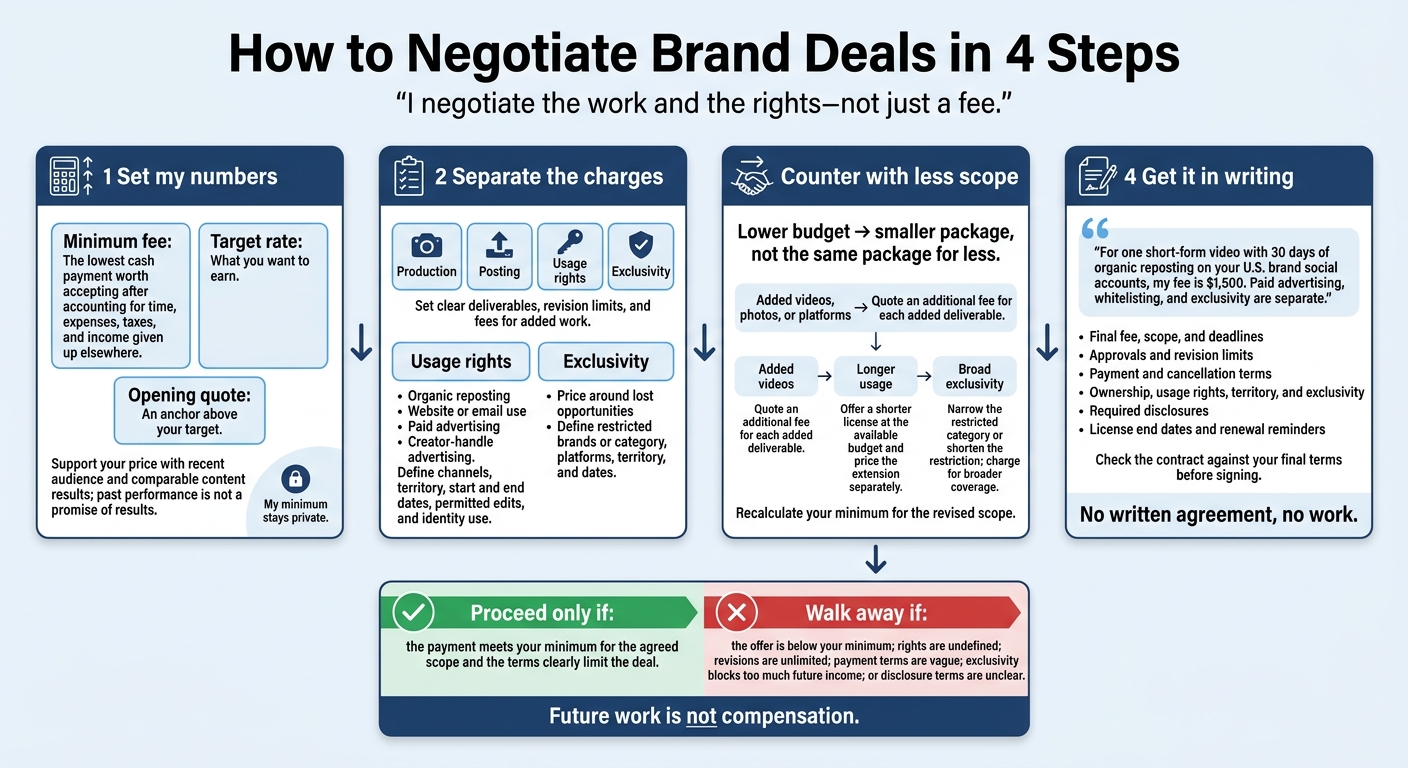
A negotiation can be organized into four steps:
-
Set your numbers: Calculate your minimum fee, target rate, and opening quote, then support your quote with recent audience and content results.
-
Separate the charges: Price production, posting, usage rights, and exclusivity, with clear limits on revisions.
-
Counter with less scope: If the budget is lower, offer fewer deliverables or fewer rights - not the same package for less.
-
Get it in writing: Confirm payment, deadlines, approvals, cancellation terms, disclosures, and license end dates before starting.
Keep your minimum private. If the final terms don’t cover your costs or put clear limits on the deal, walk away.
I Signed a $22,000 Brand Deal! | How I Price & Negotiate as a 6-Figure Creator
1. Set Your Minimum Fee and Target Rate
Set three numbers for a fixed scope: your minimum fee, target rate, and opening quote. Your minimum fee is the lowest cash payment worth accepting after accounting for time, expenses, taxes, and income you’d give up elsewhere. Your target rate is what you want to earn. Your opening quote is your anchor, set above that target.
Charge separately for extra deliverables, revisions, usage rights, and exclusivity. Establish your floor before pricing those additions.
Calculate Your Minimum Fee
Count the full cost of the project - not just filming time. The estimates below are for planning; use your own records to set your negotiation floor.[14][15][16]
Cost category Example estimate Creative planning and scripting: 2 hours × $40 $80 Filming and setup: 3 hours × $50 $150 Editing and captioning: 4 hours × $50 $200 Client communication and administration: 1.5 hours × $40 $60 Equipment, software, props, and supplies $75 Transportation or location expenses $40 Subtotal before tax reserve $605 Tax reserve: 25% of subtotal $151 Lost income from turning down other work $100 Illustrative minimum fee $856
Replace these estimates with actual costs, round the total up, and add a buffer if the brief is unclear or revisions seem likely. The tax reserve is a planning allowance, not a tax calculation. Tax treatment varies, and non-cash compensation or bartering may be taxable at fair market value.[14][15][16]
Assess gifted products separately from cash. Don’t automatically subtract their retail value from your minimum fee. The FTC treats free or discounted products as a material connection that generally requires disclosure in an endorsement.[5][13][6] Keep records and consult a tax professional.[14][15]
Back Your Rate with Audience and Content Data
Support your rate with recent results from comparable posts. Include average or median views, watch time or retention, saves, shares, and comments. Add click-through, conversion, or coupon-code data from similar campaigns, along with audience location, age range, gender distribution, and purchasing relevance when available.
Show what goes into production, too: scripting, testing, editing, and equipment. Use past performance to support your price - not to promise results. If you’re creating UGC without posting it, price production separately from access to your audience.[9][11][12]
Next, break the quote into deliverables, usage rights, and exclusivity so the brand can see what each part costs.
2. Price Deliverables, Usage Rights, and Exclusivity Separately
Once you’ve set your floor, split the deal into work, usage rights, and exclusivity. Each deserves its own price.
Define Deliverables and Revision Limits
Build a scope matrix before you quote. Then get written approval of that scope before production begins.[2][3]
| Scope item | Specify in writing | Fee treatment |
|---|---|---|
| Deliverables | Platform, format, quantity, video length, captions, tags, links, posting or delivery dates, and who publishes | Base production/publication fee |
| Production requirements | Location, styling, props, on-camera talent, music licensing, and technical requirements | State what’s included; quote extras separately |
| Approvals | Concept, script, and draft sign-off; one brand representative; feedback deadline | Timeline depends on timely sign-off |
| Revisions | Included rounds of changes after sign-off | Fee per additional round |
| Added work | New concepts, reshoots, raw footage, and project files | Separate quote and written approval |
| Rush work and expenses | Shortened deadline, travel, rentals, and shipping | Separate rush fee and approved expenses |
A revision changes approved work. A new brief or reshoot needs a new quote. Require one consolidated set of feedback within three business days per round, and state that late feedback can push back delivery dates.[2][4]
Set Separate Fees for Reposting and Advertising
Paying for content production doesn’t automatically give a brand advertising rights. Price each permission separately. For each one, define the channels, territory, start and end dates, permitted use of your name, image, voice, and handle, plus limits on editing and sublicensing.[3][17]
| Permission | Rights and limits to define | Separate fee |
|---|---|---|
| Organic reposting | Named brand-owned social accounts, credit, and permitted edits | Limited organic-use license |
| Website or email | Named website pages or email campaigns; cropping and resizing | License for the brand’s own channels |
| Paid advertising | Ads run from the brand’s ad account; approved edits | Paid ad license |
| Creator-handle advertising | Ads using your identity; authorized ad account; ad approvals | Paid ad license using your handle, renewed separately |
Whitelisting lets a brand run ads through your account or identity. It does not mean handing over account access. Set spending authority, approved ad formats, expiration procedures, and a renewal fee due before continued use. Require campaigns to stop when permission expires.[1][5][17]
Have an attorney review perpetual rights, ownership transfers, or broad editing permissions. Also confirm that required sponsorship disclosures stay visible.[1][5][17]
Price Exclusivity Based on Lost Opportunities
Spell out the product category, named restricted brands, territory, platforms, and exact start and end dates. Make clear whether the restrictions apply only to paid deals or also to unpaid mentions.[1][3][17]
Price exclusivity around the work you may lose, rather than a fixed percentage of your content fee. Use recurring clients, serious inquiries, and seasonal work to estimate that lost income.[1][3][17]
If the budget falls short, offer fewer restricted brands, fewer platforms, or a shorter restriction period - not free exclusivity. Shorten the restriction before you lower the price.[1][3][17]
3. Present Your Quote and Counter Low Offers
Turn your line items into a quote the brand can understand in one pass.
How to Quote and Counter Low Offers
Send a short package summary that spells out the deliverables, rights, and timing. Include the platform, format, quantity, length, draft and posting dates, review window, revision limit, and which rights are included or excluded. Back up your quote with a specific post, date range, and results. Lead with deliverables and rights - not follower count.
Use this sample as a format, not a rate guide. Set your fee based on your minimum, expenses, results, and opportunity cost. Tie that fee to a clear scope and the rights it covers.
For one short-form video with 30 days of organic reposting on your U.S. brand social accounts, my fee is $1,500. Paid advertising, whitelisting, and exclusivity are separate.
If the brand offers less, acknowledge its budget without apologizing or sharing your minimum. A lower price should come with a smaller package.
For example: one video instead of two, with organic use only.
Reduce Scope Instead of Discounting the Same Work
Answer low offers by changing the scope, rather than cutting the price for the same work twice. Ask what matters most: content volume, speed, or rights. Then offer one clear alternative.
Use these options when the budget doesn't cover the request.
| Brand request | Counteroffer |
|---|---|
| Lower budget | Remove a deliverable or simplify production. |
| Rush deadline | Add a rush fee, or keep the standard fee with a later delivery date. |
| Added videos, photos, or platforms | Quote an additional fee for each added deliverable. |
| Paid advertising | Add a separate, time-limited license; otherwise, keep the package organic use only. |
| Longer usage | Offer a shorter license at the available budget and price the extension separately. |
| Broad exclusivity | Narrow the restricted category or shorten the restriction; charge for broader coverage. |
Check the smaller package against your minimum fee. Fewer deliverables still mean planning, admin, and production work. Before work starts, put the revised fee, scope, rights, deadlines, payment schedule, and revision limit in writing. No written agreement, no work.
4. Confirm the Terms Before Starting Work
Check the Contract and Track the Deal
Once the brand accepts your quote, check the contract against your final terms before signing. Make sure the fee still covers your time, costs, taxes, revisions, and any rights sold separately.[19] Keep the signed contract as the final record of what you agreed to.
Review deliverables, dates, approvals, revisions, payment and cancellation terms, ownership, usage rights, territory, exclusivity, and disclosures.[19] Replace broad usage language with exact details: which media, how long, where, and what paid-amplification rights apply.[7][20]
Agree on disclosure wording and placement, and protect your ability to use a legally clear disclosure. Paid relationships, free products, discounts, and affiliate commissions generally must be disclosed within the endorsement itself.[18][8][13]
Keep the signed agreement, invoices, rate notes, deliverables, approvals, scope changes, and deadlines in one place. Track payment deadlines, usage end dates, exclusivity dates, and renewal reminders.[19] You approve every response and commitment. Complex contract terms may still need legal review.[1][2][3]
Know When to Walk Away
If the contract changes the deal, reject it. Walk away if the offer remains below your minimum, rights are undefined, revisions are unlimited, payment terms are vague, exclusivity blocks too much future income, or disclosure terms are unclear.[10]
You can offer a smaller package - but only if the payment still meets your minimum. Future work is not compensation.[10]
Before accepting any deal, calculate your minimum fee, itemize your quote, and decide which concessions you can afford.
FAQ
How Can I Justify My Rate Without Past Brand Deals?
You don’t need past brand deals to back up your rate. Base your price on the project’s scope and value: deliverables, usage rights, exclusivity, revisions, and deadlines. Show how your fee matches those requirements and the work they involve.
If the budget is tight, offer a smaller scope instead of a lower base fee. That could mean removing paid usage rights or shortening the exclusivity window.
Should I Require a Deposit Before Starting Work?
Ask the brand about payment timing before you start. A deposit or milestone schedule is one possible arrangement; if you agree on one, confirm the amounts, due dates, and deliverables it covers in writing.
What If a Brand Uses My Content After Its License Expires?
This may be a contract or rights dispute. Your options depend on what your agreement says about expiration and use without permission, so don’t rely on general guidance alone. Flag any terms that are unclear or may have been violated, and consult a qualified attorney about your rights.
For future deals, state clearly how long usage rights last. Get legal advice on how to write and enforce those terms.