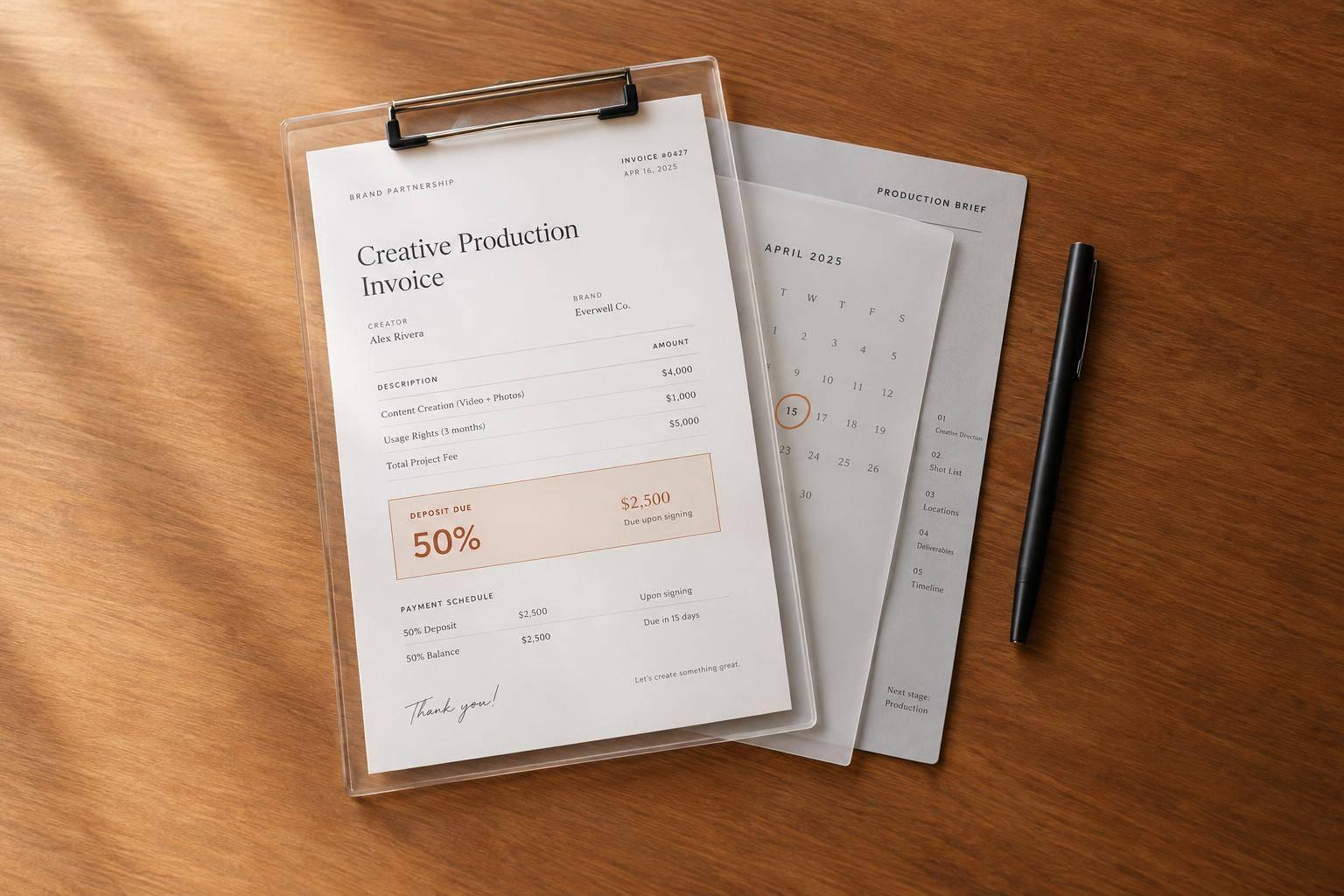
How Creators Negotiate 50% Upfront on Brand Deals
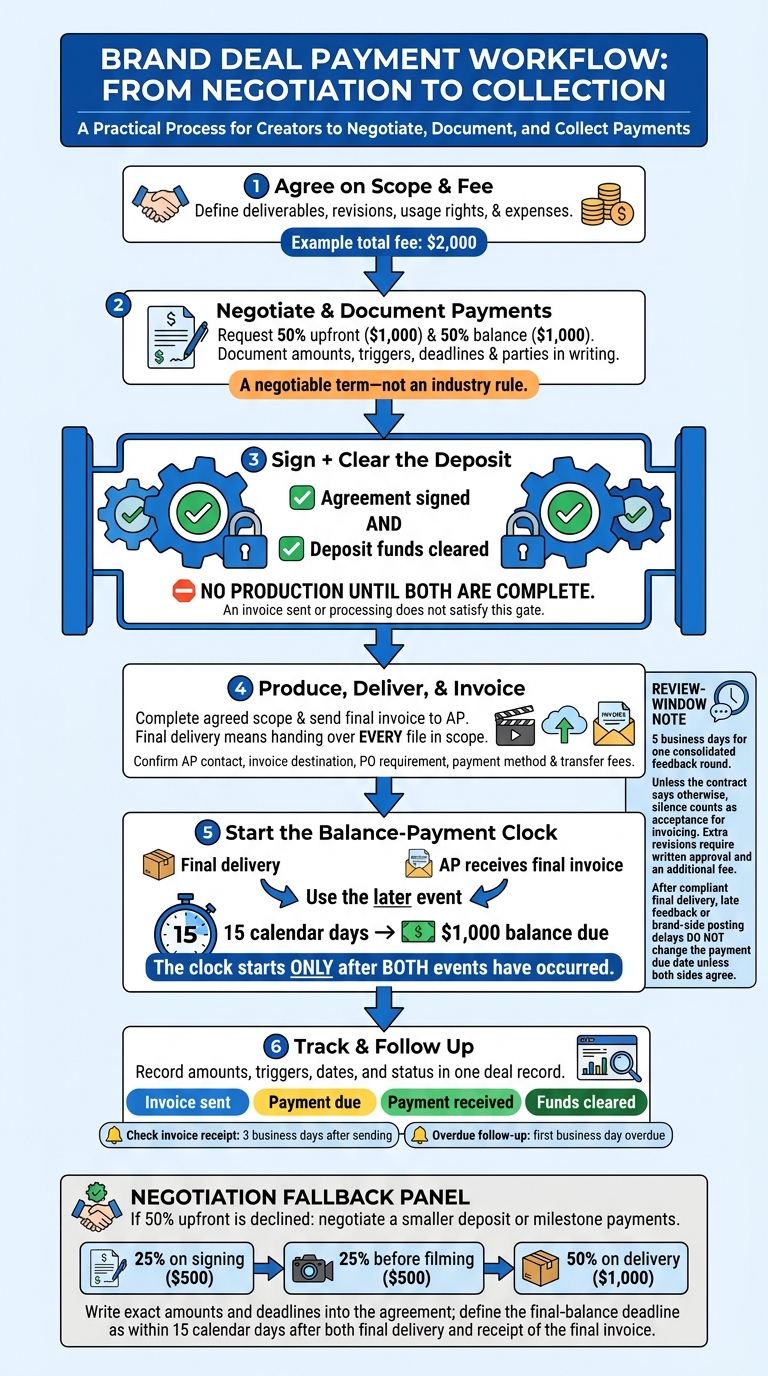
A creator can propose 50% upfront before production, with payment terms in writing. This is a negotiable term, not an industry rule. For an illustrative $2,000 deal, that means $1,000 upfront and $1,000 due within 15 calendar days after both final delivery and receipt of the final invoice.
Before starting, confirm:
- Set the scope and total fee: Agree on deliverables, revisions, usage rights, and expenses.
- Negotiate the schedule: If 50% upfront won’t work, ask for a smaller deposit plus a payment before filming or at draft delivery.
- Remove payment guesswork: Define delivery, the review window, invoice requirements, and cancellation terms.
- Track each payment: Record amounts, due dates, billing contacts, and follow-ups in one deal tracker.
A clear boundary is to begin production only after the agreement is signed and the deposit has cleared.
Step 1: Ask for 50% Upfront
Ask for the deposit when you discuss the fee and scope - not after the brand approves the deal. Treat it as a standard production term, not a trust issue. Include it in the proposal or contract before work starts.
Use a Clear Deposit Pitch
Use this wording:
“For this project, my payment structure is 50% upon signing and 50% within 15 calendar days after final delivery and receipt of the final invoice. The deposit reserves production time and covers initial production costs. I’ll send the deposit invoice with the agreement.” [4][3]
You can negotiate the percentage, payment trigger, and due date. Put the amount, trigger, recipient, responsible party, and due date in writing, and use the same payment trigger in the contract and invoices. Don’t start production until the agreement is signed and the deposit is paid.
If the brand pushes back, suggest a smaller deposit or a different trigger for the balance payment.
Respond When a Brand Declines the Deposit
“If 50% upfront is not possible, can we agree on a smaller deposit and a second payment at draft delivery?” [1]
Before changing the schedule, ask what’s blocking payment and how long approval takes.
Compare Payment Schedules
| Payment schedule | Cash-flow protection | Admin burden | Brand friction | Creator risk |
|---|---|---|---|---|
| 50% upfront; 50% on delivery | Half collected before production | Low | Moderate | Final 50% remains unpaid |
| Deposit + milestones | Strong for long or costly projects | Moderate to high | Moderate to high | Exposure falls with each payment |
| No deposit; pay on publication | Weak; creator funds production | Low to moderate | Low | Publication may be delayed or canceled |
| No deposit; full net 30 after delivery and invoice receipt | Weak; creator funds all work | Low | Low upfront | Entire fee remains unpaid after delivery |
Once the brand accepts the schedule, put the balance due date in writing.
Step 2: Set the Balance Due Date
Define Delivery, Approval, and Net Terms
After the brand accepts the 50% deposit, settle the balance terms before production starts. The remaining 50% is due within 15 calendar days after both final delivery and accounts payable (AP) receiving the final invoice.
Put these three rules in writing:
- Delivery trigger: Final delivery means handing over every file in the agreed scope. State whether included revisions must also be complete.
- Approval window: Give the brand five business days to submit one consolidated round of feedback. Set a written feedback deadline and specify what invoicing step follows. Do not treat silence as acceptance unless your signed agreement explicitly says so. Extra revisions need written approval and an additional fee.
- Payment clock: The 15-calendar-day clock starts on the later of final delivery or AP’s receipt of the final invoice. Once you deliver files that meet the agreed requirements, late feedback and brand-side posting delays don’t change the due date unless both sides agree.
Confirm Payment Amounts in Writing
Confirm the total fee, the amount of each 50% installment, and the exact balance due date in writing. That date must allow for payment within 15 calendar days after both final delivery and AP’s receipt of the final invoice.
Before invoicing, confirm the paying entity, AP contact, invoice email address or portal, purchase order (PO) requirement, payment method, and who covers wire or transfer fees.
Agree on Payment If the Brand Cancels
Agree on what payment remains earned for completed work and approved, noncancelable expenses. Specify how much of the deposit is refundable and when any remaining payment or refund is due.
Once both sides confirm these terms, record them in your deal tracker.
Step 3: Record the Payment Terms
Once the brand agrees to the terms, put everything in one place so billing and follow-ups stay on the same page.
Log Amounts, Deadlines, and Contacts
Create one deal record with every payment field. Enter the agreed total fee in USD, the deposit percentage and dollar amount, and the remaining balance. For each installment, log the payment trigger, invoice number, sent date, due date, invoice status, payment status, and actual receipt date. Add the final approval date only if the contract makes approval the payment trigger.
Keep the legal contracting entity, accounts payable (AP) contact, billing instructions, and brand contact alongside those fields. Add scope details only when they affect billing, approval, or cancellation. Link the signed agreement, amendments, confirmation messages, required purchase order (PO), invoices, and receipts.
Track invoice sent, payment due, payment received, and funds cleared as separate statuses. Enter a receipt date only after the funds arrive - not when the brand says payment is processing. If the terms change, update the schedule and link the written confirmation. Use this record to schedule follow-ups and payment checks.
Track Payment Deadlines and Follow-Ups
Use your tracker to assign every deadline, reminder, and owner. Write dates as November 5, 2026, specify whether deadlines use calendar days or business days, and note the time zone.
Schedule an invoice-receipt check three business days after sending. Set a payment follow-up for the first business day the payment is overdue. Track delivery, approval, and final-invoicing deadlines, too, with an owner and next action for each. Before escalating, confirm that AP received the invoice and any required PO.
Use a deal tracker or calendar to record terms and follow-ups. Treat signed agreements, invoices, and payment records as the authoritative sources.
Keep final approval with you: check the schedule against the signed documents, approve deal changes and brand messages, and verify that the deposit has arrived before production.
Conclusion: Check the Agreement and Deposit Before Starting
Before you close the deal, settle three things: scope, deposit, and balance. Agree on the scope and total fee before asking for 50% upfront. If the brand declines, offer this fallback:
25% on signing, 25% before filming, and 50% on delivery.[8][7][2]
Write the exact amounts and deadlines into the agreement. Make the balance due within 15 calendar days after both final delivery and receipt of the final invoice. Confirm the cancellation terms, too.[5][3][8]
Send the proposal, get written acceptance, and record the deal in your tracker so the terms stay documented from signature through final payment.[6][5] Start work only after the agreement is signed and the deposit has cleared.
FAQ
What If a Brand Wants Work Before My Deposit Clears?
Wait until the deposit clears before starting production or making a delivery. Put your payment policy in writing before work begins. Verbal promises don’t replace agreed terms. If the brand pushes back, restate your requirement.
You might say:
“I’m ready to begin production as soon as the initial deposit clears. Please confirm once payment has been processed so we can stay on schedule.”
Keep this boundary firm to protect your business.
Should Usage Rights Begin Only After Full Payment?
This isn’t a universal rule, but put this boundary in your written agreement before work begins. Usage rights and payment are separate terms, so spell out how they connect.
You can propose:
“The license to use the content takes effect only upon receipt of the full agreed fee.”
Record this condition in your contract or deal tracker, and clearly link payment milestones to usage rights.
What Should I Do If the Final Payment Is Overdue?
Review your written agreement to confirm when you’ll be paid and what your invoices must include. Don’t rely on verbal promises or assumptions about payment timing. Keep clear records of invoices, delivery approvals, and all payment-related messages to support your position.
For formal payment disputes, seek advice from a qualified professional, such as a lawyer or financial adviser, who can address your situation. These matters fall outside general creator guidance.