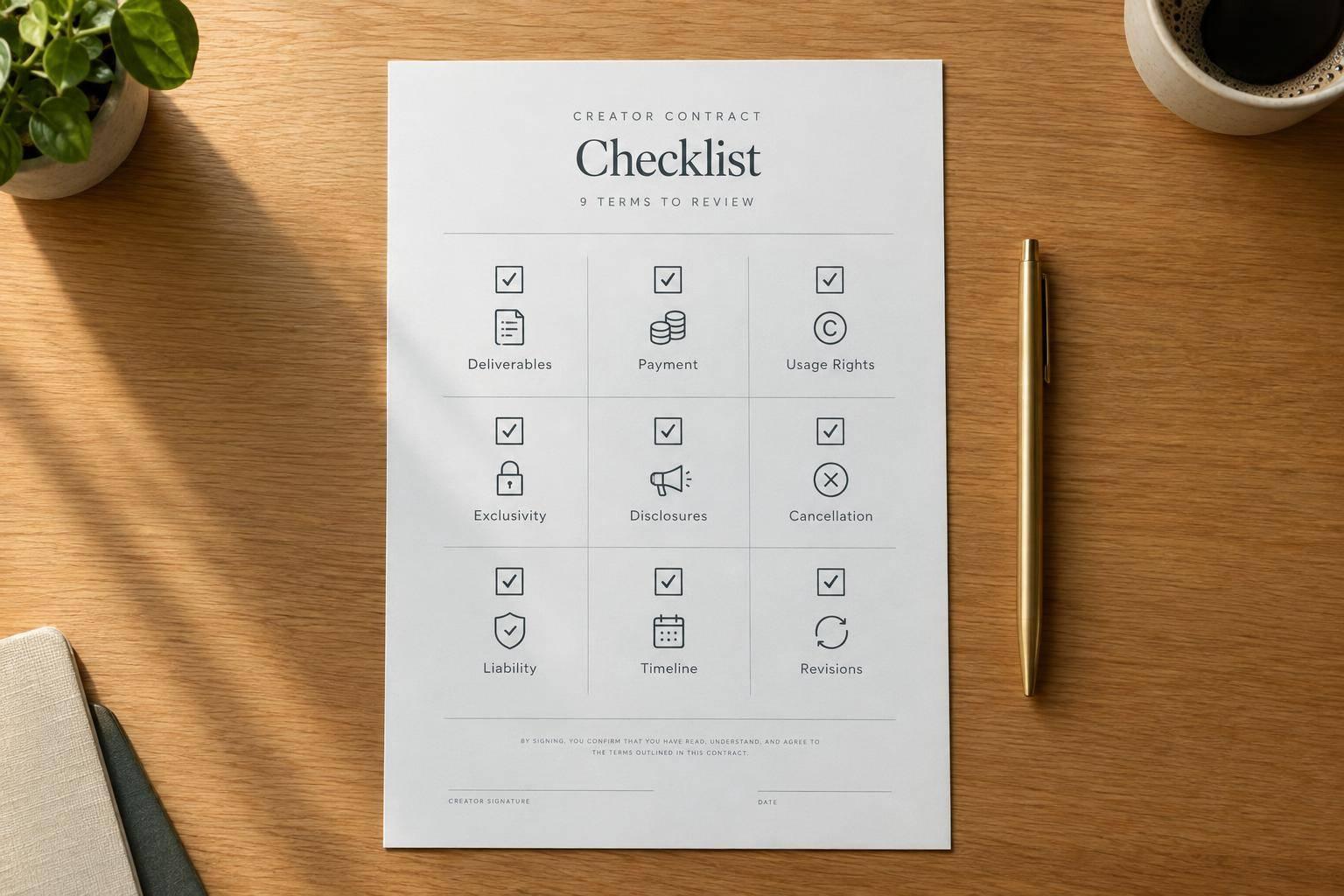
Creator Contract Checklist: 9 Terms to Review
Before I sign a creator contract, I check 9 terms that affect my pay, content rights, and future deals. I get each promise in writing - and settle unclear terms before work starts.
Here’s my checklist:
- Deliverables: What I’ll make, post, and submit for approval.
- Payment: My fee in U.S. dollars, due dates, expenses, and any advance.
- Deadlines: When I deliver and when the brand must respond.
- Revisions: How many edit rounds are included and what costs extra.
- Usage rights: Where, how, and how long the brand can use my content.
- Exclusivity: Which competing work I can’t accept - and for how long.
- Disclosures: How I’ll clearly label paid or gifted relationships.
- Cancellation: What I’m owed if the deal ends early.
- Liability: Which claims and losses each side must cover.
My starting points for negotiation? One or two minor revision rounds and, when upfront costs warrant it, a 25%–50% advance. These aren’t fixed rules.
I don’t treat an email promise as a substitute for a contract term. I compare the agreement with my brief and negotiated terms, then get changes in writing.
This is general U.S. information, not legal advice.
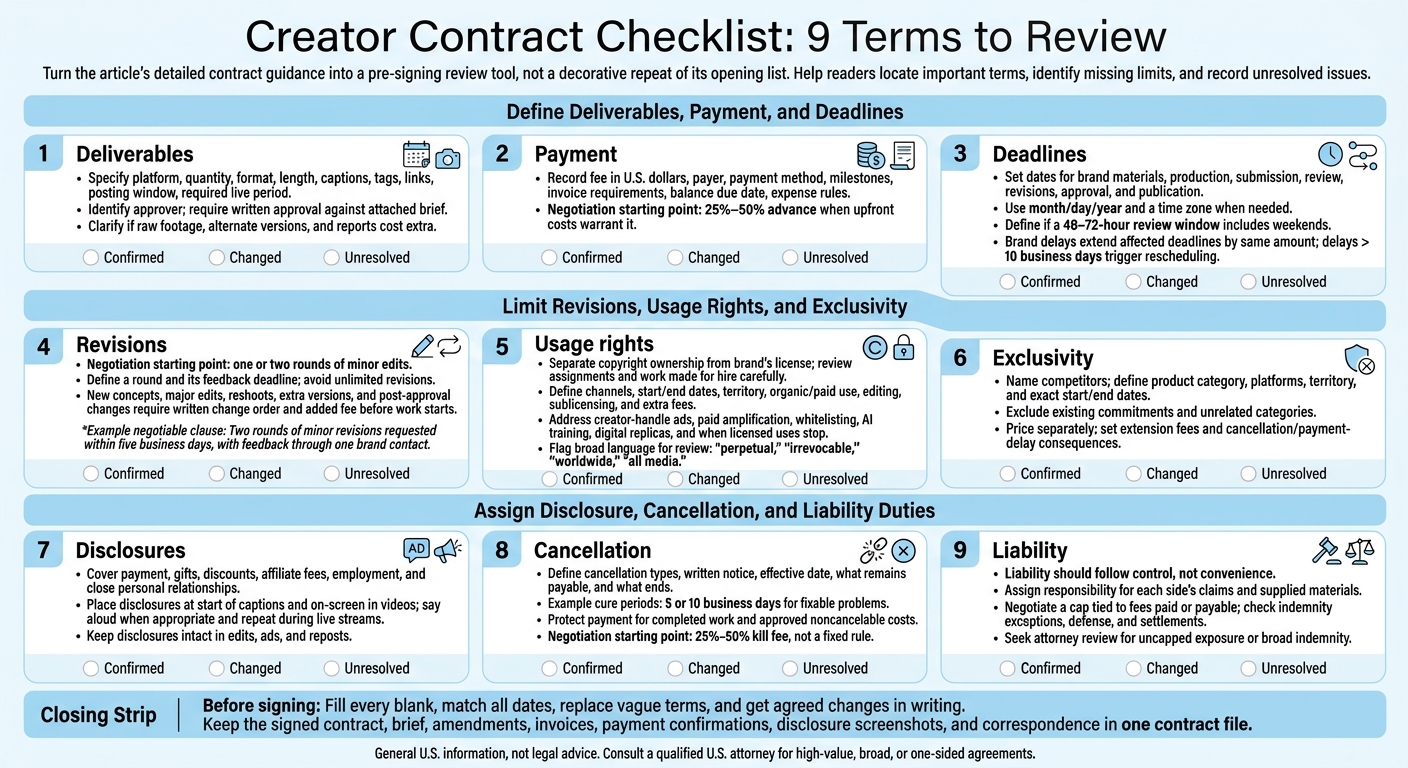
Define Deliverables, Payment, and Deadlines
1. Deliverables: List Every Asset and Approval Requirement
Attach a schedule that lists every asset’s platform, quantity, format, length, captions, tags, links, posting window, and required live period. Spell out whether raw footage, alternate versions, and performance reports are included or cost extra. Assign responsibility for products, brief changes, talking points, music, and tracking links.
Base approval on the attached brief - not personal preference. Name the person authorized to approve the work, require written approval, and define valid reasons for rejection, such as:
incorrect product details or missing technical specs
Changes to the brief should come with a new fee and an updated schedule.
2. Payment: Set Fees, Due Dates, and Expenses
Record the total fee in U.S. dollars, who will pay, the payment method, milestones, and invoice requirements. Get purchase-order details and required tax forms before invoicing. Consider negotiating a 25%–50% advance to cover upfront production costs.
Set a firm deadline for the balance, tied to delivery or a defined approval process. Payment shouldn't depend on the brand collecting money from another party.
Spell out who handles taxes, which expenses are included, and the rules for reimbursement: approval, spending caps, receipts, and payment deadlines. Require written approval for reimbursements.
Negotiate any legally permitted late fees and the right to pause future work if payment is overdue. If the brand cancels for reasons unrelated to your performance, protect your right to payment for completed work and approved noncancelable expenses.
3. Deadlines: Set Delivery and Brand Review Dates
Set separate dates for brand-supplied materials, production, submission, review, revisions, approval, and publication. Use month/day/year dates, and include a time zone when timing matters.
Define whether the 48–72-hour review window includes weekends, and allow a separate period for revisions. State what happens if the brand misses its review deadline: approval by default or escalation to the named approver.
Brand delays should extend affected deadlines by the same amount of time. Delays exceeding 10 business days should trigger rescheduling. Also specify how long posts must stay live, whether archiving counts as removal, and any fee for extending that period.
5 Things to Have in Your Influencer Agreement
Watch the related video on YouTube
Limit Revisions, Usage Rights, and Exclusivity
Once delivery terms are set, put scope, rights, and limits on competing work in writing. Spell out how scope changes affect the schedule.
4. Revisions: Cap Rounds and Charge for Added Work
Limit revisions to one or two rounds of minor edits, and define what each round includes. A round means one set of changes to the agreed concept, script, caption, or deliverable - not an approval process with no end date.
The contract can allow two rounds of minor revisions requested within five business days, with feedback sent through one brand contact.
Avoid vague terms such as:
“unlimited revisions”
“reasonable revisions”
Don't agree to keep revising until the brand is satisfied, either.[3][4]
New concepts, rewritten scripts, major edits, reshoots, extra versions, and changes after approval should require a written change order and an added fee before work starts. Apply the same rule when changed instructions, delayed approval, or incorrect product information from the brand creates extra work.[3][4]
5. Usage Rights: Separate Ownership from Brand Use
Creating content does not transfer ownership. State that you retain copyright and grant only the agreed license. Review any work made for hire or copyright-assignment language carefully, and price ownership transfers separately. Also clarify whether the deal includes raw footage, drafts, and unused concepts.[2][5]
The license should spell out channels, start and end dates, territory, organic use, paid use, editing rights, and what triggers extra fees. Require separate permission and fees for creator-handle ads, paid amplification, and whitelisting.
Don't assume the production fee covers broad rights described as:
“perpetual”
“irrevocable”
“worldwide”
“all media”
Negotiate limits on those rights. Address sublicensing, edits, and use of your name, image, voice, or likeness separately. Spell out terms for AI training and digital replicas, along with when licensed uses must stop.[1][2][5]
The contract also needs clear limits on how the brand can restrict your other work.
6. Exclusivity: Define Competitors and Time Limits
Replace vague wording such as:
“no competing products”
Name the competitors and define a narrow product category, platforms, territory, and exact start and end dates. Clarify whether exclusivity applies during production, the campaign, or a post-campaign period - and whether it covers affiliate links, appearances, or unpaid mentions. Exclude existing commitments and unrelated categories.
Price exclusivity separately based on the work you may have to turn down, and set an extension fee. State whether the restriction ends if the campaign is canceled or payment is delayed. Avoid an open-ended campaign period that delays could stretch indefinitely.[1][2][4]
Assign Disclosure, Cancellation, and Liability Duties
Once scope and rights are set, spell out disclosure, cancellation, and liability duties.
7. Disclosures: Clearly State Brand Relationships
Disclose all material connections, including payment, gifts, discounts, affiliate fees, employment, and close personal relationships. Put disclosures at the start of captions - not behind expandable text - and on-screen in videos. Say them aloud in videos when appropriate, and repeat them during live streams so late joiners hear them.[6][8][10]
Keep disclosures intact in edits, ads, and reposts.[7]
8. Cancellation: Set Notice, Fees, and Rights
Define whether cancellation stems from creator default, brand default, mutual agreement, or convenience. For each type, state what remains payable and what ends. Require written notice, set an effective date, and allow time to fix problems that can be resolved - such as 5 or 10 business days. Keep exceptions allowing immediate termination narrow.
Protect payment for completed work and approved noncancelable costs. A 25%–50% kill fee can be a starting point for negotiation, but it isn't a fixed rule.[9][11]
State who removes published content, keeps drafts, and returns products. Set a prompt removal deadline after written notice that covers creator posts, brand channels, paid ads, and third-party placements. Specify whether usage rights end, continue during a wind-down period, or survive payment. Don't assume cancellation automatically ends the license.[1]
9. Liability: Limit Risk and Assign Responsibilities
Liability should follow control, not convenience. The brand should stand behind its products, brand-supplied claims, trademarks, music, images, and required permissions. You should stand behind your original statements, genuine experience, and materials you supply.
Require support for brand-provided claims, and exclude promises outside your knowledge. Watch for one-sided indemnity, sales guarantees, and terms that make you responsible for losses caused by the brand.[1][5]
Set a liability cap tied to fees paid or payable, with narrow exceptions. Check whether indemnity obligations fall outside that cap. Spell out claim notice, who controls the defense, and who approves settlements.
Review warranties, insurance, governing law, venue, dispute procedures, and attorney-fee terms together. Have an attorney review uncapped exposure or broad indemnity before you sign.[1][5]
Conclusion: Finish Your Pre-Signing Check
Before signing, review each term one last time. Mark it as confirmed, changed, or unresolved.
Make sure every blank is filled in, all dates match, and vague terms have been replaced with clear wording.
Keep everything in one contract file: the signed contract, brief, amendments, invoices, payment confirmations, disclosure screenshots, and correspondence.
If the agreement is high-value, broad in scope, or one-sided, consult a qualified U.S. attorney before signing.
FAQ
Can I Withhold Usage Rights Until I’m Paid?
Your agreement sets the terms. Your contract can specify that usage rights begin only after you receive payment. If the contract permits it, you can also pause or withhold file delivery, additional revisions, or expanded usage permissions until payment arrives.
To protect your work, consider requiring a deposit before production starts and final payment before usage rights begin or you deliver the content.
What If a Brand Uses My Content After Its License Expires?
Document the use made without your permission with screenshots, dates, and a copy of your agreement. Then send the brand a professional written notice that identifies the content, the relevant contract term, how the use falls outside your permission, and the remedy you’re requesting.
Ideally, your contract should name who receives notices and set a takedown or wind-down timeline for active placements, such as paid ads or website content. If the issue remains unresolved, you may need to take further professional or legal steps.
How Can I Price Exclusivity Fairly?
Define the product category, exclusivity period, and brands you can’t work with. Then check those limits against your creator calendar and existing commitments to estimate the income you could lose.
Price exclusivity separately from your base creation fee. Broader restrictions or longer periods should cost more.
If the terms limit future work, ask for a narrower category, a shorter period, exceptions for existing relationships, or a higher fee. Spell out the agreed terms in your contract.