Brand Outreach Emails: 5 Templates for Creators
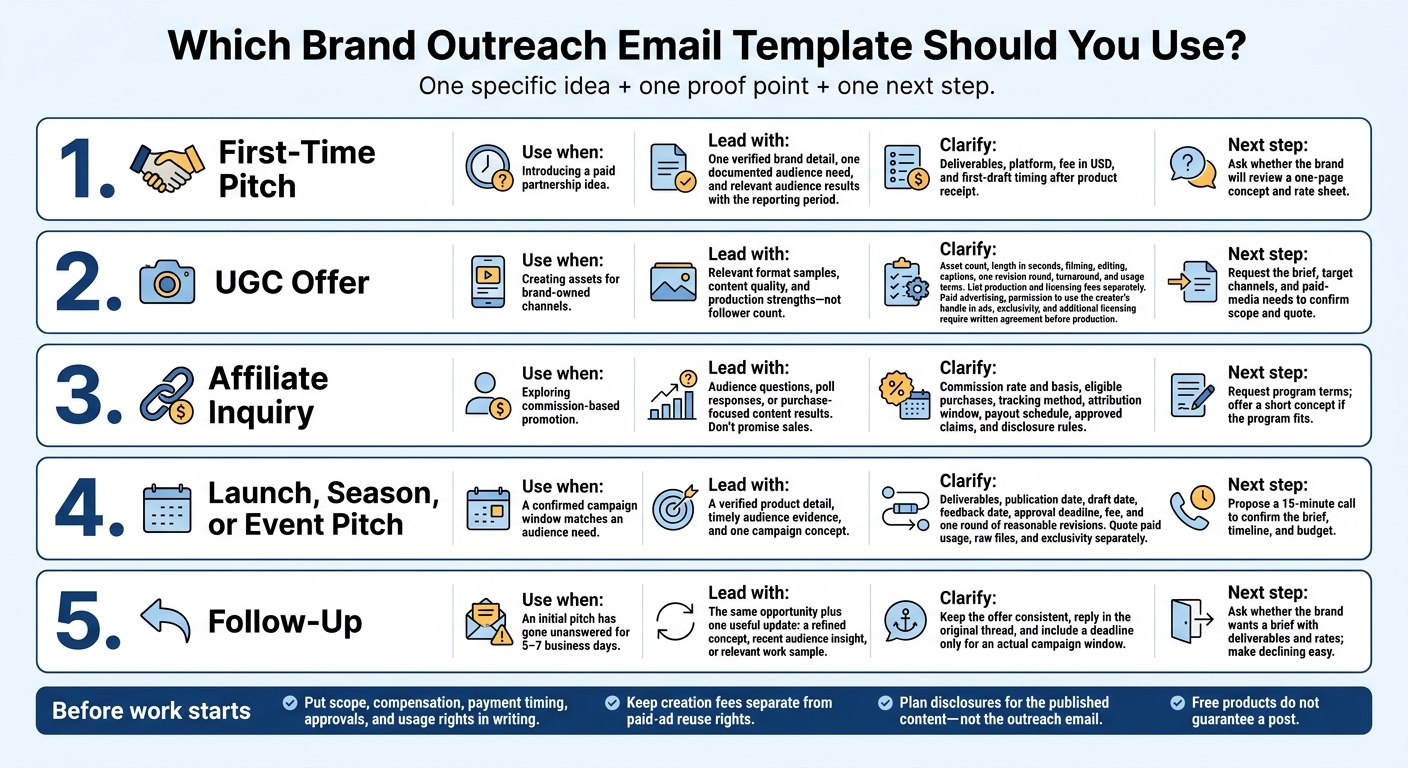
A strong brand outreach email pitches one specific idea, supports it with one proof point, and asks for one next step. Before sending, verify the brand details, choose a deliverable, and set your fee and timeline.
These five templates cover:
- First-time pitch: Introduce a paid partnership idea with audience results.
- UGC offer: Propose assets for the brand’s channels, with production and usage priced separately.
- Affiliate inquiry: Check commission rates, tracking, and payment terms without promising sales.
- Launch, season, or event pitch: Tie an idea to a confirmed campaign window.
- Follow-up: Revisit an unanswered pitch after 5–7 business days with a useful update.
Check portfolio links and put scope, payment, and usage rights in writing before work starts. Also: plan disclosures for the published content, and treat free products as no guarantee of a post.
How to Write a Brand Collaboration Email + Template
Before You Pitch: Gather Proof and Plan Your Offer
Find the right contact. Check the brand’s official website, LinkedIn page, or creator portal for someone who handles influencer marketing, partnerships, social media, PR, or affiliate marketing. Confirm their email through an official company source. Can’t find a name? Address the brand or marketing team rather than emailing several unrelated people.
Review the brand’s site, recent posts, product pages, press releases, creator collaborations, campaign hashtags, pricing, and launch dates. Check product names, features, stock status, and campaign dates before mentioning them. Then connect one verified brand detail to a documented need your audience shares with the brand’s target audience.
Prepare a short media kit and two or three direct links to relevant work to back up the template you choose below. If you haven’t had paid partnerships, use personal projects clearly labeled as samples. Test every link in a private browser window.
Use recent analytics, state the reporting period, and separate average results from a single standout post. Match your proof to the goal: reach for awareness, saves for utility, and clicks or conversions for sales.[2][4][5]
Before writing, define the deliverable, asset count, production steps, and approval process. Treat product arrival, filming, draft delivery, revisions, and publication as separate milestones. When proposing a date, specify which milestone it covers and allow time for feedback. Keep your content approach in line with what your audience already expects.
Set your rate before you write, even if you don’t include it in the first email. Base your quote on production time, revisions, posting, and usage rights.
$500–$1,000 is only an example range, not a rate standard.
Price paid advertising usage, extended licensing, and category exclusivity separately. Don’t quietly bundle them into your creation fee.[2][4][7]
1. First-Time Brand Collaboration Pitch
Use this template when you have one verified brand detail, one proof point, and one clear offer.
Email for a First-Time Approach
Subject: [Exact content hook or product use case] for [Brand Name]
Hi [Brand Contact Name],
I noticed [specific product or campaign detail], which connects with my audience’s interest in [documented need]. I’m [Creator Name], a [Niche] creator reaching [Audience Detail]. Over my last [number] [platform] posts from [date range], I averaged [verified views/reach] and [verified saves/clicks].I’d like to create [Content Idea] that shows [product’s role] for [audience benefit] in my usual style. I’m proposing [deliverables and platform] as a paid partnership for [fee in USD], with a first draft delivered [timeframe after product receipt]. Relevant work: [Portfolio Link]. Would you be open to reviewing a one-page concept and rate sheet?
Best,
[Creator Name]
[Social Profile Link]
Make the Brand Detail Specific
Choose one product, feature, or campaign detail you can verify. Then connect it to one audience need. Don’t imply you’ve used the product unless you have.[11]
Set Deliverables and Terms
Replace every bracketed field before sending. Keep [Content Idea] focused on one concept, with a clear format, setting, and product role.
For a gifted collaboration, offer an honest assessment of whether the product fits, with no guaranteed post. Don’t promise deliverables while describing the product trial as optional.
Ask for One Next Step
Keep the ask small: would they review a one-page concept and rate sheet? That makes the first reply easy. They’re deciding whether to learn more - not approving the entire partnership.
2. Product-Focused UGC Pitch
When This Pitch Fits
Use this pitch for content that runs on brand-owned channels. Focus on content quality, reliable production, and natural product demonstrations - not follower count. Your portfolio should include samples of the format you’re pitching.
Personalize the Opening
Subject: UGC concept for [Product Name]
Hi [Brand Contact Name],
I noticed [specific product detail or content gap] and would love to create [UGC Format] showing [how customers will use it]. [Relevant product or category experience]. I bring [two production strengths]. Relevant samples: [Portfolio Link].
Define Deliverables and Terms
I’m proposing [Number of Assets] [UGC Format] assets, each [Length] seconds, including filming, editing, captions, and one revision round, for [Rate or Budget Range] in USD. This fee covers production and [Usage Terms] only. Turnaround is [Turnaround Time] after receiving the product and approved brief. Paid advertising, permission to use my handle in ads, exclusivity, and any additional licensing require mutual written agreement before production.
Spell out the organic channels, license term, territory, allowed edits, and whether raw footage is included. List production and licensing fees separately, along with any charges for extra revisions or rush delivery. Free product doesn’t cover production or commercial usage rights.
Ask for the Brief
Would you share your brief, including target channels and paid-media needs, so I can confirm scope and quote?
Best,
[Creator Name]
[Contact Information]
3. Affiliate Partnership Inquiry
When This Pitch Fits
Use this template when a brand favors commission-based promotion over a flat sponsorship fee. It works when your audience’s needs match the brand’s category and you can track referrals. Back up the fit with recurring audience questions, poll responses, or results from purchase-focused content. Don’t promise sales.
Personalize the Offer
Subject: Affiliate partnership idea for [Brand Name]
Hi [Contact Name],
My audience on [Platform] regularly asks about [Specific Audience Need], based on [poll results, comments, or sales-focused content]. I’d like to explore an affiliate partnership featuring [Brand Name]’s [Product Category] because [specific reason the product fits the audience]. I’d like to use [Promotion Format]. Relevant samples and results: [Portfolio or Analytics Link, with format, metric, and time period].
Ask About Partnership Terms
Could you share your commission rate, eligible purchases, tracking method, and attribution window? I’ll clearly disclose the affiliate relationship alongside each recommendation and link.[8][9]
If this fits your program, I can send a short concept next.
Best,
[Creator Name]
[Contact Information]
Before sending, confirm the commission basis, attribution window, tracking method, payout schedule, approved claims, and disclosure rules.
4. Pitch for a Launch, Season, or Event
The Outreach Situation
Use this pitch when a confirmed launch, seasonal buying period, or event lines up with what your audience needs now. Back up the timing with recent comments, platform insights, or past post results. Don’t call something a trend without evidence. Contact the brand before its production and approval deadlines.
Personalize the Moment
Subject: A [Campaign Moment] content idea for [Brand Name]
Hi [Contact Name],
With [Campaign Moment] approaching, my [Audience Description] audience is actively looking for [Relevant Need]. I’d love to propose a campaign that supports [Campaign Goal]. Your [Product Name] fits because [Specific, Verified Product Detail]. The concept: [Hook, Setting, and Product Demonstration] on [Platform], developed in my own voice.
Define Deliverables and Terms
The scope would be [Deliverables], publishing during [Proposed Date]. I can deliver a draft by [Draft Date], with feedback by [Feedback Date] and final approval by [Approval Deadline]. My proposed fee is [Budget] for production and posting on my channels, including one round of reasonable revisions. Paid usage, raw files, and exclusivity would be quoted separately, with all terms confirmed in writing.
For a mid-December 2026 campaign, you could plan for product arrival by November 20, filming by November 30, draft delivery by December 7, approval by December 11, and publication on December 15, 2026. Replace every timeline placeholder before sending.
Make the Next Step Easy
Relevant work: [Portfolio Link to Two or Three Related Samples]. Would you be open to a 15-minute call to confirm the campaign brief, timeline, and budget? Please let me know by [Response Date] so we can reserve production time.
Best,
[Creator Name]
[Contact Information]
5. Follow-Up Email After No Response
The Outreach Situation
Use this follow-up when your first pitch goes unanswered and you have one new angle to share about the same opportunity. Wait 5–7 business days after your original pitch before reaching out again.[2]
Brand Personalization
Restate the value in one sentence, then give the recipient one new reason to reply. That could be a refined concept, a recent audience insight, or a relevant work sample. Keep the offer the same, and only include a deadline if it reflects an actual campaign window.[6]
Subject: Re: [Original Subject Line]
Hi [Contact Name],
I’m following up on my [Original Send Date] email about a potential partnership with [Brand Name]. I still believe [Updated Idea refining the original concept] could help [Brand Name] reach [relevant audience or objective].Since my original note, I’ve [useful update, such as refined the concept or added a timely angle]. You can view related work here: [Portfolio Link].
Would you like to discuss this before [Relevant Deadline]? If yes, I’ll send a brief with deliverables and rates; if not, you can reply “not a fit right now” and I’ll end the thread.
Thanks for your time,
[Creator Name]
Reply in the original email thread so the recipient can review the pitch without searching for it.[1]
The Next Step
If you still don’t hear back, send one final message 5–7 business days later. Then stop unless the recipient invites you to reconnect.[2][6]
Before You Send: Check Facts, Terms, and Disclosures
Give your draft one last fact and legal check before you send it.
Replace every placeholder. Check the recipient’s details in your chosen template, test portfolio links on desktop and mobile, and clearly label spec work.
Use current analytics and name the measurement period. Specify whether your engagement rate uses reach or followers, and keep screenshots on hand. Cut any promises of guaranteed sales or virality.
Make the offer clear without stretching the email. State the deliverables, deadlines, revisions, approval steps, compensation type, and any usage or exclusivity terms. Confirm payment timing and cancellation terms. Get these details in writing before work starts, and end the email with one easy-to-answer request.
Disclose payments, commissions, and free or discounted products in the published content itself. Plan where disclosures will appear in content produced from the outreach - not in the pitch email. Keep disclosures with the endorsement, rather than only in a profile. For affiliate videos, include disclosures in the video and near affiliate links in the description.[8][9][10]
If you haven’t tried the product, pitch a trial or concept - not a personal recommendation. Ask for evidence to support brand-provided claims before repeating them. Giving the brand credit for an unsupported claim doesn’t make it safe to repeat.[9][10] Save the agreed scope, approvals, and disclosure plan with your project records.
Conclusion: Send a Specific Partnership Offer
Choose the template that fits your offer, then keep your pitch specific, brief, and easy to answer. Include one clear offer, one proof point, and one content idea. End with a simple next step.
Track the contact, date sent, angle, reply, and terms in a spreadsheet or CRM. If you don’t hear back, send one follow-up in the same thread, then stop.[2][3]
When a brand shows interest, put compensation, deliverables, and usage rights in writing. Keep the creation fee separate from paid-ad reuse rights so the pitch stays simple and the agreement spells out what each payment covers.[4][7]
FAQ
Can I Pitch Brands with a Small Audience?
Yes. Success depends on relevance, content quality, audience trust, and fit with the brand’s needs - not just follower counts.
Point to meaningful comments, saves, repeat questions from your community, or content that performs well in the brand’s category. Show how your content fits the brand and what sets your perspective apart. A smaller, highly engaged audience can give brands a close match with their target customers and a trusted voice within a specific niche.
How Do I Price UGC Usage Rights?
Wait until the brand confirms interest and defines the scope before sharing pricing. Leave rates out of your first outreach. Before you quote, get written details on the number and types of deliverables, usage duration, exclusivity, and any paid amplification or whitelisting.
Price content creation and additional usage rights separately. Put all terms in a written agreement so your pay reflects how and where the brand plans to use and distribute your content.
What If a Brand Offers Products Instead of Payment?
Set expectations before you commit. Is the brand sending a product for review consideration, offering it in exchange for content, or paying you to create specific deliverables? Receiving a product doesn’t automatically mean you owe the brand content or give it permission to use your work.
Before work begins, put every agreement in writing, including product shipping, disclosure requirements, and any promised deliverables.