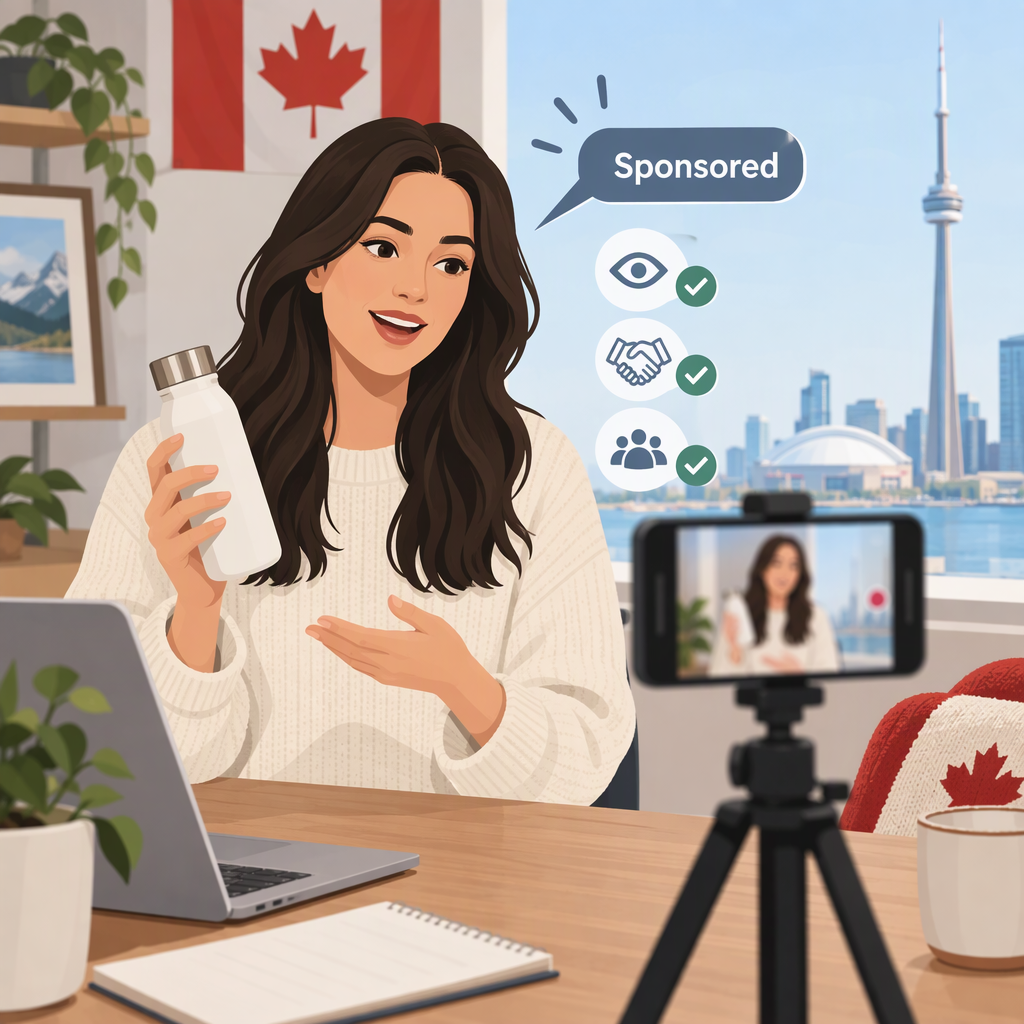
How Canadian Influencers Should Disclose Sponsored Content
Short answer: If a brand relationship could affect how people judge your independence, disclose it plainly and prominently in the content itself. Canada’s Competition Bureau identifies payments, commissions, free products or services, discounts, free trips or event tickets, and personal or family relationships as examples of connections that may be material. Put the disclosure where people will notice it, make it understandable, and adapt it to how they experience the content. A brand tag, discount code, or affiliate link alone is unlikely to make the connection clear. (competition-bureau.canada.ca)
Which Brand Relationships Should You Disclose?
The Competition Bureau says a connection may be “material” if it could affect how consumers evaluate your independence from a brand. Its examples include:
- Money or commissions
- Free products or services
- Discounts
- Free trips or event tickets
- Personal or family relationships with the business or brand
That list is illustrative, not a rule that every situation is identical. Consider the relationship and the post together: could someone seeing your recommendation reasonably want to know about the connection? If yes, disclose it. The Bureau’s guidance applies to people promoting a product, service, or business interest. (competition-bureau.canada.ca)
Gifts and free products: The Bureau specifically lists free products and services as possible material connections. If you choose to post about something a brand sent you, say that you received it. If the arrangement is unusual—for example, the item was unsolicited and there was no request or expectation to post—the guidance does not settle every detail of that situation. The practical, transparent choice is to mention the gift if you discuss or recommend it.
Affiliate links and codes: A commission is an example of a possible material connection. Tell people you may earn a commission when they buy through your link. A link, brand tag, or discount code by itself may not tell viewers that you benefit from the purchase. (competition-bureau.canada.ca)
What Makes a Disclosure Clear?
Make the relationship easy to see or hear, easy to understand, and close to the endorsement. The Competition Bureau recommends prominent, plain-language disclosures. It cautions that disclosures can be missed when buried in a long caption, mixed into a group of hashtags, or placed only in a profile bio. It also says disclosures should be visible without expanding a post and should appear on each platform where you share the content. (competition-bureau.canada.ca)
Use words that explain the actual relationship rather than relying on shorthand your audience may not understand. For example:
- Paid post: “Paid partnership with [Brand].”
- Free product: “ [Brand] sent me this product for free.”
- Affiliate link: “I may earn a commission if you buy through this link.”
- Discounted service: “I received a discount from [Brand].”
These are plain-language examples, not official required wording. Choose wording that accurately describes what happened. The Bureau advises avoiding ambiguous terms and abbreviations. (competition-bureau.canada.ca)
Applying the Guidance to Different Formats
The Bureau’s core advice is to make the disclosure prominent, clear, and appropriate to the way the audience experiences the content. It notes that some content may need both audio and visual disclosure. The checklist below translates that general guidance into practical steps; it is not a separate official rule for each platform or format. (competition-bureau.canada.ca)
| Format | Practical way to disclose |
|---|---|
| Photo or text post | Put a clear statement near the beginning of the caption or visibly on the image. Don’t bury it among hashtags or below a “more” expansion. |
| Story or other short-lived post | Put the disclosure on the content where the endorsement appears, so viewers do not have to find it elsewhere. If you share the content on another platform, include the disclosure there too. |
| Video | Use a visible on-screen disclosure; add a spoken disclosure when that helps make the connection clear to viewers. Some content may need both. |
| Livestream | Make the relationship clear in a way viewers can notice during the endorsement. The sources cited here do not prescribe a specific repetition schedule. |
| Affiliate recommendation | State near the recommendation or link that you may earn a commission. Don’t assume the link or a discount code communicates that fact. |
A platform’s branded-content label may help, but don’t assume a platform tool, tag, link, or code alone tells the audience enough. The Bureau’s guidance emphasizes whether the connection will actually be clear to the audience. (competition-bureau.canada.ca)
What Is Law, and What Is Industry Guidance?
The Competition Act addresses materially false or misleading representations made to promote a product or business interest. The Act’s section 74.01 sets out civil reviewable conduct involving false or misleading representations, among other matters. The Competition Bureau explains how its deceptive-marketing guidance applies to influencers and advises disclosing material connections. This is not the same as saying the Act contains a standalone sentence prescribing one disclosure phrase or placement for every post. (laws-lois.justice.gc.ca)
Ad Standards Canada is an advertising-industry self-regulatory organization. Its Canadian Code and Interpretation Guideline #5 address influencer endorsements and material connections; Ad Standards says disclosures should be clear, prominent, and close to the representation. Its Influencer Marketing Disclosure Guidelines, updated in Fall 2025, describe industry best practices—not legal advice or a guarantee of compliance with the Act or the Code. The full context matters, and sector-specific rules may also apply. (adstandards.ca)
A Quick Pre-Publish Check
Before publishing, ask:
- What is my connection to the brand? Include payment, commission, gifts, discounts, trips, tickets, and relevant personal or family relationships.
- Would knowing about it help viewers assess my independence? If it could, disclose it.
- Can viewers notice and understand the disclosure without extra effort? Use plain language and place it prominently with the content.
- Does it work in this format? Consider whether viewers need an on-screen disclosure, a spoken one, or both.
- Is the disclosure on every platform where I shared the content? Don’t rely on a profile bio or assume a link or tag is enough.
This is general educational information, not individualized legal advice. For an unusual arrangement, a regulated product or sector, or a high-stakes campaign, consult the relevant current regulator guidance or a qualified Canadian lawyer.