YouTube SEO Checker: Review Metadata Without Chasing Scores
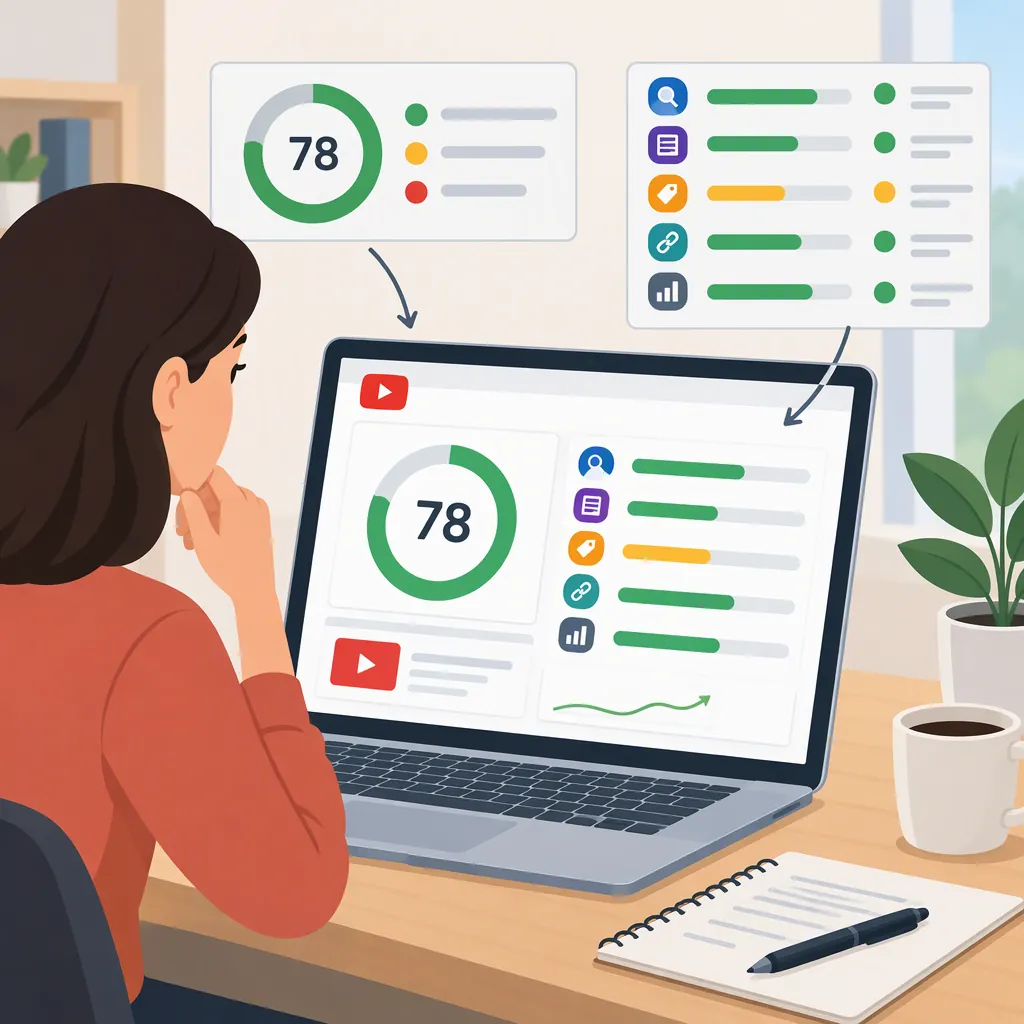
A YouTube SEO checker reviews video metadata, such as a title, description, and target query, against a set of rules. Treat its score as a checklist result—not a prediction of rankings or views. A metadata-only review cannot assess audience retention, impressions, or satisfaction. Check what the tool actually measures before acting on its recommendations. [c1]
What a YouTube SEO Score Means
The useful question is not simply “Is my score high?” It is “Which checks produced this score?”
The provided metadata-checker reference describes checks for title and description readiness, target-query match, length, readability, and optional tag hygiene. It explicitly separates these checks from predictions about competition, reach, views, or ranking probability. [c1]
Read the result as a review of the information supplied to the checker. If the input consists only of text, do not treat the output as evidence about how viewers respond to the video.
Before interpreting a score, identify:
- Inputs: Draft metadata, a published video URL, or connected account data?
- Rules: Which checks are explained, and which are opaque?
- Evidence: Does each recommendation point to a specific issue?
- Limits: What information is unavailable to the checker?
This article uses third-party tool pages as references, not official YouTube documentation or independent performance tests. Their descriptions support discussion of review methods, but do not establish that following a checklist improves rankings.
Review the Title and Description First
Use the checker to locate possible problems, then judge each suggestion against the actual video. The reference guidance recommends a clear, accurate promise, important context early in the title, and useful detail in the description rather than a universal title length that guarantees performance. [c1]
A practical review can follow this order:
- Define the viewer’s question. Write one natural search phrase that accurately represents the video.
- Check the title’s promise. Can a reader tell what the video covers and what makes it relevant?
- Check the description’s opening. Explain the subject and scope without repeating the title mechanically.
- Review query alignment. If the target phrase fits naturally, use it. If it misrepresents the content, revise the target phrase instead.
- Remove padding. Do not add repetitive wording solely to satisfy a length or keyword check.
- Inspect optional tags. Keep the review focused on relevance rather than filling every available field.
Illustrative example: For a tutorial showing how to replace a bicycle inner tube, “Bicycle Inner Tube Replacement: Tools and Steps” communicates more scope than “You Need to See This.” This is an editorial example, not a tested ranking result.
Manual Metadata Review Worksheet
Video subject:
Viewer question or target query:
What the video actually demonstrates:
Draft title:
Opening description:

Mark each item Pass, Revise, or Not Applicable:
- The title accurately describes the video.
- The main topic is clear without additional context.
- The description explains the scope and useful details.
- Any target-query wording reads naturally.
- Repeated phrases add information rather than padding.
- Optional tags describe the content accurately.

Highest-priority revision:
Reason for the revision:
Revised title and description:

This is an editorial checklist, not a ranking formula.
Separate Metadata Checks from Research and Tracking
A metadata review, keyword research, and rank tracking answer different questions. The supplied SEO-tools reference distinguishes keyword research before publication from tracking positions for target terms after publication. [c2]
| Task | Question to Answer | What Not to Infer |
|---|---|---|
| Metadata review | Does the text clearly describe the video and intended query? | A readiness score is not a view forecast. |
| Keyword research | Which search terms are worth investigating? | A candidate phrase is not proof that this video will rank. |
| Rank tracking | Where does the video appear for a tracked query? | A position alone does not explain why it changed. |
For a draft video, start with clarity and accuracy. For a published video, keep the metadata review separate from observations about search positions and audience behavior.
The metadata-checker reference explicitly says its review does not see impressions, retention, audience satisfaction, or keyword competition. Those limits matter when deciding whether a suggested rewrite addresses the problem you are investigating. [c1]
Turn Recommendations into Documented Revisions
Treat each recommendation as a proposal, not an obligation. A useful revision should have a reason that remains understandable without the score.
For example, “Clarify that this tutorial covers a road bike” is a concrete editorial reason. “Add more words to gain points” does not explain how the change helps a viewer.
Use a simple decision rule:
- Accept suggestions that improve accuracy, clarity, or relevant detail.
- Adapt suggestions that identify a real issue but propose awkward wording.
- Reject suggestions that require unsupported promises, irrelevant phrases, or repetition.
Keep a before-and-after record. If you later observe a performance change, record it separately rather than treating it as proof that the metadata revision caused the result. The distinction between metadata readiness and ranking predictions remains essential. [c1]
Metadata Revision Log
Video identifier or working title:
Review date:
Checker inputs and stated limitations:
Original metadata:
Recommendation received:
Decision: Accept / Adapt / Reject
Editorial reason:
Revised metadata:

For a published video:
Change date:
Other changes made at the same time:
Later observations and observation dates:
What remains uncertain:

Record observations separately from explanations of their cause.
FAQ
What Is a Good YouTube SEO Score?
Start with the checker’s stated rubric rather than assuming a universal target. Ask which checks passed, which need revision, and whether the suggested changes make the metadata clearer. The provided metadata-checker reference explicitly warns against treating readiness as ranking probability. [c1]
Can I Check YouTube SEO Before Publishing?
Yes, a metadata review can use a draft title, description, and optional target query before upload. That review can assess the submitted text, but it cannot establish future audience response or rankings. The supplied reference describes this pre-upload approach and its limitations. [c1]
Is an SEO Score the Same as a Search Ranking?
No. A metadata score summarizes checks against a rubric. Rank tracking observes a video’s position for target search terms after publication. The provided references describe these as separate tasks; a metadata-readiness result is not a ranking prediction. [c1] [c2]
Is There an Ideal Title Length for YouTube SEO?
The provided reference does not identify a universal title length that guarantees better performance. Its guidance is to keep the promise accurate, place important context early, and use the description for useful detail. Treat length recommendations as editing prompts, not guarantees. [c1]