YouTube Subtitle SEO: A Practical Guide to Better Captions
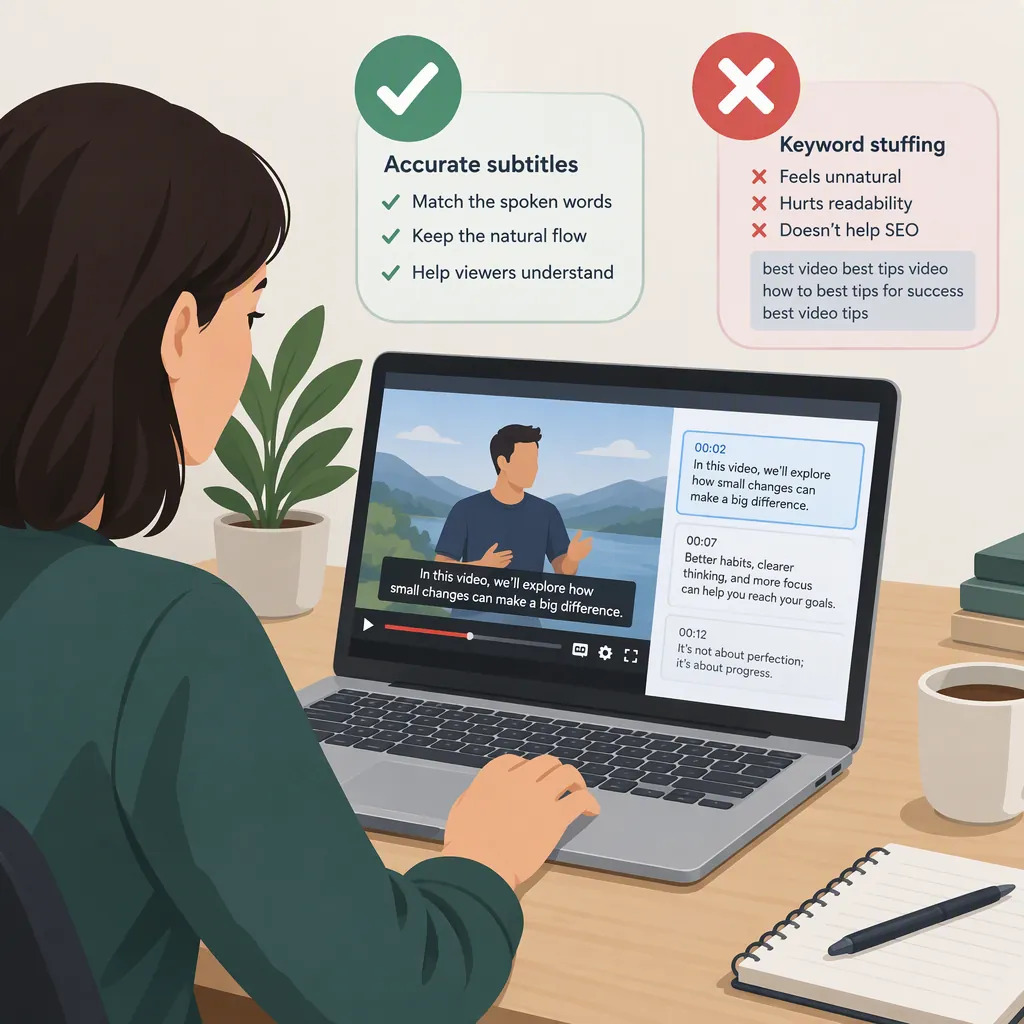
For YouTube subtitle SEO, prioritize accurate captions that faithfully represent the audio, including relevant topic terms when they are actually spoken. Captions support accessibility and comprehension; the provided sources also describe potential search benefits. However, these third-party articles do not establish YouTube’s current ranking treatment of captions or guarantee higher rankings. Treat subtitle work as content-quality maintenance, not a ranking shortcut. [source_1] [source_2]
What YouTube Subtitle SEO Means
YouTube subtitle SEO is the practice of improving caption text so that it accurately communicates a video’s subject and is useful to viewers. The supplied articles discuss captions as both an accessibility feature and a possible source of textual context for search systems. [source_1] [source_2]
Closed captions can represent spoken dialogue and relevant audio information, including sound effects. Their purpose is broader than carrying keywords: they help viewers understand content when hearing or listening is difficult. Amberscript describes benefits for deaf and hard-of-hearing viewers, non-native speakers, and people watching without sound. [source_2]
A practical priority order is therefore: preserve meaning, correct errors, check readability, and only then review whether important terminology is represented accurately.
Separate Potential SEO Benefits from Proven Results
Sunny Startup Marketing states that YouTube indexes caption text to understand video content. Amberscript similarly argues that captions give search systems textual context and may improve viewing experiences. These are third-party explanations, not current YouTube documentation. [source_1] [source_2]
The supplied material does not establish which caption tracks YouTube currently indexes, how much weight captions receive, or whether adding captions alone causes a ranking improvement. It also does not substantiate a reliable ranking gain from translated subtitles.
Keep the distinction clear:
- Viewer value: Captions provide a text-based way to follow audio. [source_2]
- Potential search value: The sources describe captions as additional context for search systems. [source_1] [source_2]
- Unverified outcome: A specific ranking increase, traffic gain, or featured-snippet appearance cannot be promised from this evidence.
Accessibility remains a reason to improve captions even when search performance does not change.
Review Captions Against the Audio
Start with a listening pass rather than a keyword pass. Sunny Startup Marketing notes that background noise, unclear speech, and accents can affect automatic transcription and recommends correcting automatically generated captions. Amberscript also recommends proofreading for accuracy and readability. [source_1] [source_2]
Use this review sequence:
- Compare the caption text with the spoken audio.
- Correct missing words, misheard phrases, names, and technical terms.
- Check that punctuation preserves the speaker’s meaning.
- Review timing and line breaks during playback so the text is easy to follow.
- Include relevant non-speech audio information where it is needed to understand the scene.
- Review the published track rather than assuming the edited version displays correctly.
The Sunny Startup Marketing article contains instructions for Classic Creator Studio and YouTube Studio beta. Those historical menu paths should not be treated as verified instructions for today’s interface. [source_1]
Caption Review Checklist
- [ ] Caption text has been compared with the audio.
- [ ] Names, acronyms, and technical terms have been checked.
- [ ] No unrelated keywords have been added.
- [ ] Punctuation preserves meaning.
- [ ] Timing and line breaks have been reviewed during playback.
- [ ] Relevant non-speech audio information is represented.
- [ ] The published caption track has been checked.
Use Natural Terminology and Review Translations
Plan clear topic language in the video itself. If a tutorial explains a particular technique, name that technique naturally in the narration. The captions should then reflect the words that were spoken, not introduce an extra layer of promotional or search-targeted text.
Both sources recommend natural keyword use. Sunny Startup Marketing also suggests a keyword-density target, but the supplied evidence does not validate that percentage as a YouTube ranking rule. There is no need to force a quota into a script or caption track. [source_1] [source_2]
For translated subtitles, prioritize faithful meaning and consistent terminology. Sunny Startup Marketing recommends professional translation or professional review of machine translation; Amberscript describes translated captions as a way to make content understandable across language barriers. [source_1] [source_2]
Treat translation as an audience-access decision. Do not assume that adding a language track will make a video rank well in a particular country.
Evaluate Changes Without Overclaiming
Use a simple change log to keep caption improvements separate from other edits. Record the publication date of the corrected track, the errors fixed, any added languages, and whether the title, description, thumbnail, or video content changed at the same time.
If you review performance afterward, distinguish an observation from a causal conclusion. A video receiving more views after a caption update does not, by itself, demonstrate that captions caused the increase. The supplied articles discuss possible SEO benefits but do not provide a controlled basis for predicting an uplift from your edits. [source_1] [source_2]
Evaluate the work first on outcomes you can inspect directly: faithful wording, readable presentation, useful audio information, and translation quality.
Caption Change Log Template
Video identifier:
Caption language:
Review date:
Published update date:
Errors corrected:
Timing or readability changes:
Translation reviewer, if applicable:
Other video or metadata changes:
Playback review result:
Later performance observations:
Limits on attributing results to captions:
FAQ
Do YouTube Subtitles Improve Rankings?
The provided sources describe possible search benefits from caption text, but they do not establish YouTube’s current ranking rules or guarantee an improvement. Accurate captions are useful for accessibility and comprehension regardless of ranking changes. [source_1] [source_2]
Are Automatic Captions Enough for Subtitle SEO?
Treat them as a starting point, not a completed review. The Sunny Startup Marketing article notes that audio conditions and speech characteristics can affect automatic transcription. Compare the text with the audio and correct errors, particularly important topic terms and names. [source_1]
Should I Add Keywords That Are Not Spoken in the Video?
No. Keep captions faithful to the audio. If clearer topic wording is needed, plan it naturally in future narration rather than inserting unrelated terms into a caption track. Both supplied sources emphasize natural language rather than forced keyword use. [source_1] [source_2]