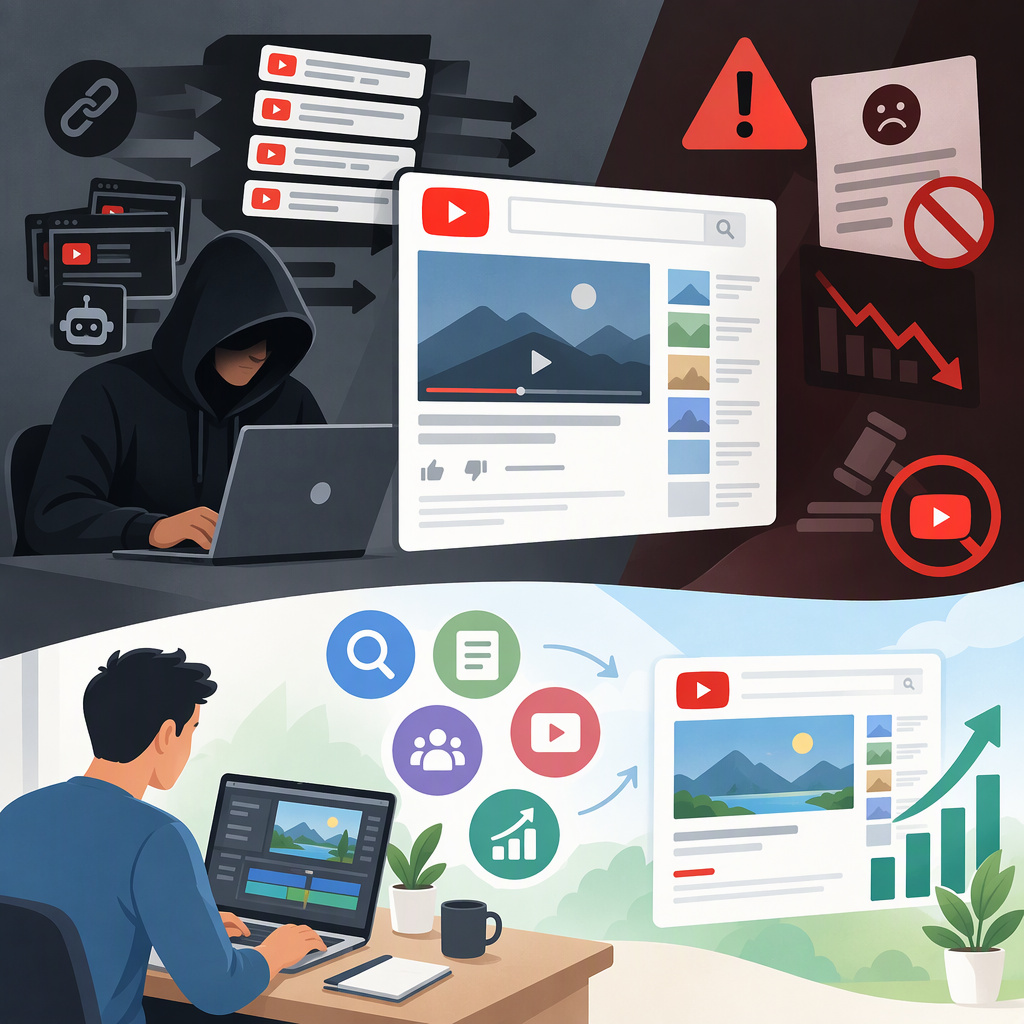
YouTube Black-Hat SEO: Risks, Policy Violations, and Safer Alternatives
The Short Answer
“Black-hat SEO” is an informal label, not a stand-alone YouTube policy category established by the official guidance cited here. Whether a tactic creates a policy risk depends on what it actually does. YouTube’s rules address practices such as artificial engagement, spam, and misleading viewers; they do not establish that every aggressive optimization tactic—or every drop in views—triggers an automatic ranking penalty. Policy enforcement can, however, remove content or lead to other account consequences. (support.google.com)
What “Black-Hat SEO” Means on YouTube
Creators and marketers commonly use “black-hat SEO” to mean attempts to gain search or recommendation exposure through deception, spam, or artificial activity. YouTube’s official guidance names specific policies rather than relying on that label. So assess the conduct against the relevant policy instead of assuming that a tactic is prohibited simply because someone calls it “black hat.” (support.google.com)
Examples of conduct YouTube’s Spam Policy or Fake Engagement Policy addresses include:
- Artificial engagement: buying or otherwise artificially increasing views, likes, comments, or subscribers; using bots; or taking part in coordinated “sub-for-sub” schemes. YouTube says it is allowed to ask viewers to like, comment, or subscribe; the line is manipulation, coercion, deception, or artificial inflation. (support.google.com)
- Spam promotion: posting repetitive or deceptive comments to drive traffic—for example, the same “check out my channel” message across many videos—or flooding community features with repetitive low-effort posts. (support.google.com)
- Misleading metadata or packaging: using a title or thumbnail that does not accurately represent the video can mislead viewers. YouTube’s title guidance recommends accurate titles; its Spam Policy broadly prohibits misleading viewers to boost engagement. The exact policy outcome depends on the content and circumstances, not the phrase “clickbait” alone. (support.google.com)
- Excessive tags in the description: YouTube explicitly says excessive tags in a video description are against its policies on spam, deceptive practices, and scams. That is different from adding relevant tags in the designated tag field; YouTube says tags generally play a minimal role in discovery, except they can help with commonly misspelled terms. (support.google.com)
- Repetitive mass uploads or attempts to evade abuse detection: YouTube’s Spam Policy gives examples including high-volume, minimally changed content and altering a TV episode to avoid detection. These examples concern spam or detection evasion—not ordinary experimentation with formats or a few variations. (support.google.com)
By contrast, accurate, concise titles, relevant descriptions, and an honest thumbnail are ordinary optimization choices. YouTube recommends making titles accurate and says that searchable titles can clearly tell viewers what to expect. (support.google.com)
What Risks Are Documented—And What Is Not Established
Documented policy consequences: YouTube says a Spam Policy violation may result in content removal, a warning or strike for some violations, suspended monetization, or termination of a channel or account. Its Fake Engagement Policy also says noncompliant content or channels may be terminated and removed. These are possible enforcement outcomes, not a statement that every questionable tactic receives the same penalty. (support.google.com)
For Community Guidelines enforcement generally, YouTube says the first violation is typically a warning, but severe abuse may result in termination without a warning. A warning or strike can be appealed; the official appeal guidance gives a six-month window for warnings and strikes and up to one year for content removals. If you receive a notice, read the specific policy and notice rather than relying on a third-party claim about what happened. (support.google.com)
Visibility is a separate question. YouTube’s public descriptions say Search considers relevance, engagement, and quality, and that recommendation systems take viewer personalization and video performance into account. They also identify topic interest, competition, and seasonality as factors affecting how many people see a video. The cited guidance does not establish a universal, automatic “black-hat SEO penalty” that suppresses every video or channel in search and recommendations. A removal can plainly make the removed content unavailable, but a view decline by itself does not prove that YouTube applied a hidden penalty. (support.google.com)
That distinction matters: a creator may observe lower impressions after changing metadata, publishing a video, or receiving a policy notice, but timing alone does not show which factor caused the change. YouTube’s own guidance points to multiple audience, performance, competition, and seasonal factors. Avoid treating anecdotes or before-and-after comparisons as proof of a platform-wide enforcement rule. (support.google.com)
Policy-Aligned Ways to Improve Discoverability
- Make the title and thumbnail accurately set expectations. Put the important topic near the beginning of a concise title. Use a thumbnail that is easy to read and genuinely represents the video. YouTube notes that inaccurate titles can cause viewers to stop watching, which can affect discoverability. (support.google.com)
- Use relevant descriptions instead of keyword stuffing. Describe what the specific video covers. YouTube says the title, tags, description, and video content can contribute to Search relevance, and its creator guidance recommends a unique description with one or two main words that describe the video. (support.google.com)
- Treat tags as a minor aid, not a shortcut. Add accurate tags when useful, especially for commonly misspelled terms. Don’t put excessive tag lists in the description: YouTube says that practice violates its spam policies. (support.google.com)
- Earn engagement rather than manufacturing it. Invite viewers to subscribe, like, or comment, which YouTube says is allowed. Avoid purchased metrics, bots, coercive rewards, sub-for-sub arrangements, and repetitive promotional comments. (support.google.com)
- Build for a real audience and review results in context. YouTube says recommendations use viewer personalization and how people respond to videos, while reach can also vary with topic demand, competing videos, and seasonality. Use analytics to assess audience response; don’t interpret a single fluctuation as proof of a penalty or a tactic as a guaranteed ranking boost. (support.google.com)
Quick Self-Audit
Before publishing or hiring someone to promote a video, ask:
- Does the title and thumbnail accurately represent what viewers will see?
- Are the description and tags relevant, rather than stuffed with unrelated terms?
- Are views, likes, comments, or subscribers coming from genuine audience interest—not bots, purchases, coercion, or exchanges?
- Is promotion useful and non-repetitive, rather than mass-posted across unrelated videos or comments?
- If an agency or contractor is involved, have you checked their methods? YouTube says a creator may be affected by a promoter’s policy-violating actions. (support.google.com)
Practical Takeaway
Don’t decide whether a YouTube SEO tactic is safe based on the “black hat” label. Identify the actual behavior, compare it with the relevant YouTube policy, and distinguish documented enforcement from speculation about rankings. Accurate packaging, useful descriptions, relevant tags, and authentic viewer engagement are practical alternatives—but none guarantees a particular position, impression count, or level of reach. (support.google.com)