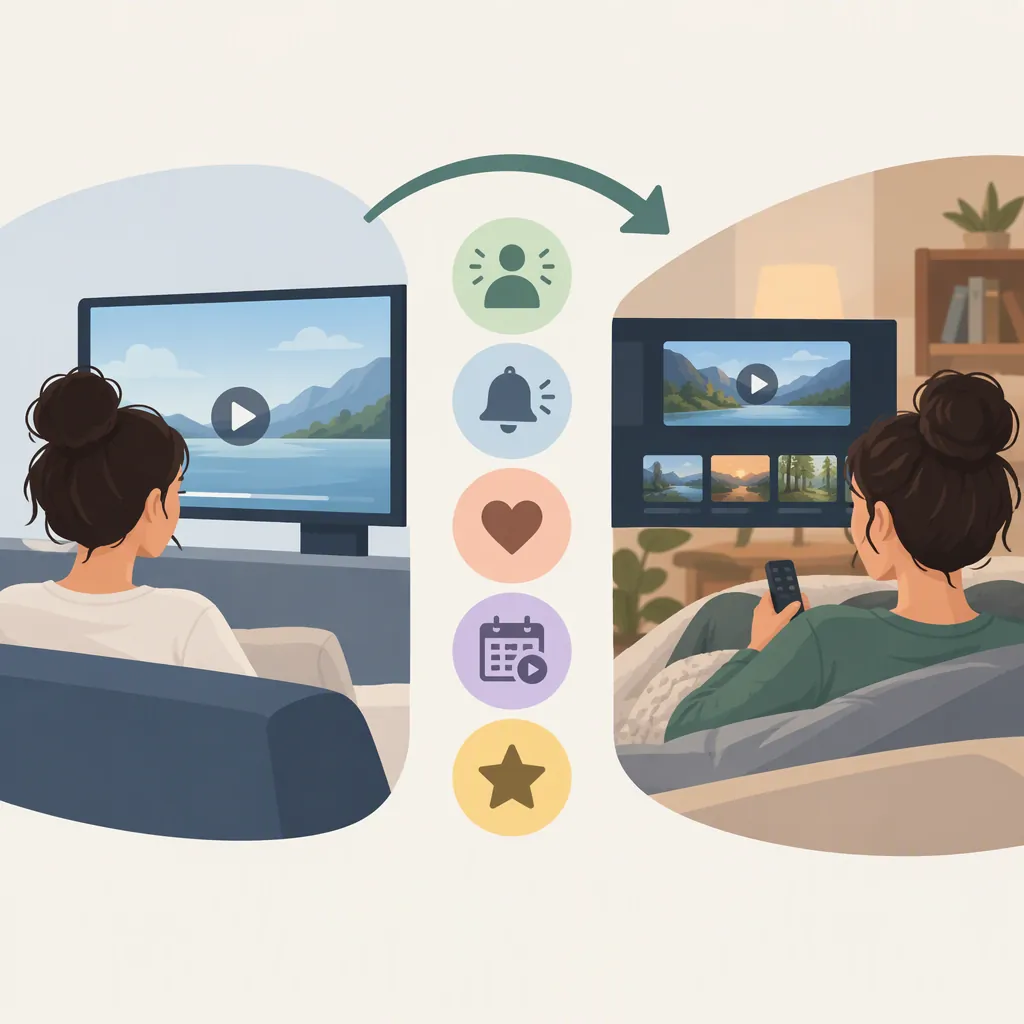
How to Turn One-Time Viewers into Returning Viewers
Give first-time viewers a satisfying video and a clear reason to watch another: a related topic, a useful series, or a recognizable recurring format. Keep each video complete on its own, make the next relevant video easy to find, and review repeat-viewing trends across comparable periods. Treat these steps as experiments, not guaranteed growth tactics. The supplied sources recommend connected content and intentional viewing journeys, but do not establish a universal conversion rate. [c1] [c2]
Separate Returning Viewers from Video Retention
Video retention and returning viewers answer different questions. Retention concerns how long people watch an individual video; returning-viewer analysis concerns whether people watch your content again. A video can answer a one-time question well without giving its audience a reason to revisit the channel. The Vidpros article makes this distinction between attention within a video and repeat viewing across content. [c1]
For planning, separate three goals:
- Discovery: A new viewer finds a relevant video.
- Continuation: That viewer chooses another related video.
- Return: The viewer comes back for more content later.
These are planning categories, not official analytics definitions. Watching several videos in one sitting is useful behavior to examine, but it does not by itself demonstrate a lasting viewing habit.
Evidence limitation: The supplied YouTube references are a third-party article and a published transcript, not current YouTube documentation. The transcript describes an earlier analytics interface. Do not rely on either source for current audience-category thresholds, interface availability, or recommendation-system ranking rules. [c1] [c2]
Design a Useful Second Video
Start with the question that remains after the first video delivers its promise. The next video should extend the same audience need rather than merely be your newest upload.
For example, a beginner tutorial on taking sharper photos could lead to a video about diagnosing blur in low light. This is an illustrative content sequence, not a reported result.
The GoTranscript transcript recommends giving each video one primary purpose and deliberately connecting first-time viewing with further viewing. Vidpros also recommends paying attention to the second video and organizing related material into series and playlists. [c1] [c2]
A practical sequence is:
- Identify an entry video that attracts the audience you want to serve.
- Write down the problem it fully resolves.
- Identify one likely next question.
- Choose or create a video that answers that question.
- Explain the connection in a short closing sentence.
- Place the destination in an appropriate available navigation surface, such as a playlist or end screen.
Avoid withholding the promised answer to force another view. The first video should still be useful to someone who never returns.
Two-Video Planning Worksheet
Entry video: [Title]
Audience need: [One specific question]
Complete answer delivered here: [Outcome]
Likely next question: [Related need]
Next video: [Title]
Connection sentence: [Explain what the next video adds]
Navigation placement: [Available location]
Success signal to review: [Relevant metric available in your analytics]
Make Returning Worthwhile and Predictable
A return visit needs a reason beyond familiarity. Consider a recurring audience problem, an ongoing project, or a format that offers a different useful example each time.
Vidpros recommends recognizable presentation, series, and a predictable publishing schedule. These are practical suggestions in a secondary source, not proof that posting on a fixed schedule triggers recommendation benefits. [c1]
Use consistency selectively:
- Keep the audience and core promise recognizable.
- Use recurring segments only when they help the content.
- Choose a publishing rhythm you can sustain without weakening the work.
- Give a brief recap when an episode builds on earlier material.
- Explain recurring references so newcomers can follow along.
Consistency does not require identical lengths, rigid editing, or repetitive topics. A useful experiment is to keep the audience promise stable while varying the examples or depth.
The GoTranscript transcript also distinguishes content intended for discovery from content intended to deepen connection with an existing audience. [c2] A follow-up answering a thoughtful viewer question can serve the latter purpose without becoming an unrelated channel update.
Read Audience Patterns as Clues, Not Verdicts
Use audience analytics to decide what to investigate, not to declare that a single upload caused loyalty. The GoTranscript transcript emphasizes interpreting new and returning viewers alongside content strategy and warns that older successful videos can obscure the contribution of recent work. [c2]
The following are working hypotheses, not definitive diagnoses:
| Pattern | Possible Explanation | What to Examine |
|---|---|---|
| New viewers rise while repeat viewing stays flat | The topic may satisfy a one-time need, or the next video may be poorly matched | Topic continuity and the second-video destination |
| Returning viewers rise while discovery stays flat | Existing viewers may be responding, while entry content reaches fewer newcomers | Whether introductory videos are understandable without prior context |
| Both groups rise | Reach and repeat viewing may be improving together | Whether the pattern persists across comparable periods |
| Returning-viewer share falls while its count rises | New viewers may be growing faster | Absolute counts alongside proportions |
Keep date ranges comparable and note changes in publishing volume, topics, and formats. A changing percentage is not automatically evidence of a changing number of people.
Do not label returning viewers divided by new viewers a first-time-to-returning conversion rate. Those totals alone do not show which first-time viewers later returned. A conversion measure requires a defined starting group, an observation window, and a way to identify subsequent viewing.
Run a Small Repeat-Viewing Experiment
Test a specific change rather than rebuilding the whole channel at once. For example, improve the connection between an entry tutorial and its follow-up while leaving the main format broadly unchanged.
Before publishing, record the hypothesis and the evidence you will review. Choose a review period that includes several normal publishing opportunities; there is no supported universal waiting period in the supplied evidence.
Review channel-level returning-viewer trends alongside any available continuation metrics and individual-video retention. These describe different behaviors. An increase in clicks toward another video can support the navigation hypothesis, but it does not establish that those viewers returned on a later day.
If results improve, repeat the approach on another related sequence. If they do not, examine whether the follow-up answers a real audience need before changing presentation again. Keep conclusions narrow: observational analytics can suggest an association, but other uploads, topic demand, and audience changes may also explain the result.
Repeat-Viewing Experiment Log
Hypothesis: [Specific reason viewers might watch again]
Content sequence: [Entry video and follow-up]
Single change: [What will differ]
Baseline period: [Dates]
Review period: [Comparable dates]
Available measures: [Returning-viewer counts, continuation metrics, and video retention]
Other changes: [Topics, upload volume, or formats]
Observed result: [What changed]
Limitation: [What the data cannot establish]
Next decision: [Repeat, revise, or stop]
FAQ
Are Returning Viewers the Same as Subscribers?
No. Subscription status and repeat viewing describe different behaviors. The Vidpros article distinguishes an active repeat-viewing audience from a subscriber total. Review viewing behavior rather than assuming every subscriber watches regularly. [c1]
What Is a Good Returning-Viewer Rate?
The supplied evidence does not establish a universal target. Compare your own results across similar periods, keeping the metric definition, audience, topics, and publishing activity in view. Do not treat channel-level audience totals as a cohort conversion rate.
Will Posting More Often Make Viewers Return?
More frequent publishing is not a guaranteed solution. Vidpros recommends predictability alongside connected, recognizable content. A sustainable schedule with relevant follow-ups is a more focused experiment than increasing volume without a clear audience need. [c1]
Why Can a Video Have Good Retention but Few Returning Viewers?
People may watch because the video solves a specific problem, then have no further need for the channel. Retention measures attention within the video, while returning-viewer analysis concerns repeat viewing. Examine whether another video serves a genuinely related need. [c1]