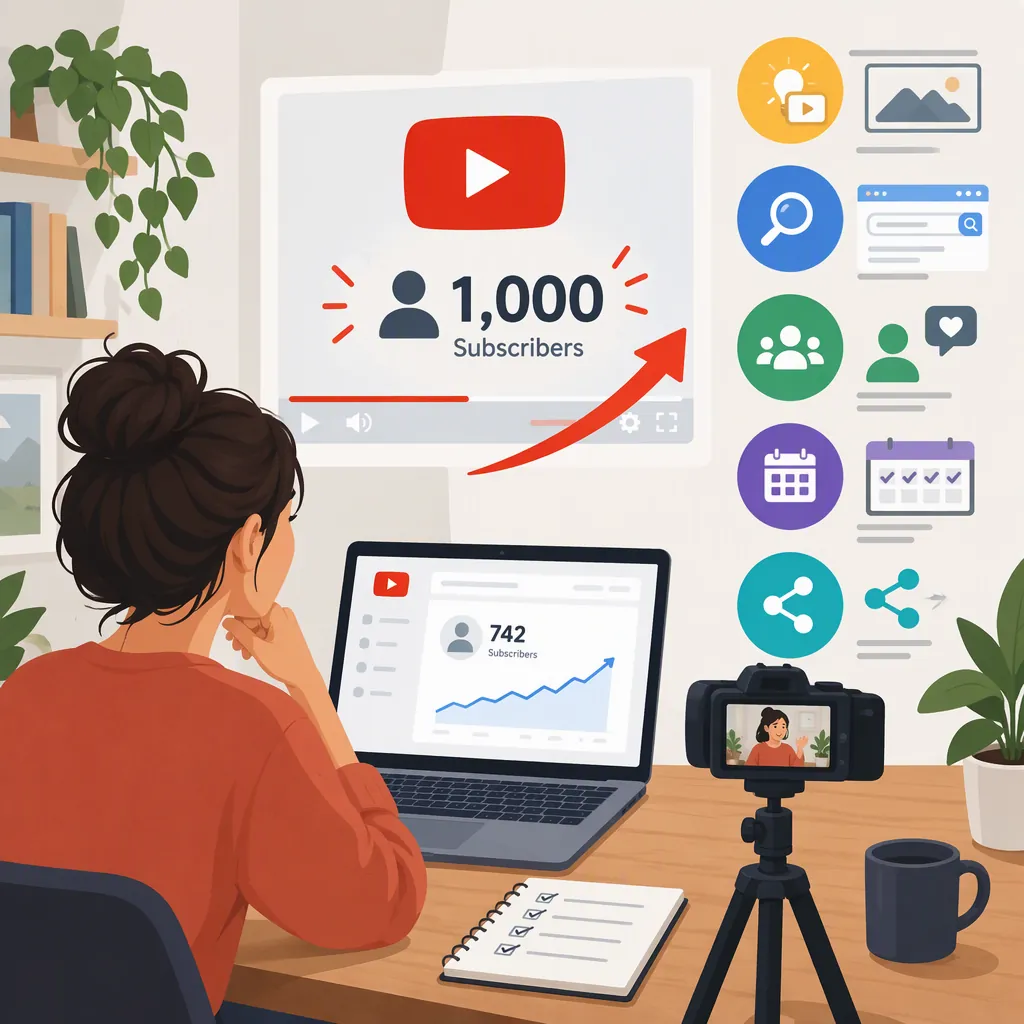
How to Reach 1,000 Subscribers on YouTube with a Repeatable Plan
To work toward 1,000 YouTube subscribers, make videos for a clearly defined audience, deliver what each title promises, organize related content, and review which uploads actually gain subscribers. Use those results to choose your next topics and improvements. Shorts and searchable tutorials are options to test, not guaranteed shortcuts. The provided sources support these practices but do not establish a reliable deadline for an individual channel. [c1] [c2]
Define Who Your Channel Serves
Start with a specific viewer and a recurring need. vidIQ recommends choosing one target audience and expressing a clear content promise. TubeBuddy similarly recommends making the channel’s focus evident in its banner, description, featured videos, and playlists. [c1] [c2]
A practical planning exercise is to complete this sentence: “This channel helps [audience] understand or accomplish [outcome] through [type of video].” Treat it as an editorial guide, not a promise of results.
For example, a hypothetical beginner cooking channel could focus on affordable meals using basic equipment rather than alternating between unrelated cooking, gaming, and travel videos. Each planned upload should answer two questions:
- Would the same intended viewer find this useful?
- What related subject could that viewer explore next?
Review your channel page against that focus. Make the description concrete and group existing videos into useful topic sequences rather than leaving visitors with an undifferentiated upload list. These steps adapt the channel-organization recommendations in both guides. [c1] [c2]
Channel Focus Worksheet
Intended viewer: ______
Recurring problem or interest: ______
Video format I can sustain: ______
Channel promise: ______
Three related video ideas: ______
Existing playlist that supports this promise: ______
Plan Useful, Connected Video Topics
TubeBuddy recommends evergreen videos: tutorials, explanations, and other subjects that remain relevant beyond their publication date. In his personal account, Alex Hyett describes prioritizing search-oriented software engineering videos rather than relying on a viral hit. His experience is an example, not evidence that every niche will follow the same growth pattern. [c2] [c3]
For your next small batch of videos, consider three complementary roles:
- Entry video: Answers a specific question an unfamiliar viewer might have.
- Follow-up video: Explains the next difficulty or decision.
- Application video: Demonstrates the skill or idea in context.
This is a suggested planning framework, not a required YouTube format. For a hypothetical phone-editing channel, the sequence might cover trimming a clip, improving dialogue audio, and assembling a complete short scene.
If you already have uploads, do not choose topics solely from your highest view counts. TubeBuddy explicitly distinguishes videos that attract views from videos that generate subscriptions. Use your own subscriber results to decide which themes deserve follow-ups. [c2]
Improve the Click and the Viewing Experience
Separate the decision to click from the experience after clicking. vidIQ recommends clear titles and thumbnails, an opening that establishes the payoff, and editing that removes slow introductions and filler. TubeBuddy recommends revisiting titles and thumbnails on existing videos that have engagement but insufficient clicks. Neither recommendation guarantees additional subscribers. [c1] [c2]
Before publishing, use this editorial check:
- Title: Does it identify a concrete subject or outcome without exaggeration?
- Thumbnail: Does it communicate the same idea clearly at a small size?
- Opening: Does it begin addressing the promised subject promptly?
- Main content: Are the explanations, examples, or demonstrations necessary and understandable?
- Ending: Is there a genuinely relevant follow-up video or playlist?
Check production basics before assuming you need new equipment. Hyett’s account describes adjustments to room acoustics, lighting, and his editing process. Those are observations from one creator’s workflow, not proof that a particular setup produces growth. A useful quality check is to listen for intelligible speech and inspect whether important details are visible. [c3]
Use Analytics to Choose the Next Improvement
vidIQ recommends reviewing subscribers gained, audience retention, traffic sources, and end-screen element clicks. TubeBuddy also emphasizes identifying uploads that generate subscriptions. Together, these suggest a more useful review than checking subscriber totals alone. [c1] [c2]
Use the following table as a diagnostic starting point. The proposed explanations are hypotheses to investigate, not conclusions that a metric can prove by itself.
| Observed Pattern | Question to Investigate | Possible Next Test |
|---|---|---|
| Impressions but few clicks | Is the topic and its value clear? | Revise an unclear title or thumbnail. |
| Viewers leave near the beginning | Does the opening delay or mismatch the promised content? | Begin the next video with the relevant result or explanation. |
| Views but few subscribers gained | Does the video serve the channel’s intended audience? | Plan a related follow-up and clarify the channel focus. |
| Few end-screen clicks | Is the suggested follow-up useful to this viewer? | Select a closer topic match. |
When comparing videos, use similar observation periods where possible. Record both views and subscribers gained so that a high-volume upload does not automatically dominate your interpretation. As an optional planning calculation, divide subscribers gained by views and multiply by 1,000. Label this as subscribers gained per 1,000 views—not a count of unique viewers who subscribed or proof of causation.
Choose one primary change for the next upload and record what happened. This is a practical learning method, not a controlled experiment.
Video Review Log
Video: ______
Observation period: ______
Views: ______
Subscribers gained: ______
Opening retention observation: ______
End-screen result, if available: ______
Possible explanation: ______
One change to test next: ______
Result and remaining uncertainty: ______
Test Formats at a Sustainable Pace
vidIQ recommends a sustainable publishing cadence and using Shorts to introduce related ideas. Hyett describes repurposing portions of existing long-form videos into short-form content. These provide options for testing formats without treating daily publishing or Shorts as mandatory. [c1] [c3]
A manageable work cycle could be:
- Plan and produce one focused main video.
- If suitable, adapt one self-contained explanation into a Short.
- Organize the main video with relevant existing content.
- Review analytics and substantive viewer questions before planning the next upload.
Keep any Short understandable on its own. Evaluate whether its topic fits the audience you intend to serve; reach alone is not enough to assess whether a format supports your subscriber goal. TubeBuddy’s distinction between views and subscriptions is useful here. [c2]
Avoid adopting an upload schedule simply because a guide presents it as a fast-growth formula. Start with a pace that leaves time for research, production, and review, then adjust based on your capacity and observed results.
Keep Timelines and Evidence Limits Visible
There is no dependable deadline for reaching 1,000 subscribers in the provided evidence. vidIQ reports widely varying timelines, but its supplied article also gives inconsistent general timing guidance. TubeBuddy’s guide includes growth predictions, while Hyett’s article describes one creator’s experience. None establishes what will happen to your channel. [c1] [c2] [c3]
The two growth guides come from companies selling creator tools. Their general recommendations can inform a plan, but their promotional language and examples should not be treated as independent guarantees. Hyett’s personal account is useful for understanding a workflow, not estimating typical outcomes. [c1] [c2] [c3]
Use 1,000 subscribers as a milestone rather than a promised result. More actionable interim goals are a coherent video library, clearer packaging, stronger delivery, and documented evidence about which topics gain subscribers. Also keep subscriber growth separate from monetization: the supplied sources describe additional eligibility requirements, but no official YouTube policy reference was provided to verify current rules. [c1] [c3]
FAQ
How Long Does It Take to Reach 1,000 YouTube Subscribers?
The provided references do not support a reliable individual forecast. They include reported channel data, broad advice, and a personal success account, which should not be combined into a guaranteed timeline. Track your own results over comparable periods instead. [c1] [c2] [c3]
Should I Use Shorts to Reach 1,000 Subscribers?
Shorts are an option to test, not a requirement. vidIQ recommends them for discovery, and Hyett describes repurposing longer videos into Shorts. Keep their topics aligned with your channel and evaluate subscriber gains rather than views alone. [c1] [c2] [c3]
Why Am I Getting Views but Few Subscribers?
Views and subscriber gains measure different outcomes. TubeBuddy recommends checking which videos actually generate subscriptions and whether the channel page communicates a clear focus. Review audience fit, opening retention, and the relevance of follow-up content as possible explanations rather than assuming one cause. [c1] [c2]
How Many Videos Do I Need to Reach 1,000 Subscribers?
There is no fixed upload count established for your channel. vidIQ reports a wide range among channels that reached the milestone, but that does not show how many uploads you will need. Use a sustainable schedule and improve topic selection, packaging, and delivery from your own results. [c1]
Does Reaching 1,000 Subscribers Automatically Mean I Can Earn Ad Revenue?
Do not treat subscriber count alone as proof of eligibility. The supplied references describe additional monetization requirements. Because no official YouTube policy source was provided, this article does not verify current thresholds or application rules. [c1] [c3]