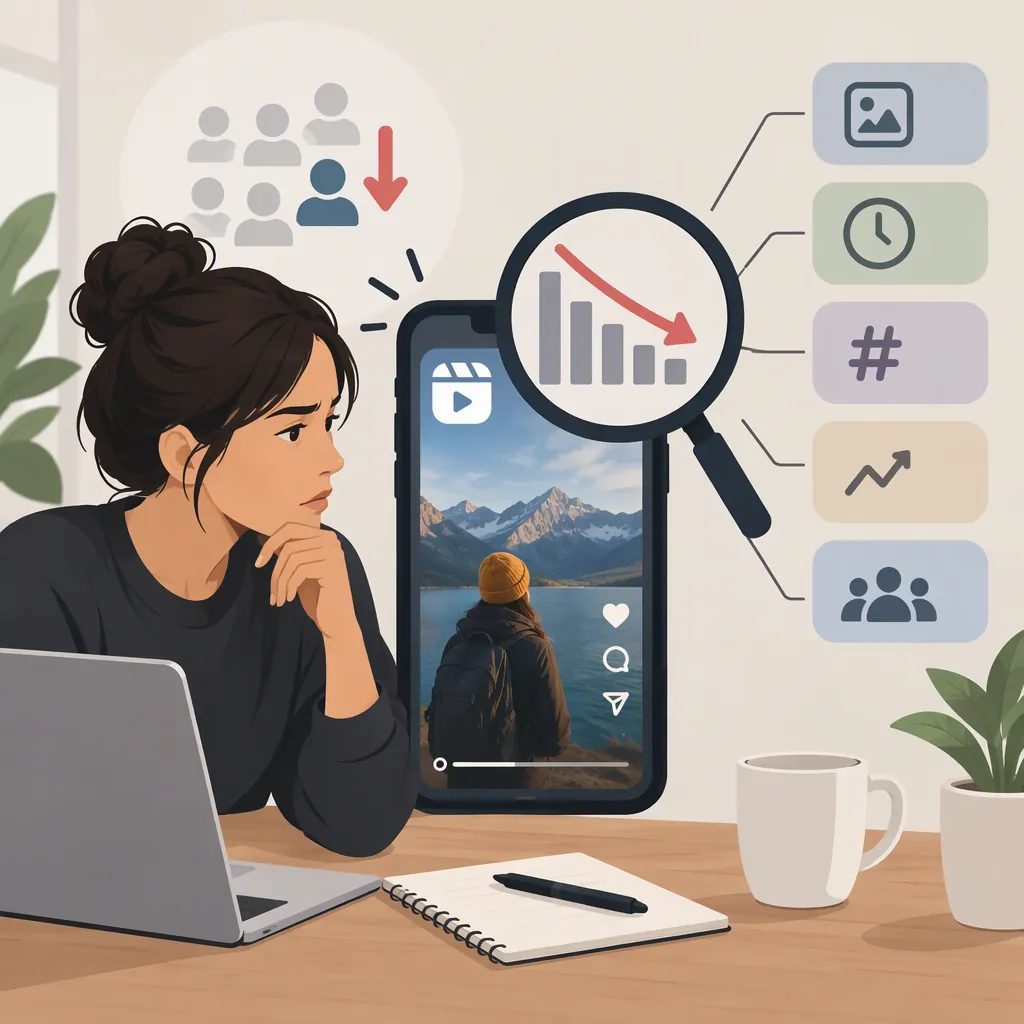
Instagram Reels Getting No Reach? Diagnose and Test Improvements
If your Instagram Reels have little or no reach, first distinguish a visibility problem from a performance decline. Confirm that the Reel is published and accessible to its intended audience, then compare recent Reels at the same age using the same metric. Where available, separate follower from non-follower reach and review watch time, shares, and saves. Test one content change at a time rather than assuming a shadowban. The supplied guides recommend analytics-led diagnosis, but they do not establish a guaranteed fix or recovery timeline. [reach_basics] [reels_performance] [reach_audit]
Define What “No Reach” Means
“No reach” can describe different situations: a Reel that is not visible, an accessible Reel with almost no reported activity, or a Reel performing below your usual baseline. Treat these as separate diagnostic paths.
The Slidy Creator guide defines reach as unique accounts that saw content, unlike impressions or views that can include repeated exposure. It also distinguishes follower reach from non-follower reach. [reach_basics]
The supplied sources disagree about reporting availability. Wheeler Marketing Agency describes a move toward views and reduced reach reporting, while Slidy Creator describes reach breakdowns in Insights. These references do not establish which fields every account currently receives. Use the labels and definitions shown in your own interface, and do not substitute views for unique accounts reached. [reach_audit] [reach_basics]
Before changing your content, record the exact metric, the Reel’s publication time, and whether the concern is zero activity or a decline relative to earlier posts.
Problem Definition Worksheet
Record these items before testing:
- Problem type: inaccessible Reel, zero reported activity, or below-baseline performance.
- Metric: copy its exact label from Insights.
- Observation time: record when you checked.
- Reel age: record the time elapsed since publication.
- Comparison set: identify earlier Reels with similar topics and lengths.
- Missing data: mark unavailable metrics as unavailable, not zero.
Check Visibility Before Editing Content
For a Reel showing no activity, use a basic verification sequence before treating the opening or editing as the problem:
- Confirm that the Reel appears published rather than remaining in a draft or upload process.
- Check its intended audience and your account’s privacy configuration.
- Confirm that an intended viewer can open the Reel. A single viewer’s result is a visibility check, not a distribution test.
- Review any account or content notices available in the app. If a notice provides a review or appeal option, follow its stated process.
- Record any playback or upload error separately from performance metrics.
These are troubleshooting steps, not proven reach boosters. The supplied Instagram page contains creator posts promoting account settings and Account Status checks, but it is not an official explanation of ranking or recommendation eligibility. Its presence on instagram.com does not validate the creators’ claims. [instagram_examples]
Do not infer a hidden restriction from one weak Reel, an unsuccessful search, or failure to appear in Explore. Those observations alone do not identify the cause.
Find Where Performance Changed
For an accessible Reel with disappointing results, build a comparison rather than starting with a presumed cause. Wheeler’s guide recommends locating the start of the decline, separating content formats, and logging observations. Slidy Creator recommends distinguishing follower and non-follower reach. [reach_audit] [reach_basics]
Use several comparable Reels, not just your best-ever post. Compare them at a consistent elapsed time after publication. This is a proposed measurement method, not an Instagram distribution deadline.
| Observation | Question to Investigate |
|---|---|
| Non-follower reach declined while follower reach stayed similar | Did the topic, framing, or audience relevance change? |
| Views stayed similar but interactions declined | Is the content less useful or less relevant to viewers? |
| Watch time weakened on comparable-length Reels | Does the opening delay the promised value, or does the middle lose focus? |
| Reels declined while other formats stayed similar | What changed specifically in the Reel topics or execution? |
| Multiple formats declined together | Did audience behavior, posting patterns, or an account notice change? |
These patterns generate hypotheses; they do not prove a ranking penalty. Dcrayon’s guide emphasizes openings, retention, relevance, and engagement as possible areas to investigate, but it does not provide a validated causal test for an individual account. [reels_performance]
Reel Comparison Log
Create one row per Reel with these columns:
Reel identifier | Publication date | Age at measurement | Topic | Length | Opening approach | Accounts reached, if available | Views | Follower/non-follower breakdown, if available | Watch time, if available | Shares | Saves | Relevant account notices | Notes

Use the same measurement age for comparisons. Keep unavailable fields separate from zero values. Flag unusual posts, such as collaborations or paid promotion, rather than mixing them into an ordinary organic baseline.
Test One Improvement at a Time
Choose the most plausible issue from your comparison, then make a focused test. The supplied guides recommend stronger openings, clearer pacing, useful content, and audience-informed posting times. Treat those recommendations as testable ideas rather than guaranteed algorithm levers. [reels_performance] [reach_basics] [reach_audit]
- Opening test: Replace a general introduction with the specific question, result, or demonstration the Reel delivers. Avoid promising an outcome the video cannot support.
- Pacing test: Remove repetition or unnecessary setup while preserving enough explanation to make the content understandable. Do not assume every Reel needs the same length.
- Relevance test: Address one clearly defined audience problem instead of combining unrelated topics.
- Clarity test: Improve difficult-to-read text, unclear framing, or distracting audio.
- Timing test: If audience activity data is available, compare suitable publishing windows without changing the topic and editing style simultaneously.
Keep other elements reasonably similar. Repeat the idea across comparable posts before deciding it helped. A better-performing Reel is evidence worth investigating, not proof that one edit caused expanded distribution.
For interaction comparisons, a consistent denominator matters. For example, calculate shares per account reached when that field is available, or shares per view when it is not. Label the denominator explicitly and do not compare the two rates as equivalent.
Single-Variable Test Plan
Hypothesis: State the specific issue suggested by your comparison log.
Change: Select one variable, such as opening, pacing, topic specificity, or posting window.
Keep Similar: List the topic category, length range, production approach, and other elements you will hold reasonably steady.
Primary Measure: Choose one available metric and its exact definition.
Secondary Measures: Record watch time and interactions where available.
Review Point: Compare posts at the same age after publication.
Decision: Keep, revise, or stop the approach based on repeated observations; note alternative explanations.
Avoid Unsupported Reach Fixes
The references offer useful diagnostic ideas, but their strongest algorithm claims need caution. They are third-party guides and creator posts, not a complete set of official platform documentation.
Do not treat the following as established rules:
- A fixed initial test-audience percentage.
- A universal first-hour deadline for distribution.
- A required Reel length or engagement-rate benchmark.
- A setting, trending sound, or hashtag combination that guarantees reach.
- A fixed number of days needed to “reset” algorithmic trust.
The supplied articles present specific testing-window or recovery claims, while the Instagram collection contains creator promises about settings and viral outcomes. This evidence does not establish those claims as universal. [reach_basics] [reels_performance] [reach_audit] [instagram_examples]
A defensible conclusion is narrower: describe what changed in your own data, check visible account notices, and evaluate focused content tests. If results remain mixed, keep that uncertainty in the diagnosis rather than assigning an unsupported cause.
FAQ
Does Zero Reel Reach Mean I Am Shadowbanned?
No reach number alone establishes a hidden restriction. First verify publication and intended-audience access, then check any visible account notices and compare multiple posts. Dcrayon discusses content-performance explanations for low views, but the supplied references cannot determine whether your account is restricted. [reels_performance]
Why Can Views Be Higher than Accounts Reached?
The Slidy Creator guide distinguishes unique accounts reached from counts that include repeat exposure. If your Insights provides both, use reach to assess audience breadth and views to assess total viewing activity. Follow the definitions shown in your interface because the supplied sources disagree about reporting availability. [reach_basics] [reach_audit]
Should I Post More Reels to Recover Reach?
Increasing frequency is not an established fix. The supplied guides emphasize content relevance, attention, and interaction rather than volume alone. A manageable schedule can support repeated tests, but changing frequency alongside every other variable makes results harder to interpret. [reach_basics] [reels_performance]
How Long Does It Take for Reel Reach to Recover?
The provided evidence does not establish a reliable recovery period. Although the third-party guides give timing estimates, those estimates should not be treated as a promise for your account. Compare posts at consistent ages and look for repeated improvement rather than assuming a deadline or algorithm reset. [reels_performance] [reach_audit]
Sources
-
[reach_basics] Instagram Reach Explained: Why It's Low and How to Fix It (2026) — Slidy Creator
-
[reels_performance] Why Are My Reels Not Getting Views? The Real Reason
-
[instagram_examples] Reach On Instagram Reels
-
[reach_audit] Instagram Reach Suddenly Dropped? Here’s Why + How to Recover