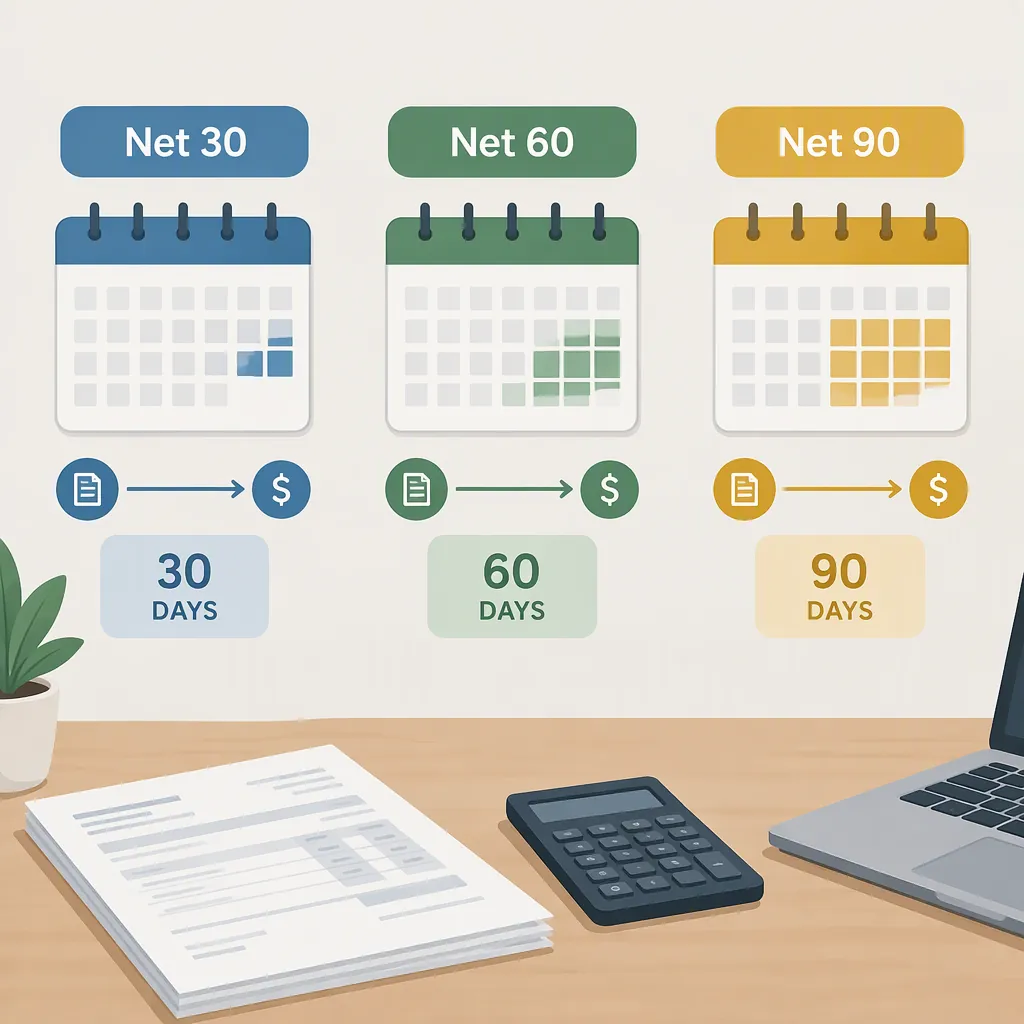
30, 60, And 90 Payment Terms: Comparing Net Terms
Net 30, net 60, and net 90 mean the full invoice balance is due within 30, 60, or 90 days of the agreed starting date, typically the invoice date. They are payment deadlines—not three installments. Longer terms give the buyer more time to pay but leave the seller waiting longer for cash. Confirm the starting event and day-count rules in the agreement rather than relying on the number alone. [c1] [c2]
Net 30 Vs. Net 60 Vs. Net 90
The number following “net” identifies the payment window. Under standard invoice-date terms, net 30 allows 30 days, net 60 allows 60 days, and net 90 allows 90 days to settle the invoice in full. [c1] [c3]
| Term | Standard Payment Window | Buyer’s Perspective | Seller’s Perspective |
|---|---|---|---|
| Net 30 | 30 days from the invoice date | Least time to arrange payment among these options | Shortest scheduled wait for payment |
| Net 60 | 60 days from the invoice date | 30 more days than net 30 | An additional 30 days before payment is due |
| Net 90 | 90 days from the invoice date | 60 more days than net 30 | Longest scheduled wait among these options |
These comparisons assume the same invoice date and counting rules. Longer payment windows can help buyers manage cash, while sellers must cover expenses during the wait. Neither shorter nor longer terms guarantee payment on time. [c1] [c2]
How to Calculate the Due Date
For an agreement using calendar days from the invoice date, add the stated number of days to that date. Do not substitute “one month,” “two months,” or “three months”: calendar months have different lengths. Billbooks describes standard net 30 as including weekends and holidays, while also noting that agreements can specify different counting rules. [c4]
Hypothetical example: An invoice dated May 1, 2026, uses calendar days, with no end-of-month adjustment.
| Term | Calculation | Due Date |
|---|---|---|
| Net 30 | May 1 plus 30 days | May 31, 2026 |
| Net 60 | May 1 plus 60 days | June 30, 2026 |
| Net 90 | May 1 plus 90 days | July 30, 2026 |
The starting event matters as much as the duration. Some agreements start the clock at delivery or receipt of goods instead of the invoice date. Net 60 EOM, for example, counts 60 days from the end of the invoice month; net 60 ROG counts from receipt of goods. [c2]
Before calculating, confirm:
- The event that starts the clock.
- Whether days are calendar days or business days.
- Whether an EOM or accumulation-period rule applies.
- The exact due date shown on the invoice.
An accumulation-period arrangement is not necessarily ordinary net terms. Hannah Sheridan & Cochran distinguishes invoice-date terms from terms that begin at the end of a defined accumulation period. [c3]
Compare the Cash Flow Trade-Offs
The central question is not which term sounds most flexible, but how long the seller can wait without disrupting operations. Invoice Simple recommends assessing cash flow needs and considering different terms for different customer relationships or order sizes. altLINE also emphasizes the seller’s ability to cover expenses while waiting under net 90. [c1] [c2]
Use these questions as a decision framework rather than a universal rule:
- Expense timing: Which project costs, supplier bills, or other operating expenses fall due before payment arrives?
- Available cash: Can those obligations be covered if the buyer pays on the final permitted day?
- Payment history: Is there enough evidence to assess the buyer’s reliability?
- Order size: Would one unpaid invoice create a significant cash shortfall?
- Negotiating room: Would a shorter window or an early-payment discount work for both parties?
Net 30 has the shortest contractual wait of these three choices. Net 60 offers an intermediate window. Net 90 gives the buyer the most time but requires the seller to plan for the longest delay. Creditworthiness and an established relationship may support consideration of extended terms, but they do not remove nonpayment risk. [c1]
For project work, compare the proposed due date against the expense schedule. Treat that comparison as a planning exercise—not evidence that any particular term is standard for creators, agencies, or freelancers.
How Early-Payment Discounts Differ
A plain net term states the payment window; it does not automatically offer a discount. Additional notation supplies the discount percentage and its deadline. [c1] [c4]
- 2/10 net 30: A 2% discount applies if payment is made within 10 days; otherwise, the full balance is due within 30 days. [c4]
- 1/10 net 60: A 1% discount applies within 10 days; otherwise, the full balance is due within 60 days. [c2]
- 2/10 net 90: A 2% discount applies within 10 days; otherwise, the full balance is due within 90 days. [c1]
Hypothetical calculation: On a $2,000 invoice with an eligible 2% early-payment discount, the discount is $40 and the discounted payment is $1,960. Without the discount, the balance remains $2,000.
For sellers, the trade-off is earlier cash in exchange for lower revenue on that invoice. Discounts can encourage earlier payment, but they also reduce margins. For buyers, compare the savings with the cash needed to pay early. [c1] [c4]
Put the Timing Rules in Writing
A useful payment clause identifies the duration, starting event, counting convention, and exact due date. The agreement and invoice should describe the same arrangement. The provided sources emphasize clear documentation and checking whether stated terms match actual billing practices. [c2] [c3] [c4]
The worksheet below is an original drafting aid, not a legally validated contract clause. Replace every placeholder and confirm that the completed wording matches the agreement.
Do not assume “net 30,” “net 60,” or “net 90” alone establishes a late fee, interest rate, or enforcement remedy. Those labels describe payment timing. This overview does not determine which additional charges or remedies are enforceable in a particular jurisdiction.
Payment Timing Worksheet
Payment term: Net [30, 60, or 90].
Amount and currency due: [amount and currency].
Starting event: [invoice date, invoice receipt, delivery, or another specifically agreed event].
Starting date: [Month Day, Year].
Day-count convention: [calendar days or business days, with any agreed holiday rules].
Payment due date: [Month Day, Year].
Payment completion rule: [define whether payment must be initiated or received by the deadline].
Early-payment discount: [none, or percentage, eligibility conditions, and deadline].
Other agreed conditions: [identify any relevant provisions separately].
FAQ
Do 30, 60, and 90 Payment Terms Mean Three Installments?
No. Net 30, net 60, and net 90 are alternative deadlines for full payment. They do not, by themselves, establish payments at all three intervals. An installment schedule needs separate wording specifying the amounts and deadlines. [c1]
Are Net Terms Counted in Calendar Days or Business Days?
Billbooks describes standard net 30 as calendar days, including weekends and holidays, but notes that variations can specify business days. Confirm the counting convention in the agreement, especially when it affects the deadline. [c4]
Does the Clock Start When the Invoice Is Sent or Received?
The invoice date is a typical starting point, but agreements can use another event. The provided references describe alternatives such as delivery or receipt of goods. Identify the agreed trigger explicitly instead of assuming that sending, receiving, and dating an invoice are interchangeable. [c1] [c2]
Which Is Best: Net 30, Net 60, or Net 90?
There is no universally best option. Net 30 provides the shortest scheduled wait for the seller; net 90 provides the longest window for the buyer. Compare expense timing, available cash, order size, and buyer reliability before agreeing to a term. Longer terms do not guarantee that payment will arrive. [c1] [c2]