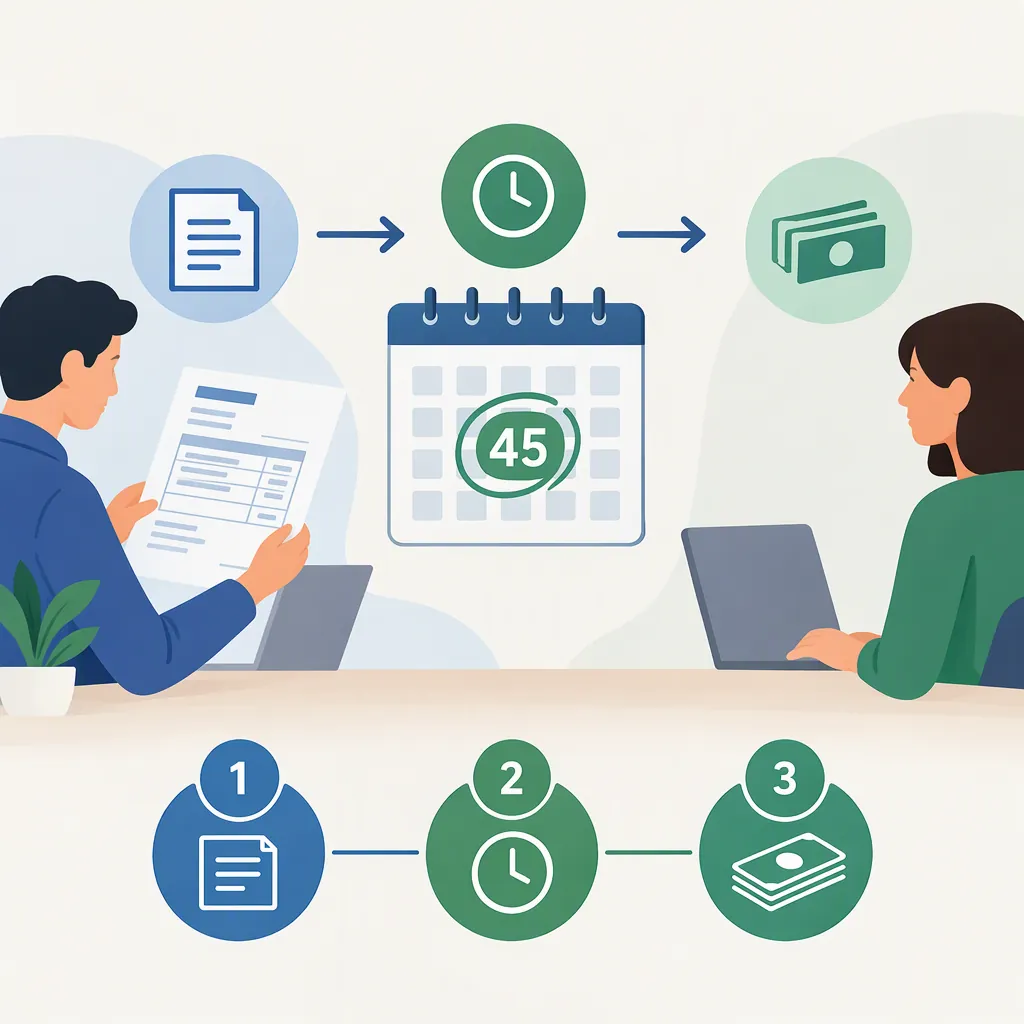
45-Day Payment Terms: Meaning, Due Dates, and Invoice Wording
Net 45 means the full invoice amount is due within 45 days of the agreed starting point. GoCardless describes net-day terms as running from invoice receipt to the due date; applying that explanation to Net 45 gives a 45-day payment window. Confirm the starting event and counting rules in your agreement rather than relying on the label alone. [c1]
What Net 45 Payment Terms Mean
The useful question behind 45-day payment terms is: “Forty-five days after what?” GoCardless explains net-day terms as the number of days from invoice receipt to the payment due date. Under that explanation, Net 45 gives the customer 45 days from receipt to pay the full invoice amount. [c1]
For a specific transaction, read the agreed wording. If it names invoice issuance, receipt, delivery, or approval as the starting event, use that event when identifying the due date. Do not silently substitute the day work began or the day a deliverable was published.
Net 45 describes a payment deadline, not a promise that funds will arrive on a particular earlier date. For planning purposes, distinguish the agreed due date from your expected collection date. This article provides general educational guidance; the supplied reference does not establish the legal effect of a particular contract.
How to Calculate a Net 45 Due Date
Before calculating, identify the starting event, whether the agreement uses calendar or business days, and any rule for a deadline that falls on a weekend or holiday. These are details to specify, not assumptions established by the supplied reference.
Illustrative example: Assume the agreement starts the clock when the invoice is received, uses calendar days, and treats the receipt date as day zero. If the invoice is received on March 1, adding 45 calendar days gives April 15. Under those assumptions, April 15 is the due date.
If an invoice is issued on March 1 but received on March 4, the same receipt-based calculation gives April 18. This illustrates why documenting receipt can matter: GoCardless's explanation uses receipt, rather than issuance, as the starting point. [c1]
Write the resulting date on the invoice so both parties can check it against the agreed terms.
Due Date Calculation Worksheet
Agreed starting event: __________
Date that event occurred: __________
Day-count basis: Calendar days / Business days
Starting-date counting rule: __________
Payment period: 45 days
Weekend or holiday rule, if agreed: __________
Calculated payment due date: __________
Evidence of the starting event: __________
What to Put in the Agreement and Invoice
GoCardless recommends clearly listing the invoice date, payment due date, accepted payment methods, submission instructions, contact details for payment issues, and any penalty for delayed payment. [c1]
For Net 45, also make the starting event explicit. A practical drafting checklist is:
- Define what starts the 45-day clock.
- Specify calendar or business days and how the starting date is counted.
- State the exact due date on each invoice.
- Identify where the invoice must be submitted.
- Explain how invoice receipt will be documented.
- Resolve any mismatch between the agreement and invoice before relying on the deadline.
The sample below is illustrative wording, not a complete contract or a statement of legal enforceability. Include late-payment charges only if appropriate to the agreement and applicable requirements; the supplied source does not establish which charges are legally permitted.
Illustrative Receipt-Based Net 45 Wording
Payment terms: Net 45. The full invoice amount is due 45 calendar days after receipt at the agreed invoice submission address. The receipt date is day zero for this calculation.

Invoice date: __________
Invoice receipt date: __________
Payment due date: __________
Accepted payment method and instructions: __________
Payment questions contact: __________
Any separately agreed weekend or holiday adjustment: __________
Applying Net 45 to Creator and Service Projects
For a creator or service project, separate the delivery schedule from the payment schedule. As a planning exercise, record when work starts, when deliverables are submitted, when an invoice may be sent, and what starts the payment clock.
If proposed terms start payment only after approval, clarify who approves, what approval means, and how the approval date will be recorded. A 45-day period measured from approval should not be budgeted as 45 days from initial delivery unless those events coincide.
Before accepting the terms, map expenses against the assumed due date. Consider whether deposits, milestone payments, or a shorter payment period would better fit the project, subject to agreement between the parties. These are planning options, not claims about standard creator-industry practice.
Evidence limit: The supplied GoCardless article discusses general invoice terms. It does not establish that Net 45 is standard for creator deals or that a particular payment clause is enforceable. [c1]
FAQ
Does Net 45 Start on the Invoice Date?
Not necessarily. GoCardless explains net-day terms using invoice receipt as the starting point. Check whether your agreement instead specifies invoice issuance or another event, and state the resulting due date explicitly. [c1]
Does Net 45 Mean Calendar Days or Business Days?
The supplied source does not resolve that distinction. Specify the counting basis in the agreement, along with how to handle the starting date, weekends, and holidays. The calculation example in this article assumes calendar days and a starting date counted as day zero. [c1]
How Does Net 45 Compare with Net 30?
Using the same starting event and counting rules, Net 45 provides 15 more days to pay than Net 30. GoCardless describes Net 30 as payment within 30 days of invoice receipt; applying the same net-day framework gives the comparison. This does not establish which term is appropriate for a particular project. [c1]