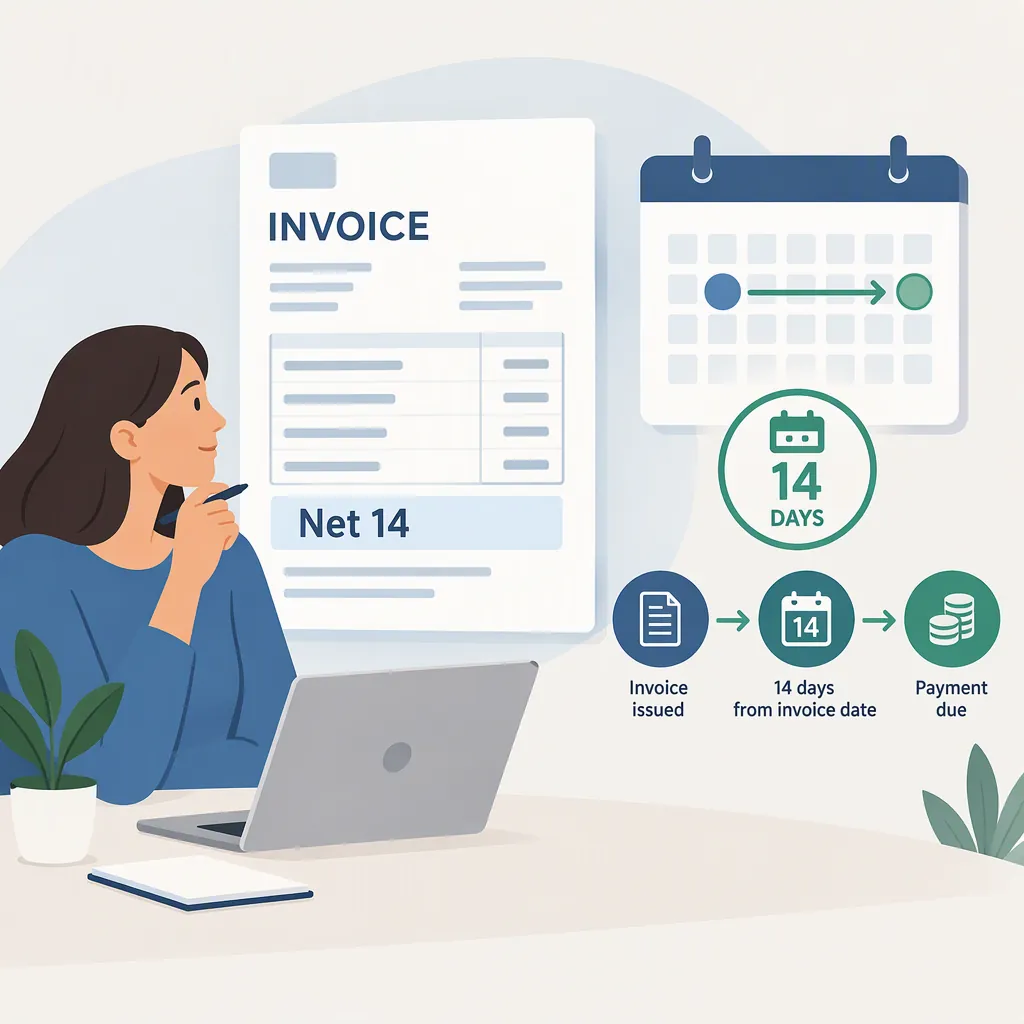
Invoice Payment Terms: What Net 14 Means
Net 14 means an invoice is payable within 14 days of the agreed starting date, commonly the invoice date. For example, an invoice dated March 1 would be due March 15 when the agreement uses invoice date plus 14 calendar days. State the starting event, whether days are calendar or business days, and the exact due date rather than relying on “Net 14” alone. [accoru] [stripe]
What Net 14 Means on an Invoice
Net 14 is a payment deadline, not a requirement to wait two weeks before paying. Accoru defines it as payment due within 14 days of the invoice date. Payment terms more broadly describe when and how payment should be made, including any separately agreed discounts or late-payment conditions. [accoru] [stripe]
The number alone does not explain every part of the arrangement. The supplied references use different starting points: Accoru defines Net 14 from the invoice date, while Stripe’s discussion of net terms refers to both invoice date and invoice receipt. Make the starting event explicit in the agreement and on the invoice. [accoru] [stripe]
Net 14 also does not, by itself, specify an early-payment discount or a late fee. Treat those as separate conditions rather than assumptions. [stripe]
How to Calculate a 14-Day Due Date
For an agreement that explicitly uses 14 calendar days after the invoice date, add 14 days to that date. The following is an illustrative calculation, not a customer invoice:
| Invoice Date | Agreed Calculation | Due Date |
|---|---|---|
| March 1 | March 1 plus 14 calendar days | March 15 |
| March 25 | March 25 plus 14 calendar days | April 8 |
Calendar days include weekends. If the parties instead agree to business days, define which days and holidays are excluded before calculating the deadline. Do not assume that a weekend due date automatically moves to Monday; make any adjustment rule explicit.
Print the actual due date alongside “Net 14.” Accoru recommends displaying both the term and the specific deadline so the recipient does not have to calculate it. [accoru]
Due-Date Verification Checklist
- Confirm the agreed starting event: invoice date, receipt, or another specified event.
- Confirm whether the period uses calendar days or business days.
- Add 14 days using that agreed method.
- Apply any explicitly agreed weekend or holiday adjustment.
- Show the resulting due date on the invoice.
- Check that the invoice and agreement use the same rule.
How to Write Clear Net 14 Terms
Use plain language alongside the abbreviation. Agree on the terms before work begins and record them in writing; do not introduce a shorter deadline for the first time on the invoice. Both Stripe and Accoru recommend documenting agreed payment terms. [stripe] [accoru]
Include the currency, accepted payment method, payment details, and exact due date. Check the recipient’s processing requirements, such as a purchase order number, before sending the invoice. GoCardless recommends clear itemization and confirming these requirements in advance. [gocardless]
For project-based work, keep the payment trigger separate from delivery and approval language. If the parties want the clock to start after acceptance rather than invoice issuance, define that event precisely. This is a drafting recommendation, not a universal rule.
The sample below assumes invoice-date-based calendar days. It is educational wording, not a complete contract or legal advice.
Sample Net 14 Invoice Wording
Payment terms: Net 14. The total amount shown as due is payable within 14 calendar days after the invoice date.
Invoice date: [Month Day, Year]
Payment due date: [Month Day, Year]
Currency: [Agreed Currency]
Payment method and instructions: [Agreed Method and Verified Payment Details]
Payment reference: [Invoice Number]
Net 14 Compared with Other Payment Terms
Using the same invoice-date starting point, Net 7 allows seven days, Net 14 allows 14 days, and Net 30 allows 30 days. Due on receipt instead makes payment due when the invoice is received. Advance payment requires some or all of the payment before work or delivery. [accoru] [stripe]
Choosing Net 14 is a balance between the seller’s cash needs and the payer’s ability to process the invoice. Stripe recommends considering cash flow, billing cycles, project size, and client circumstances. For a larger project, deposits or staged payments may be alternatives to waiting for one final payment. [stripe]
A shorter stated deadline does not guarantee earlier collection. The supplied references are general educational guidance, not evidence that every payer can meet a two-week deadline or that changing terms will produce a particular result.
What to Do When a Net 14 Invoice Is Overdue
First, check the agreed deadline and whether payment has already arrived. Then send a factual reminder identifying the invoice, outstanding amount, due date, and payment instructions. GoCardless recommends regular reminders for delayed outstanding payments. [gocardless]
If the recipient reports missing information or a dispute, identify the specific issue and keep a written record of any agreed resolution or revised schedule.
Do not assume Net 14 automatically authorizes interest, fees, or collection costs. Payment terms can address late-payment consequences, but the supplied sources do not establish a generally applicable US right or rate. This article provides educational guidance, not jurisdiction-specific legal advice. [stripe]
Neutral Overdue Reminder Template
Subject: Payment Status for Invoice [Invoice Number]

Hello [Recipient Name],

Invoice [Invoice Number] shows an outstanding balance of [Amount and Currency] and a due date of [Due Date]. Please confirm its payment status and expected payment date. If payment has already been sent, please share the payment reference so the records can be checked.

Please also identify any missing information or disputed item affecting processing.

Thank you,
[Sender Name]
FAQ
Does Net 14 Mean Calendar Days or Business Days?
Specify the day-counting method explicitly. Accoru defines Net 14 as 14 days from the invoice date, but that shorthand alone is not a complete counting rule. Writing “14 calendar days after the invoice date” removes a source of ambiguity. [accoru]
Does the 14-Day Period Start When the Invoice Is Sent or Received?
Use the starting event agreed by the parties. Accoru uses the invoice date for Net 14, while Stripe’s explanation of net terms mentions both invoice date and receipt. State the trigger and the exact due date instead of assuming both parties interpret the abbreviation identically. [accoru] [stripe]
Can an Invoice Be Paid Before the Net 14 Due Date?
Yes. Net 14 sets the payment deadline; it does not require payment on day 14. Any early-payment discount should be stated separately, because discount terms are distinct from the basic net payment period. [accoru] [stripe]
Can Existing Net 30 Terms Be Changed to Net 14?
Discuss and document the proposed change before applying it. Accoru recommends communicating changes in advance, and Stripe recommends putting agreed terms in writing. Do not assume that printing Net 14 on a new invoice overrides an existing agreement. [accoru] [stripe]